Why invest in user experience for ecommerce growth
TL;DR:
- Over 90% of UK shoppers abandon websites with poor user experience, impacting sales and reputation.
- Improving checkout UX alone can increase conversion rates by up to 35-40%.
- Ongoing UX optimization is essential for customer retention and long-term ecommerce success.
Over 90% of UK shoppers will abandon an online store if the experience feels clumsy or confusing. That is not a minor inconvenience — it is a direct hit to your revenue, your brand reputation, and your ability to build a loyal customer base. For UK ecommerce businesses, the stakes have never been higher. Competition is fierce, margins are tight, and shoppers have zero patience for friction. This guide walks you through what user experience actually means, how it affects your conversions, which methodologies deliver real results, and how to turn one-off buyers into repeat customers who genuinely trust your brand.
Table of Contents
- What is user experience and why does it matter?
- How user experience directly impacts your conversion rates
- Proven methodologies to optimise ecommerce user experience
- Building customer loyalty through memorable user experience
- What most ecommerce owners get wrong about user experience
- Take your ecommerce UX to the next level
- Frequently asked questions
Key Takeaways
| Point | Details |
|---|---|
| User experience drives conversions | Investing in UX directly boosts sales and decreases cart abandonment for UK ecommerce sites. |
| Checkout optimisation is highest ROI | The fastest conversion gains come from improving the checkout process and removing friction. |
| Continuous testing matters | Implement A/B testing, heatmaps, and mobile-first approaches for sustainable UX success. |
| Loyalty comes from consistency | A memorable, seamless experience encourages repeat business and long-term customer loyalty. |
What is user experience and why does it matter?
User experience, or UX, is the sum of every interaction a customer has with your online store. It covers how easy your site is to navigate, how quickly pages load, how clearly products are presented, and how smoothly someone can move from browsing to buying. It is not just about making things look attractive. It is about making them work.
In ecommerce, UX directly shapes performance in ways that are measurable and significant. A confusing product page, a broken filter, or a checkout that demands account registration can each independently cost you a sale. Multiply that across hundreds of daily visitors and the losses stack up fast.
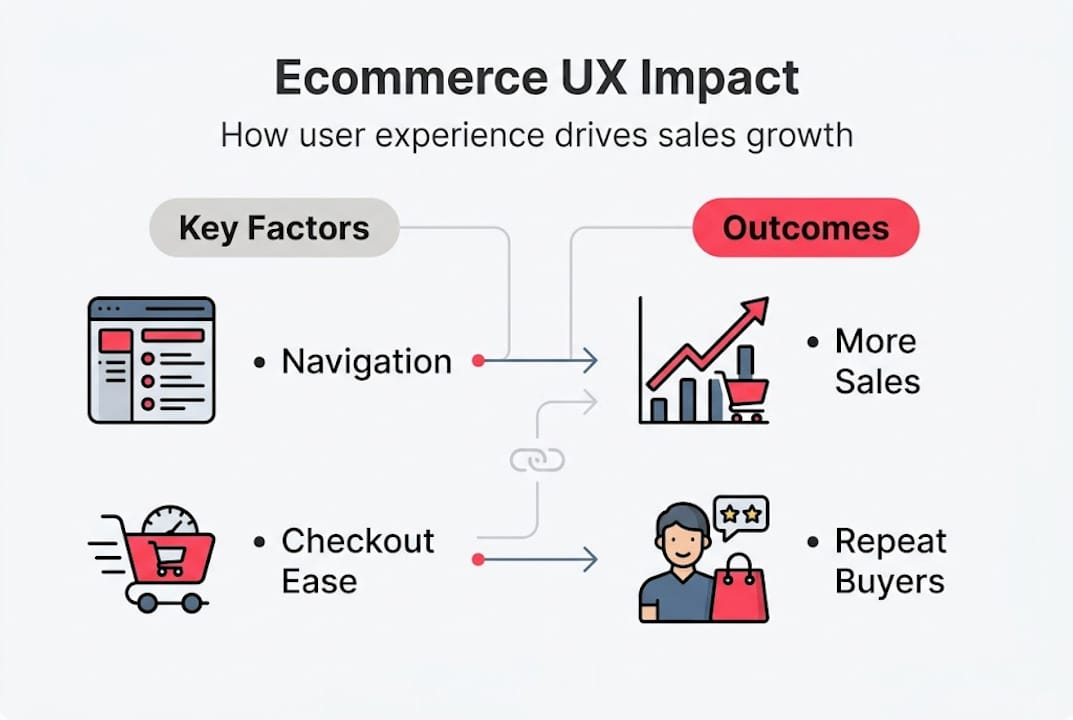
The scale of UK ecommerce makes this especially urgent. Internet sales account for 27.4% of all UK retail, and with 90% of shoppers abandoning stores with poor UX and 71% of traffic arriving via mobile devices, the pressure to get the experience right is enormous. If your store is not built with mobile users in mind, you are essentially turning away the majority of your potential customers before they even see your products.
Here is what good ecommerce UX actually looks like in practice:
- Usability: Shoppers can find what they need without thinking too hard about it
- Accessibility: The store works for users with different needs, devices, and connection speeds
- Satisfaction: The overall experience leaves customers feeling confident and in control
- Speed: Pages load fast enough that users do not abandon before content appears
- Clarity: Product information, pricing, and policies are easy to understand at a glance
“A well-designed user interface could raise your website’s conversion rate by up to 200%, and better UX design could yield conversion rates up to 400%.” — Forrester Research
The quality of your ecommerce web design underpins all of this. Even small improvements, such as simplifying a navigation menu or adding clearer call-to-action buttons, can produce measurable uplifts in sales. UX is not a luxury reserved for big brands with large budgets. It is a commercial necessity for any store that wants to grow.
How user experience directly impacts your conversion rates
Understanding the importance of UX is one thing, but seeing its effect on your bottom line is another. Here is how every UX change can directly increase your conversions.

Conversion rate is the percentage of visitors who complete a purchase. Most ecommerce stores convert at somewhere between 1% and 4%. That gap between 1% and 4% represents a huge difference in revenue, and UX is one of the primary levers you can pull to move that number. Baymard research shows a 35% conversion lift is achievable through checkout UX improvements alone. That is not a marginal gain — that is transformational.
| UX issue | Before improvement | After improvement |
|---|---|---|
| Forced account registration | 72% checkout abandonment | 45% abandonment |
| Unclear delivery costs | 58% cart abandonment | 31% abandonment |
| Poor mobile layout | 1.2% mobile conversion | 2.8% mobile conversion |
| Slow page load (4+ seconds) | 3.2% bounce rate uplift per second | Sub-2s load, bounce rate normalised |
The numbers speak clearly. Friction kills conversions. The most common conversion killers we see across UK stores are:
- Forced account creation before checkout
- Confusing or multi-step navigation that buries products
- Poor mobile experience, including tiny tap targets and slow load times
- Unexpected costs appearing late in the checkout process
- Lack of trust signals, such as reviews, security badges, and clear returns policies
Each of these is fixable. None of them require a complete redesign. If you want to increase ecommerce conversions quickly, start with the checkout. It is where intent is highest and where friction does the most damage.
Pro Tip: Before investing in traffic acquisition, audit your checkout flow first. Sending more visitors to a broken checkout is expensive and wasteful. Fix the leak before you turn on the tap. Our guide on conversion rate improvement covers this in practical detail.
Proven methodologies to optimise ecommerce user experience
Knowing that UX matters, what can you do to make a tangible improvement? Let us look at the most effective methods, from strategic testing to quick wins.
The good news is that there is a well-established toolkit for optimising your online store’s UX. You do not need to guess what is broken. You can measure it, test it, and fix it with confidence.
| Methodology | What it involves | Best for |
|---|---|---|
| A/B testing | Comparing two versions of a page element | Checkout, CTAs, product pages |
| Heatmaps | Visualising where users click and scroll | Navigation and layout decisions |
| Session recordings | Watching real user journeys | Identifying unexpected friction |
| Usability testing | Observing real users completing tasks | Deeper behavioural insight |
| Heuristic evaluation | Expert review against UX principles | Quick audit without user data |
Key methodologies such as A/B testing, heatmaps, session recordings, and usability testing each serve a distinct purpose. Used together, they give you a rounded picture of where your store is losing people and why.
Here are practical steps to get started:
- Start with A/B testing on your highest-traffic pages, particularly the checkout and product pages
- Install a heatmap tool to see where users are actually clicking versus where you expect them to click
- Enable guest checkout immediately if you have not already — this single change removes one of the biggest barriers to purchase
- Run a mobile audit on your most visited pages using a real device, not just a browser emulator
- Add trust signals prominently: verified reviews, security badges, and a clear returns policy
Pro Tip: Focus your first round of improvements on mobile optimisation and trust signals. These two areas consistently deliver the fastest visible impact for UK stores, regardless of platform or sector.
Our UK ecommerce UX guide goes deeper on each of these methodologies if you want a step-by-step framework to follow.
Building customer loyalty through memorable user experience
With practical steps in hand, it is essential to see UX as a foundation for not just conversions, but lasting customer relationships.
A first-time buyer who has a smooth, pleasant experience is far more likely to return. That sounds obvious, but many store owners focus almost entirely on acquiring new customers while neglecting the experience that determines whether those customers come back. Retention is significantly cheaper than acquisition, and UX is the engine that drives it.
User-centred ecommerce design puts the customer’s needs at the heart of every decision. When shoppers feel understood, respected, and in control, they trust your brand. Trust drives repeat purchases. Repeat purchases drive sustainable growth.
The UX factors that most consistently build loyalty include:
- Consistent branding across every touchpoint, from the homepage to the order confirmation email
- Fast, reliable page loading that never makes customers wait or wonder
- Transparent policies on delivery, returns, and data privacy, displayed clearly and accessibly
- Personalised experiences such as relevant product recommendations and tailored content
- Responsive customer support that is easy to find and quick to respond
- Post-purchase communication that keeps customers informed and valued
“Customers who have a positive experience with a brand are 5x more likely to make a repeat purchase and 4x more likely to refer a friend.” — Bain & Company
The 90% abandonment rate associated with poor UX tells us something important: most customers will not give you a second chance if the first experience is bad. But the inverse is equally true. Get it right and you are not just making a sale — you are building a relationship.
Explore our ecommerce design tips for UK retail brands for specific, actionable recommendations on building loyalty through design.
What most ecommerce owners get wrong about user experience
Taking all the practical advice together, it is worth pausing to identify what most owners overlook — and what actually makes a difference.
The most common mistake we see is treating UX as a one-time project. A store gets redesigned, everyone feels good about it, and then nothing changes for three years. Meanwhile, customer expectations shift, competitors improve, and the store quietly falls behind. The brands that consistently outperform their rivals treat UX as an ongoing discipline, not a deliverable.
Another blind spot is over-indexing on aesthetics. A beautiful store that is slow to load or confusing to navigate will still lose customers. We have seen UK stores with genuinely stunning design that converted at under 1% because the checkout was a mess or the mobile experience was broken.
Microcopy is another area that gets ignored far too often. The words on your buttons, error messages, and form labels have a measurable impact on whether users complete actions. “Buy now” and “Add to basket” perform differently. “Something went wrong” and “We could not process your payment — please check your card details” feel very different to a frustrated shopper.
Our in-depth UK UX guide covers these overlooked areas in detail. The stores that win are the ones that keep iterating, keep testing, and keep listening to their customers.
Take your ecommerce UX to the next level
If this guide has highlighted gaps in your current store experience, you are not alone — and the good news is that every issue we have covered is fixable with the right approach.
At Big Eye Deers, we specialise in designing and building high-performing ecommerce stores that convert visitors into loyal customers. Whether you are on Magento or looking at Shopify design services, we bring over 17 years of hands-on experience to every project. We use Figma to map user journeys before a single line of code is written, ensuring your store is built around real customer behaviour. If you are ready to see what a properly optimised UX can do for your revenue, get in touch with our team and let us take a look at where your store stands today.
Frequently asked questions
How quickly can improved user experience increase sales?
Serious UX fixes, especially in the checkout, can lift conversion rates within weeks — 35% uplifts are achievable through targeted checkout improvements alone.
What is the most important area to optimise for user experience?
The checkout process delivers the highest ROI for most UK stores because it is where purchase intent is highest and where friction causes the most direct revenue loss.
Which user experience improvements are quick wins for small teams?
Guest checkout, mobile optimisation, and visible trust signals are the fastest-impact improvements available to teams with limited time or resource.
Why is mobile optimisation crucial for UK ecommerce?
Over 71% of UK ecommerce traffic arrives via mobile devices, making a mobile-first approach essential rather than optional for any store serious about growth.
Recommended



Adobe Commerce (Magento)
Formerly known as Magento, Adobe Commerce is built for complex catalogues, integrations, and long term growth. We design and develop stable, scalable stores that support demanding eCommerce requirements, including multi-store setups, complex pricing, and Hyva based performance improvements.

Bespoke Build
We design and build custom eCommerce platforms for businesses with complex workflows, integrations, or non standard requirements. Built from scratch around your business needs using Laravel and modern architectures.

Working with brands across the UK from our offices in Cardiff and Exeter, you deal directly with a senior team of designers and developers specialising in Shopify, Magento, WordPress and bespoke eCommerce platforms.
We focus on commercial outcomes. Better conversion rates, strong SEO foundations and eCommerce platforms that continue to improve long after launch.