User Experience in Ecommerce: Boosting Conversions and Loyalty

Every ecommerce manager knows the challenge of turning website visits into long-term business relationships. For mid-sized B2B retail brands in Cardiff and Exeter, creating a seamless user experience means more than an attractive homepage. It requires deep insight into how buyers interact with your platform and what barriers stand in the way of smooth transactions. This guide explores practical strategies grounded in user research and technical best practices to help you optimise every touchpoint for conversion and customer loyalty.
Table of Contents
- Defining User Experience In Ecommerce
- Core Elements Of Effective Ecommerce Ux
- Types Of User Journeys And Decision Paths
- Ux’s Impact On Conversions And Retention
- Common Ux Pitfalls And How To Avoid Them
- Integrating Security And Performance In Ux Design
Key Takeaways
| Point | Details |
|---|---|
| Understanding User Experience is Essential | Effective ecommerce UX involves creating intuitive digital environments that cater to user needs throughout the entire shopping journey. |
| Continuous Improvement is Crucial | Regular user testing and feedback analysis are necessary to refine the user experience and increase conversion rates. |
| Balancing Security with Usability | Integrating robust security measures into the user experience is imperative, ensuring that they do not hinder usability or performance. |
| Building Trust through Transparency | Providing clear product information and transparent pricing helps build customer trust and loyalty, encouraging repeat engagement. |
Defining User Experience in Ecommerce
User experience (UX) in ecommerce represents the comprehensive interaction a customer has with an online shopping platform, encompassing every touchpoint from initial website entry to post-purchase support. User experience is more than aesthetic design – it’s about creating seamless, intuitive digital environments that anticipate and fulfil customer needs.
At its core, UX in ecommerce focuses on understanding user behaviours, preferences, and pain points through systematic user research methodologies. Government digital service guidelines emphasise the critical importance of deeply comprehending user requirements across different interaction stages.
Key components of effective ecommerce user experience include:
- Intuitive website navigation
- Fast page loading speeds
- Clear product information
- Simple checkout processes
- Responsive mobile design
- Personalised product recommendations
- Transparent pricing and shipping details
Successful UX design requires continuous refinement based on user feedback and behavioural data. By systematically analyzing user interactions, brands can create digital experiences that not only meet but exceed customer expectations.
Pro tip: Conduct regular user testing and analyse website interaction metrics to continuously improve your ecommerce platform’s user experience.
Core Elements of Effective Ecommerce UX
Effective ecommerce user experience requires a strategic approach that combines design, functionality, and deep understanding of user behaviours. Successful UX design demands comprehensive research into customer needs, preferences, and interaction patterns across digital platforms.
The fundamental elements of exceptional ecommerce UX encompass several critical dimensions:
- Intuitive site architecture
- Seamless navigation pathways
- Responsive and adaptive design
- Clear product presentation
- Streamlined purchasing processes
- Personalisation capabilities
- Performance and loading efficiency
Technical proficiency plays a pivotal role in creating exceptional digital experiences. Designers must possess advanced skills in usability principles, coding languages like HTML and CSS, and sophisticated design software to craft interfaces that are not just visually appealing but functionally superior.

Moreover, legal compliance contributes significantly to user trust and overall user experience. Transparent information, secure transaction processes, and adherence to digital service standards are fundamental in building customer confidence and encouraging repeat engagement.
Pro tip: Implement continuous user testing and analytics tracking to iteratively refine your ecommerce platform’s user experience and identify potential friction points.
Types of User Journeys and Decision Paths
User journeys in ecommerce represent complex pathways that customers navigate while interacting with online platforms. Mapping users’ broader problem contexts is crucial for understanding the nuanced decision-making processes that drive digital interactions.
Typical ecommerce user journeys can be categorised into several distinct archetypes:
- Purposeful Purchasers: Direct, goal-oriented shoppers
- Browsing Explorers: Casual browsers seeking inspiration
- Comparative Researchers: Methodical consumers comparing options
- Impulse Buyers: Emotionally driven, spontaneous purchasers
- Loyal Repeat Customers: Returning clients with established preferences
Understanding these journey types requires comprehensive user research methodologies that delve beyond surface-level interactions. Contextual observation, in-depth interviews, and experience mapping techniques help uncover the intricate motivations and barriers that influence purchasing decisions.
Each user journey involves multiple touchpoints and decision nodes that can significantly impact conversion rates. Businesses must design flexible, intuitive interfaces that accommodate diverse user behaviours, providing seamless navigation and personalised experiences that anticipate and respond to individual customer needs.
The following table outlines how different user journey archetypes influence ecommerce design priorities:
| User Journey Type | Design Focus | Business Impact |
|---|---|---|
| Purposeful Purchasers | Fast navigation, clear CTA | Increased conversion rates |
| Browsing Explorers | Inspiring visuals, discovery tools | Higher engagement, potential upsells |
| Comparative Researchers | Detailed comparisons, filters | Builds trust, reduces cart abandonment |
| Impulse Buyers | Prominent recommendations, swift checkout | Boosts impulsive sales |
| Loyal Repeat Customers | Personalised experience, loyalty rewards | Promotes retention and advocacy |
Pro tip: Develop detailed customer personas representing different journey types to create targeted, adaptive user experiences that address specific behavioural patterns and preferences.
UX’s Impact on Conversions and Retention
User experience fundamentally drives the success of digital commerce platforms, directly influencing both conversion rates and customer loyalty. Personalized digital experiences play a crucial role in transforming casual browsers into committed customers.
Key mechanisms through which UX impacts conversion and retention include:
- Reducing friction in navigation
- Creating intuitive purchasing pathways
- Providing transparent product information
- Offering personalised recommendations
- Ensuring seamless mobile responsiveness
- Implementing fast, secure checkout processes
- Delivering consistent, high-quality visual design
Behavioural targeting and dynamic user interfaces enable businesses to create targeted retention strategies that adapt to individual user preferences. By understanding and anticipating customer needs, ecommerce platforms can significantly enhance both immediate conversion potential and long-term customer loyalty.
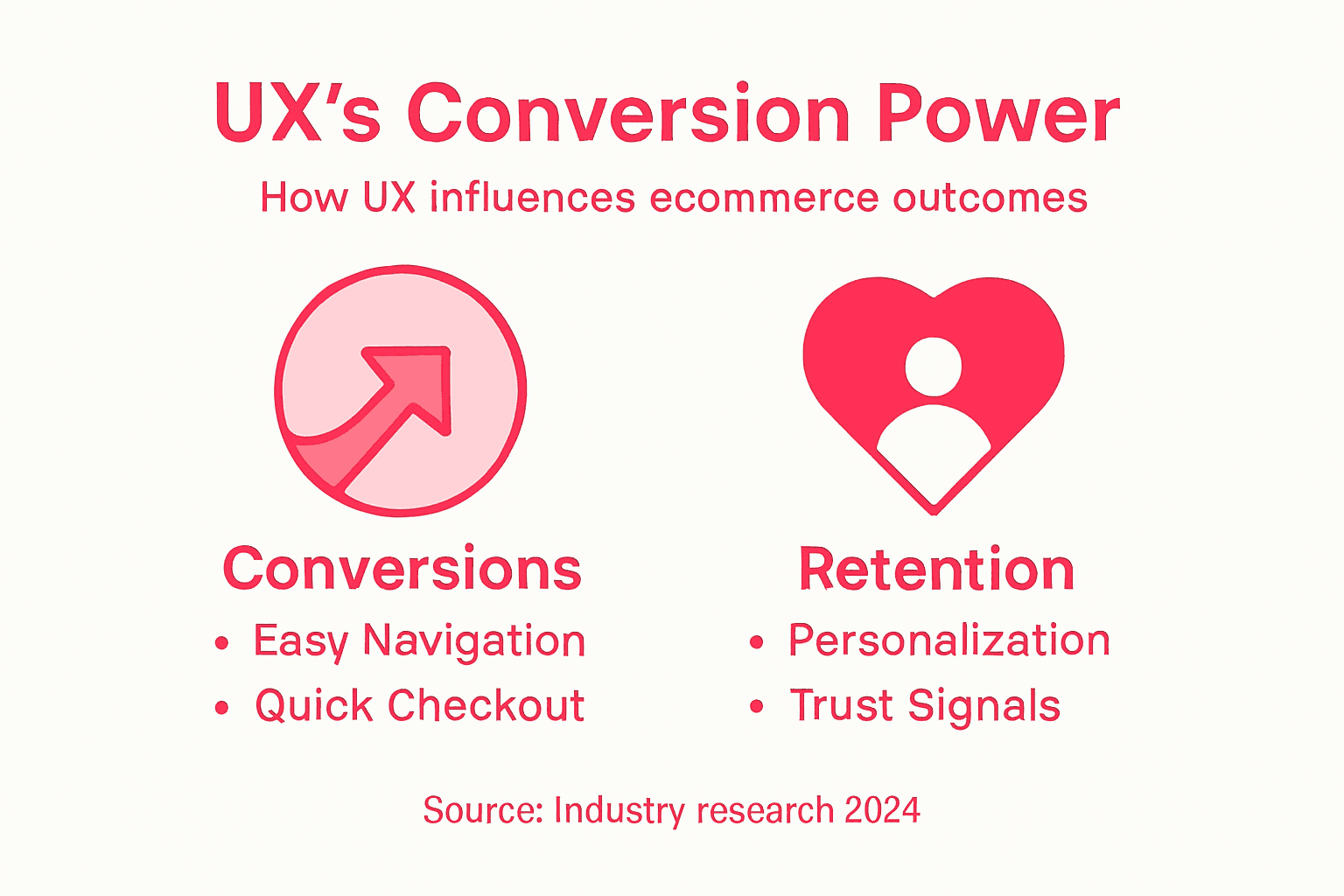
Successful UX design transforms transactional interactions into meaningful experiences. It requires continuous refinement, deep user understanding, and a commitment to creating digital environments that not only meet but exceed customer expectations, ultimately driving sustainable business growth.
Pro tip: Conduct regular user experience audits and implement A/B testing to systematically improve your platform’s conversion and retention performance.
Common UX Pitfalls and How to Avoid Them
User experience design requires meticulous attention to detail and a proactive approach to identifying potential challenges. Avoiding misleading advertising practices is fundamental to maintaining user trust and preventing potential legal complications in digital commerce.
Common UX pitfalls that can significantly impact user engagement include:
- Unclear navigation paths
- Inconsistent design elements
- Overwhelming product information
- Complex checkout processes
- Non-responsive mobile interfaces
- Hidden pricing structures
- Lack of clear product descriptions
- Slow page loading times
Successful UX design demands comprehensive stakeholder research and engagement that goes beyond surface-level observations. By systematically addressing underlying user needs and potential friction points, businesses can create more intuitive and user-friendly digital experiences.
Here is a comparison of common UX pitfalls and recommended preventive actions to ensure optimal user engagement:
| Pitfall | Preventive Action | Benefit to User |
|---|---|---|
| Unclear navigation paths | User-centred menu structure | Faster product discovery |
| Inconsistent design elements | Unified design guidelines | More reliable browsing |
| Overwhelming information | Progressive disclosure | Easier decision-making |
| Non-responsive mobile design | Mobile-first design principles | Seamless use across devices |
Transparency, simplicity, and user-centric design are the cornerstones of effective ecommerce platforms. Continuously monitoring user interactions, gathering feedback, and iteratively improving the digital experience can help mitigate potential UX challenges before they impact user satisfaction and conversion rates.
Pro tip: Implement regular user testing sessions and utilise heat mapping tools to identify and resolve potential UX friction points before they negatively impact your conversion rates.
Integrating Security and Performance in UX Design
Digital security is no longer an afterthought but a fundamental component of user experience design. Secure by design principles mandate integrating robust security measures seamlessly within the user interface without compromising performance or usability.
Key strategies for balancing security and user experience include:
- Implementing unobtrusive authentication methods
- Using progressive security layers
- Creating transparent privacy controls
- Designing intuitive security notifications
- Minimising friction during verification processes
- Providing clear data protection explanations
- Enabling user control over security settings
- Utilising intelligent risk assessment technologies
Successful security integration requires a holistic approach that considers user psychology and interaction patterns. By developing security mechanisms that feel natural and supportive rather than restrictive, businesses can build user trust while maintaining robust digital protection.
Modern ecommerce platforms must prioritise a delicate balance between robust security protocols and seamless user experiences. This means designing interfaces that communicate security measures transparently, implement advanced protection technologies discreetly, and empower users to understand and control their digital interactions.
Pro tip: Conduct regular user testing focused specifically on security interactions to identify and eliminate potential friction points in your authentication and verification processes.
Elevate Your Ecommerce User Experience to Drive Conversions and Loyalty
The article underlines key challenges such as reducing friction in navigation, creating intuitive purchasing pathways, and enhancing personalised experiences that foster customer retention. If navigating complex user journeys or improving mobile responsiveness feels overwhelming, Big Eye Deers specialises in solving these exact pain points. We integrate proven UX design principles including lifecycle marketing and advanced product discovery tools to transform browsing into loyal purchasing.
Take the next step to boost your ecommerce platform’s performance with our expertise in Magento and Shopify solutions. Harness a secure, fast, and user-centric store that not only meets but exceeds customer expectations. Visit Big Eye Deers today or explore how our tailored ecommerce services can enhance your user experience and retention strategies.
Frequently Asked Questions
What is user experience (UX) in ecommerce?
User experience (UX) in ecommerce refers to how customers interact with an online shopping platform, from their first visit to after they’ve made a purchase. It involves creating a seamless and intuitive environment that meets customers’ needs.
How does user experience impact conversion rates in ecommerce?
A positive user experience can significantly increase conversion rates by reducing friction during navigation, ensuring intuitive purchasing pathways, and providing clear and personalised product information. This encourages users to complete their purchases.
What are common pitfalls in ecommerce UX design?
Common pitfalls include unclear navigation paths, inconsistent design elements, complex checkout processes, and slow page loading times. Addressing these issues can enhance user engagement and satisfaction.
How can security be integrated into ecommerce UX design?
Security can be seamlessly integrated by using unobtrusive authentication methods, clear privacy controls, and transparent security notifications. This approach helps maintain user trust while ensuring a smooth and functional experience.
Recommended



Adobe Commerce (Magento)
Formerly known as Magento, Adobe Commerce is built for complex catalogues, integrations, and long term growth. We design and develop stable, scalable stores that support demanding eCommerce requirements, including multi-store setups, complex pricing, and Hyva based performance improvements.

Bespoke Build
We design and build custom eCommerce platforms for businesses with complex workflows, integrations, or non standard requirements. Built from scratch around your business needs using Laravel and modern architectures.

Working with brands across the UK from our offices in Cardiff and Exeter, you deal directly with a senior team of designers and developers specialising in Shopify, Magento, WordPress and bespoke eCommerce platforms.
We focus on commercial outcomes. Better conversion rates, strong SEO foundations and eCommerce platforms that continue to improve long after launch.