Why user centred design transforms ecommerce success
TL;DR:
- User centred design emphasizes understanding real customer behaviors to improve ecommerce performance.
- Designing for error recovery and real user flows significantly boosts conversion and reduces abandoned carts.
- Small, iterative UCD efforts are cost-effective and essential for long-term business growth.
Most ecommerce businesses assume user centred design is a luxury reserved for large retailers with deep pockets and dedicated UX teams. It is not. Every online store, regardless of size, loses sales when its design ignores how real shoppers actually behave. Real shoppers make typos. They get interrupted mid-checkout. They hesitate, second-guess, and sometimes return hours later expecting to pick up where they left off. When your store is not built to handle those moments, you lose the sale. This guide explains what user centred design genuinely means, why it matters commercially, and how to put it into practice on your ecommerce site.
Table of Contents
- What is user centred design and why does it matter?
- The business impact: How user centred design boosts conversions
- Practical application: Putting user centred design into action
- Common misconceptions about user centred design in ecommerce
- Our perspective: What most ecommerce brands miss about user centred design
- Next steps: Enhance your ecommerce experience with expert support
- Frequently asked questions
Key Takeaways
| Point | Details |
|---|---|
| Real users drive results | Designing for actual user behaviour reduces lost sales and boosts conversions. |
| Edge cases are vital | Common mistakes like typos in checkout must be anticipated, not ignored. |
| UCD delivers long-term value | User centred design increases conversion, loyalty, and overall business reputation. |
| Practical steps work | Applying iterative research, testing, and recovery design is possible for any budget. |
What is user centred design and why does it matter?
User centred design, often shortened to UCD, is an approach that places the needs, behaviours, and limitations of real users at the heart of every design decision. It sounds straightforward, but most ecommerce sites are not built this way. They are built around what the business wants to show, not what the shopper needs to do.
Traditional design approaches tend to start with aesthetics or brand guidelines and work outward. UCD flips that. You start with research into how your actual customers behave, map their real journeys, and design around those findings. The difference in outcomes is significant.
The four core principles of UCD in ecommerce are:
- User research: Understanding who your shoppers are, what they want, and where they struggle
- Real user flows: Mapping the actual paths people take through your site, not the ideal path you imagine they take
- Feedback loops: Gathering data from real interactions and using it to inform design decisions
- Iteration: Continuously refining based on what you learn, rather than treating a launch as the finish line
One of the most common pitfalls we see is designing for the ideal user. The ideal user knows exactly what they want, types perfectly, has a stable internet connection, and completes checkout without distraction. That user barely exists. Real shoppers are messier, and your design needs to account for that.
“Edge cases are the main journey: checkout interruptions and errors must be anticipated for real-world ecommerce users.”
This is a point worth sitting with. What designers often label as edge cases, such as a user mistyping their postcode or accidentally closing the browser mid-checkout, are not rare exceptions. They happen constantly. Treating them as afterthoughts is a costly mistake.
Pro Tip: Map the errors your users make at checkout, not just the steps they complete successfully. If your checkout form does not handle a mistyped email address gracefully, you are actively creating abandonment. The custom ecommerce development benefits of building with real user behaviour in mind are far greater than the short-term savings of skipping research.
The business impact: How user centred design boosts conversions
Understanding the fundamentals, let us examine exactly how user centred design pays off for your business.
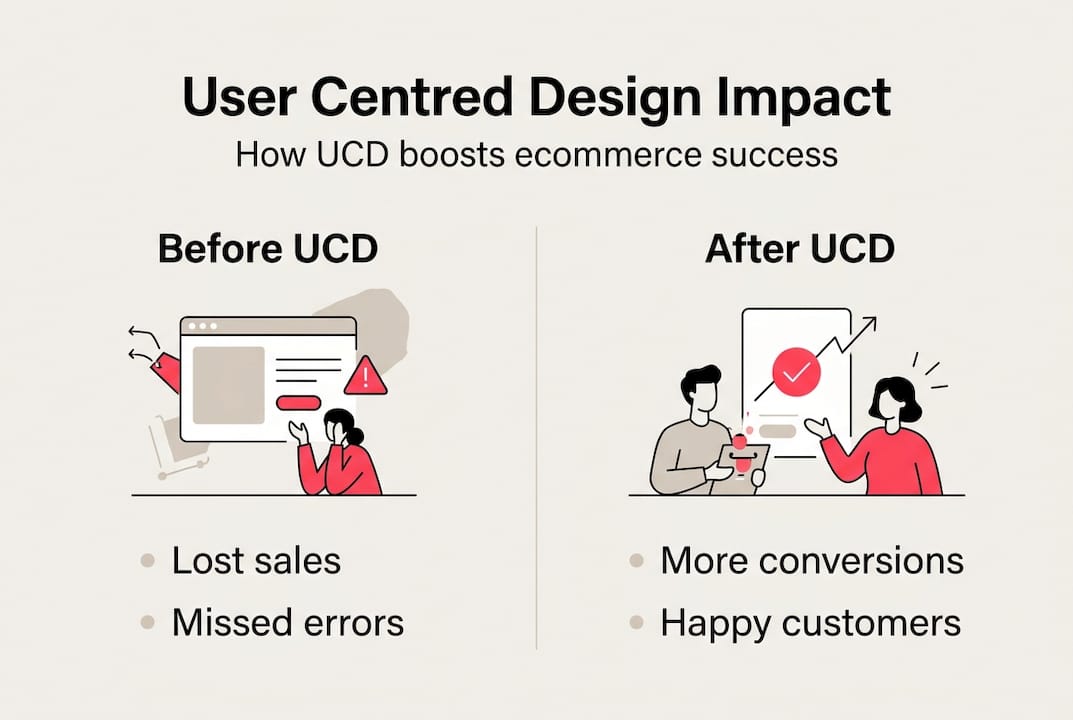
The commercial case for UCD is not abstract. When you design around real user behaviour, more shoppers complete their purchases. It is that direct. Consider two scenarios. In the first, a shopper enters an incorrect card number and sees a generic error message with no guidance. They give up. In the second, the same shopper sees a clear, specific message telling them exactly what went wrong and how to fix it. They complete the purchase. Same shopper, same intent, entirely different outcome based on design.

Designing recovery paths for user errors can significantly reduce cart abandonment, and this is where UCD delivers some of its most measurable returns.
| Design element | Without UCD | With UCD |
|---|---|---|
| Checkout error messages | Generic, unhelpful | Specific, actionable |
| Form validation | On submission only | Inline, real-time |
| Basket persistence | Lost on browser close | Saved for return visits |
| Mobile navigation | Desktop layout adapted | Designed for thumb use |
| Search and filtering | Basic keyword match | Behaviour-informed results |
The ecommerce user experience impact on revenue is well documented, and businesses that get ecommerce right from a UX perspective consistently outperform those that do not.
The main business outcomes of applying UCD properly include:
- Higher conversion rates through fewer friction points and clearer journeys
- Increased average order value when product discovery and upsell flows are intuitive
- Stronger customer trust built through consistent, reliable experiences
- Reduced support costs because users can self-serve without confusion
- Greater repeat business from shoppers who enjoyed the experience the first time
These are not marginal gains. For a mid-sized UK ecommerce business, even a one or two percent improvement in conversion rate can represent tens of thousands of pounds in additional annual revenue. UCD is not a nice-to-have. It is a commercial lever.
Practical application: Putting user centred design into action
Knowing the value, it is time to look at how you can start putting user centred design into practice.
Implementing UCD does not require a full redesign or a massive budget. It requires a shift in how you approach decisions. Start with research, not assumptions. Here is a practical sequence to follow:
- Conduct user research: Interview real customers, run surveys, and review session recordings to understand where shoppers struggle
- Map pain points: Identify the specific moments where users drop off, make errors, or show signs of frustration
- Build prototypes in Figma: Create wireframes that address the pain points you have identified before writing a single line of code
- Test with real shoppers: Ask actual users to complete tasks on your prototype, including tasks where they make mistakes
- Design error recovery explicitly: Build in save-and-return functionality, clear error messages, and correction flows before launch
- Launch and measure: Use analytics and heatmaps to track whether the changes improved real behaviour
- Iterate: Treat every launch as a starting point, not an endpoint
Step four is where most businesses cut corners. They test with colleagues or stakeholders who already understand the site. Real shoppers do not behave that way. They hesitate, they misread labels, and they sometimes abandon a session and return the next day expecting to find their basket intact.
Save-and-return, corrections, and recovering from interruptions are real ecommerce user needs that must be designed for, not bolted on after complaints start arriving.
Pro Tip: When you optimise store UX, always include at least one test scenario where the user makes a deliberate mistake. How your site responds to errors tells you far more than how it handles a perfect journey. You can also use our website UX improvement guide and resources to measure user experience quantitatively over time.
Common misconceptions about user centred design in ecommerce
With practical steps outlined, it is equally important to address what UCD is not and why common misconceptions hold businesses back.
There is a lot of noise around UCD, and some of it actively misleads businesses into either dismissing the approach or applying it incorrectly. Let us clear a few things up.
| Myth | Reality |
|---|---|
| UCD is expensive and slows delivery | Catching design problems early is far cheaper than fixing them post-launch |
| Edge cases are rare and unimportant | They represent core journeys for a significant portion of your shoppers |
| UCD is just about making things look good | It is about making things work for real people in real conditions |
| You only need UCD for a full redesign | Small, iterative UCD improvements deliver ongoing commercial value |
| User testing requires a lab and large budget | Guerrilla testing with five real users reveals the majority of critical issues |
“Edge cases represent core user journeys, not just rare exceptions, so they require attention in every ecommerce design.”
The cost myth is particularly damaging. Businesses that skip UCD to save time upfront consistently spend more on post-launch fixes, customer service, and lost revenue from poor conversion. The maths does not work in their favour.
What UCD is and is not, in plain terms:
- UCD is researching real users and designing around their actual behaviour
- UCD is iterative, ongoing, and never truly finished
- UCD is not guessing what users want based on internal opinions
- UCD is not purely aesthetic or brand-driven design
- UCD is not a one-time project delivered at launch
Our ecommerce UX case studies show consistently that businesses who invest in understanding their users outperform those who rely on assumptions, regardless of how confident those assumptions feel internally.
Our perspective: What most ecommerce brands miss about user centred design
Having set the record straight on what UCD is and is not, here is our take from years of ecommerce design work.
The single biggest missed opportunity we see, time and again, is brands obsessing over how their store looks while ignoring how it actually functions under real conditions. A beautifully designed checkout that fails when a user miskeys their address is not a good checkout. It is a liability.
We have worked with businesses that only addressed error recovery after abandonment rates spiked. By that point, they had already lost thousands of sales they will never recover. The fix was not complicated. Clear inline validation, a persistent basket, and a helpful error message. Simple changes, significant impact.
The uncomfortable truth is that most ecommerce design processes are built around the happy path, the journey where everything goes right. But real shoppers do not live on the happy path. They live in the messy middle, and that is exactly where you boost sales with UX improvements that actually move the needle. Prioritise error recovery and user help throughout the design process, not as a final checklist item.
Next steps: Enhance your ecommerce experience with expert support
If you are ready to put these principles into action and see the difference on your own ecommerce site, here is how to get started.
Effective user centred design takes expertise, honest user research, and a development partner who understands how real shoppers behave. That is exactly what we do at Big Eye Deers.
Whether you are running a Shopify store or a complex Magento build, our team works with you from research and Figma wireframes through to launch and ongoing iteration. Our Shopify agency specialists and Magento web design experts have helped UK ecommerce businesses improve conversion, reduce abandonment, and build lasting customer loyalty. If you want to understand what is really holding your store back, meet the Big Eye Deers team and let us take a look together.
Frequently asked questions
How does user centred design reduce cart abandonment?
By designing recovery paths for mistakes and interruptions, user centred design makes it easier for shoppers to complete their purchases, minimising lost sales at the most critical point in the journey.
Is user centred design expensive for small ecommerce businesses?
No. UCD saves money over time by reducing costly post-launch fixes and increasing conversion rates, and it can be applied incrementally at any budget level.
What are ‘edge cases’ in user centred design?
Real user behaviours such as typos, hesitations, and checkout interruptions are commonly called edge cases, but they occur frequently enough to be treated as core design requirements.
Can user centred design increase repeat business?
Yes. A site that handles real user behaviour gracefully builds trust and confidence, which encourages shoppers to return rather than try a competitor next time.
How do I start implementing user centred design?
Begin by speaking to real customers, reviewing session recordings to identify where people struggle, and making small, iterative improvements based on what you find rather than what you assume.
Recommended



Adobe Commerce (Magento)
Formerly known as Magento, Adobe Commerce is built for complex catalogues, integrations, and long term growth. We design and develop stable, scalable stores that support demanding eCommerce requirements, including multi-store setups, complex pricing, and Hyva based performance improvements.

Bespoke Build
We design and build custom eCommerce platforms for businesses with complex workflows, integrations, or non standard requirements. Built from scratch around your business needs using Laravel and modern architectures.

Working with brands across the UK from our offices in Cardiff and Exeter, you deal directly with a senior team of designers and developers specialising in Shopify, Magento, WordPress and bespoke eCommerce platforms.
We focus on commercial outcomes. Better conversion rates, strong SEO foundations and eCommerce platforms that continue to improve long after launch.