SEO guide for online stores: boost your store’s visibility
TL;DR:
- Technical foundation focusing on mobile responsiveness, page speed, and crawlability is essential in 2026.
- Building topical authority through comprehensive content and logical site structure boosts search visibility.
- Ongoing disciplined execution of strategy and technical tasks is key to sustained SEO success.
Your online store stocks great products, your design looks clean, and yet traffic flatlines. Sound familiar? It’s one of the most frustrating positions to be in as a UK e-commerce owner, and the cause is almost always the same: SEO is being treated as an afterthought rather than a foundation. Search engine optimisation is shifting fast in 2026, with Google placing ever-greater emphasis on technical quality, topical authority, and genuine user value. Whether you’re running a Magento build or a Shopify store, the steps you take now will determine your organic visibility for years to come. This guide walks you through exactly what to do.
Table of Contents
- Essential SEO prerequisites for 2026 online stores
- Step-by-step SEO setup for Magento and Shopify
- Building topical authority and optimal site structure
- Common SEO mistakes and how to verify your results
- Why prioritising both strategy and detailed execution is essential
- Ready to elevate your online store’s SEO?
- Frequently asked questions
Key Takeaways
| Point | Details |
|---|---|
| Solid foundation first | Make sure your site’s technical basics are perfect before launching any SEO campaign. |
| Platform-specific tactics | Magento and Shopify require tailored SEO setups—don’t treat them exactly the same. |
| Topical authority wins | Well-structured content hubs and smart navigation boost search rankings significantly. |
| Avoid common pitfalls | Prevent duplicate content and noindex errors to save time and improve Google performance. |
| Continuous verification | Regular audits and KPIs tracking are needed for sustainable SEO growth in e-commerce. |
Essential SEO prerequisites for 2026 online stores
Before you touch a meta title or write a single word of category copy, your store needs to pass a structural health check. Think of it as the MOT before you take your car on a long motorway run. Skip it, and you’ll likely break down halfway.
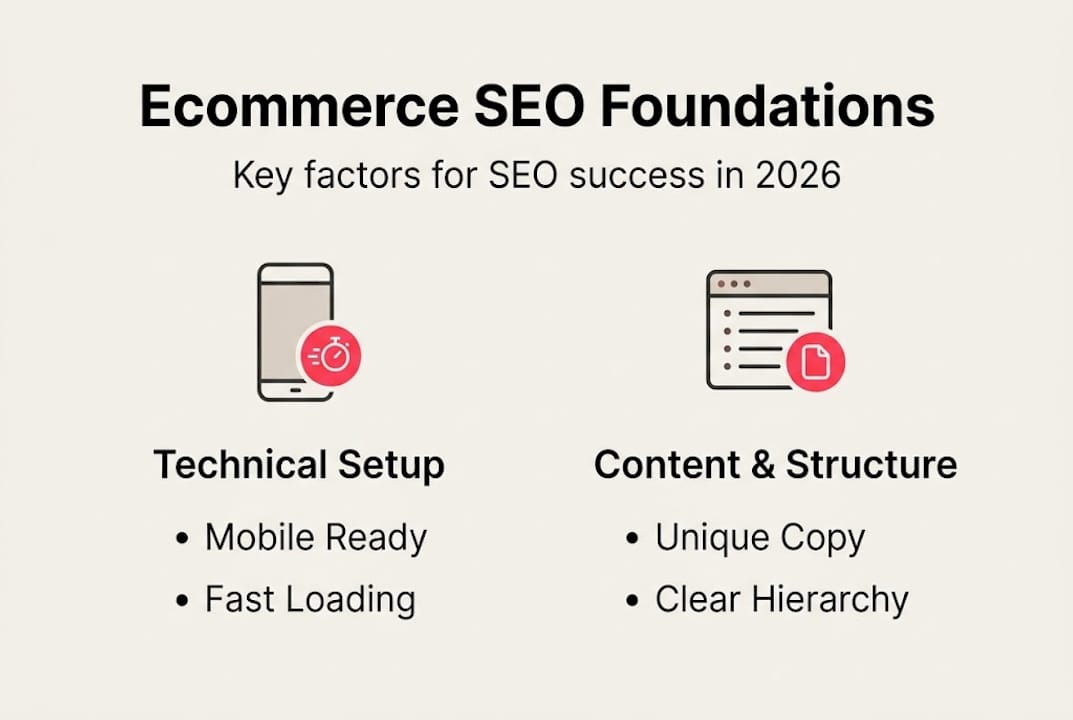
The three non-negotiables for any online store in 2026 are mobile responsiveness, page speed, and crawlability. Google’s mobile-first indexing means your mobile experience is what Google actually ranks, not your desktop version. Page speed affects both rankings and conversion rates directly. Crawlability determines whether search engines can even find and index your pages.
For a quick overview of what to check on each platform, here’s a useful starting point:
| Prerequisite | Magento check | Shopify check |
|---|---|---|
| Mobile responsiveness | Theme breakpoints, Hyvä frontend | Responsive theme, mobile preview |
| Page speed | Full Page Cache, image optimisation | Lazy loading, app bloat reduction |
| Canonical tags | Verify in head for all page types | Auto-generated but verify manually |
| Robots.txt | Customise to block staging/admin URLs | Access via Online Store settings |
| XML sitemap | Configure in Stores > Configuration | Auto-generated at /sitemap.xml |
For Magento users, check your robots.txt carefully. Admin panels and staging environments should never be crawlable. For Shopify, as noted in the Shopify SEO Guide 2026, Shopify auto-canonicalises collection product URLs but this must still be manually verified. Filtered pages (size, colour, price range) can create hundreds of near-duplicate URLs, so noindex those to prevent crawl budget waste.
For auditing your store’s readiness, we recommend a combination of:
- Google Search Console for indexing issues and manual actions
- Screaming Frog or Sitebulb for crawl depth and broken links
- PageSpeed Insights or Lighthouse for Core Web Vitals
- Ahrefs or Semrush for keyword gap and backlink analysis
Our ecommerce features checklist covers many of the structural points worth reviewing before you move forward. For a broader SEO context, the complete ecommerce SEO guide is a solid external reference. You should also look at our web development tips 2026 if you’re considering any structural changes to your store this year.
Pro Tip: Always test canonical tags using your browser’s view source or a tool like Screaming Frog. One incorrectly set canonical pointing to a filtered URL can quietly sabotage an entire category page’s rankings, and it’s a mistake we see regularly on both Magento and Shopify stores.
Step-by-step SEO setup for Magento and Shopify
With your store’s foundation solid, here’s how to configure each platform properly for search.
For Magento, the setup tasks are more granular but offer greater control:
- Navigate to Stores > Configuration > Catalogue > XML Sitemap and configure your sitemap generation schedule.
- Set canonical tags for category and product pages under Stores > Configuration > Catalogue > Catalogue.
- Update your robots.txt via the admin panel to disallow staging, admin, and checkout URLs.
- Ensure your URL rewrites are clean. Avoid parameter-heavy URLs wherever possible.
- Add unique, keyword-rich H1 tags and meta descriptions to your top category pages.
For Shopify, the process is more streamlined but requires its own vigilance:
- Access Online Store > Preferences and verify your title tag and meta description for the homepage.
- Review each collection page and confirm canonical tags point to the correct primary URL.
- Use the Shopify SEO playbook approach and add unique category content of 150 to 300 words per collection.
- Install a redirect app and handle any 404s promptly.
- Review your installed apps. Each one adds JavaScript, and too many will tank your speed scores.
Here’s a comparison of key configuration tasks across both platforms:
| Task | Magento | Shopify |
|---|---|---|
| Sitemap generation | Manual configuration required | Auto-generated |
| Canonical tag control | Granular, per page type | Automatic, limited manual control |
| robots.txt editing | Full admin access | Restricted, limited editing |
| Duplicate URL handling | URL rewrite rules | Canonical + noindex |
| Category content | Rich text editor in admin | Collection description field |
Building SEO strategies for ecommerce that actually work requires you to treat content as seriously as configuration. A well-set-up store with thin category pages will still underperform. Use your category descriptions purposefully, and if you want to understand how this connects to boosting ecommerce sales, the relationship between content quality and conversion rate is tighter than most store owners realise.

Pro Tip: Use a simple spreadsheet to map every category page URL against its word count, meta title, meta description, and H1. It takes an hour to set up and becomes an invaluable tracking tool as your catalogue grows.
Building topical authority and optimal site structure
Once your technical setup is complete, it’s time to organise your content for maximum search visibility. Google’s 2025 and 2026 algorithm updates have continued to reward sites that demonstrate genuine expertise across a topic, not just pages optimised for individual keywords.
Topical authority means your store covers a subject area deeply enough that search engines regard you as a trusted source. For an online store selling, say, cycling equipment, that means having not just product pages but buying guides, maintenance FAQs, comparison articles, and beginner resources. These all link to each other and to your product catalogue.
Content types that consistently build authority include:
- Product buying guides that address specific buyer intent queries
- Category FAQs that answer the questions your customers actually search for
- Comparison content covering product types or brands you stock
- How-to articles related to product use
- Seasonal trend content tied to your product range and ecommerce trends 2026
Site structure matters as much as content creation. A flat, logical hierarchy (home > category > subcategory > product) makes it easier for both users and crawlers to navigate your store. Avoid orphan pages, which are pages that no other page links to. They receive no link equity and are rarely indexed well.
Internal links are trust signals. When your buying guide links to a relevant category, and that category links to a related guide, you’re distributing authority across your site and keeping users engaged longer. That combination supports both rankings and user experience in ecommerce, which is why we always factor internal linking into our UX planning with Figma before a single line of code is written.
As noted in the broader content hubs for SEO research: success from combining topical authority content hubs with diligent technical and UX checklists consistently outperforms stores that choose one or the other. There’s no shortcut here.
“The stores that dominate in organic search aren’t the ones who picked the right tactic. They’re the ones who understood that structure, content, and authority reinforce each other.”
If you want to understand why this investment pays off commercially, our piece on why you should invest in ecommerce UX connects those dots clearly.
Common SEO mistakes and how to verify your results
With site structure and content in place, it’s critical to avoid the errors that quietly undo good work, and to know how to measure whether your efforts are actually working.
The most damaging mistakes we see on Magento and Shopify stores are:
- Duplicate content from faceted navigation, session IDs, or parameter URLs
- Thin category pages with fewer than 100 words of unique content
- Slow load times caused by unoptimised images or excessive third-party scripts
- Broken internal links left behind after a site migration or product removal
- Ignoring crawl budget, particularly on large Magento catalogues with thousands of SKUs
On filtered pages specifically, it’s worth reiterating that you should noindex filtered pages to save crawl budget, especially on large stores where filter combinations can generate tens of thousands of low-value URLs.
To run a proper SEO audit on your store, follow these steps:
- Crawl your site using Screaming Frog and export a full list of URLs, status codes, and meta data.
- Cross-reference in Google Search Console for any indexing errors, manual actions, or Core Web Vitals failures.
- Identify pages with duplicate or missing meta titles and descriptions.
- Check internal link depth. No important page should be more than three clicks from your homepage.
- Review your top landing pages in Google Analytics. If bounce rates are high, the issue is often content mismatch or page speed.
- Export your sitemap and compare it against your crawl. Any page in your sitemap that returns a non-200 status code needs fixing immediately.
Once fixes are implemented, track your progress monthly using Search Console’s Performance report. Watch for improvements in average position and click-through rate on your target keywords. Stores that address common ecommerce SEO mistakes consistently report meaningful improvements in organic sessions within two to three months. That improvement in traffic, combined with better page quality, also has a direct positive effect on your ability to increase ecommerce conversions over time.
Why prioritising both strategy and detailed execution is essential
Here’s something we’ve learned over 17 years of building and supporting Magento and Shopify stores: the brands that dominate organic search aren’t necessarily the ones with the biggest budgets or the cleverest content strategies. They’re the ones who never let execution slip.
We see it consistently. A store invests in a content hub, builds great buying guides, then lets its sitemap go stale for six months. Or a team nails the technical configuration but publishes identical category descriptions across 40 pages. The strategy is sound; the execution breaks down.
The brands winning in 2026 are those who treat holistic SEO strategies as an ongoing operational discipline, not a one-time project. Algorithm updates will keep coming. What insulates you is having both the authority-building content and the technical rigour working together, consistently. Pick one and neglect the other, and you’re always vulnerable. Unify both, and you build something genuinely durable.
Ready to elevate your online store’s SEO?
If you’ve worked through this guide and realised the scale of what needs doing, you’re not alone. Most store owners underestimate how many moving parts are involved in getting SEO right on Magento or Shopify, and how quickly things drift without a clear owner.

At Big Eye Deers, we work with UK e-commerce brands every day on exactly these challenges. Whether you need a specialist Magento web design team to handle configuration and performance, or a Shopify development agency to sharpen your store’s structure and content, we can help. As ecommerce SEO specialists with offices in Cardiff and Exeter, we combine technical build expertise with commercial awareness. If you’d like to talk through an SEO audit or a longer-term project, get in touch. We’d love to dig into your store with you.
Frequently asked questions
What is the first SEO step for a new online store in 2026?
Start by auditing your site’s technical foundation, checking mobile-friendliness, page speed, and crawl errors. Foundational SEO hygiene on platforms like Shopify and Magento must be solid before any content or link-building work will gain traction.
How do I avoid duplicate content issues on Shopify?
Check that canonical tags are set correctly across all collection and product URLs. While Shopify auto-canonicalises product URLs, manual verification is still required, and filtered pages should be set to noindex.
Why does unique content matter for category pages?
Unique content of 150 to 300 words per category gives search engines context to rank those pages, and helps users understand what they’re browsing. Thin or duplicated descriptions are one of the most common reasons category pages fail to rank.
How often should I audit my e-commerce store’s SEO?
A full audit every quarter is ideal, with lighter monthly checks during busy trading periods. Regular SEO audits keep your store aligned with best practice and help you catch issues before they affect rankings.
Which results should I expect after implementing these SEO steps?
Most stores see meaningful ranking and traffic improvements within two to three months of implementing fixes. The time lag between fixes and visible results depends on your domain authority and how competitive your category is, but consistent progress is achievable with disciplined execution.
Recommended



Adobe Commerce (Magento)
Formerly known as Magento, Adobe Commerce is built for complex catalogues, integrations, and long term growth. We design and develop stable, scalable stores that support demanding eCommerce requirements, including multi-store setups, complex pricing, and Hyva based performance improvements.

Bespoke Build
We design and build custom eCommerce platforms for businesses with complex workflows, integrations, or non standard requirements. Built from scratch around your business needs using Laravel and modern architectures.
Working with brands across the UK from our offices in Cardiff and Exeter, you deal directly with a senior team of designers and developers specialising in Shopify, Magento, WordPress and bespoke eCommerce platforms.
We focus on commercial outcomes. Better conversion rates, strong SEO foundations and eCommerce platforms that continue to improve long after launch.