Ecommerce Trends 2026: The Shifts Reshaping UK Retail

Every Ecommerce manager knows the pressure to adapt as consumer habits and technology evolve. In the United Kingdom, trends like hyper-personalised shopping experiences and AI-powered assistants are reshaping what customers expect by 2026. Whether you manage Magento or Shopify stores, understanding these shifts provides valuable insight into designing digital commerce that feels seamless, sustainable, and trustworthy for the next generation of British shoppers.
Table of Contents
- What Defines Ecommerce Trends in 2026
- AI, Automation, And Hyper-Personalisation
- The Mainstreaming Of Agentic Commerce And Social Buying
- Sustainable And Circular Commerce Expectations
- Security, Compliance, And Customer Trust In 2026
Key Takeaways
| Point | Details |
|---|---|
| Artificial Intelligence Integration | AI will drive personalised shopping experiences, enhancing consumer engagement and fostering brand loyalty. |
| Sustainable and Circular Commerce | Brands must prioritise transparency and sustainability to meet evolving consumer expectations and reduce environmental impact. |
| Agentic Commerce Growth | Autonomous shopping capabilities will transform purchasing behaviours, necessitating seamless integration of AI into shopping platforms. |
| Security and Consumer Trust | Robust cybersecurity measures and transparency in data handling are crucial for maintaining customer trust in the digital marketplace. |
What Defines Ecommerce Trends in 2026
The United Kingdom’s ecommerce landscape is undergoing a profound digital transformation, driven by technological innovation and shifting consumer expectations. In 2026, retail isn’t just about selling products—it’s about creating intelligent, personalised, and sustainable shopping experiences that adapt to rapidly changing consumer needs.
Several pivotal trends are redefining how UK brands approach digital commerce. Technological advances are fundamentally reshaping retail through emerging capabilities that go far beyond traditional transactional models. These transformative shifts include:
- Artificial Intelligence (AI) Integration: Moving from simple recommendation engines to autonomous shopping agents that can understand and predict consumer preferences
- Product Transparency: Growing consumer demand for complete information about product origins, environmental impact, and ethical manufacturing
- Social Commerce Evolution: Rising engagement through virtual influencers, livestream shopping, and interactive digital experiences
- Circular Retail Models: Increased adoption of resale, refurbishment, and sustainable consumption practices
- Intelligent Supply Chains: Advanced logistics technologies improving delivery speed and operational efficiency
The core driver of these trends is a fundamental reimagining of digital commerce. Ecommerce in 2026 is not merely a sales channel, but a comprehensive ecosystem that seamlessly blends technology, personalisation, and consumer experience. Hyper-personalised shopping experiences powered by machine learning and behavioural analytics will become the new standard, transforming how UK consumers discover, interact with, and purchase products.
Moreover, technological integration will extend beyond traditional boundaries. Mobile commerce will dominate, voice commerce will expand, and omnichannel strategies will become increasingly sophisticated. Brands that can create intelligent, responsive digital experiences that feel personalised and frictionless will gain significant competitive advantages.
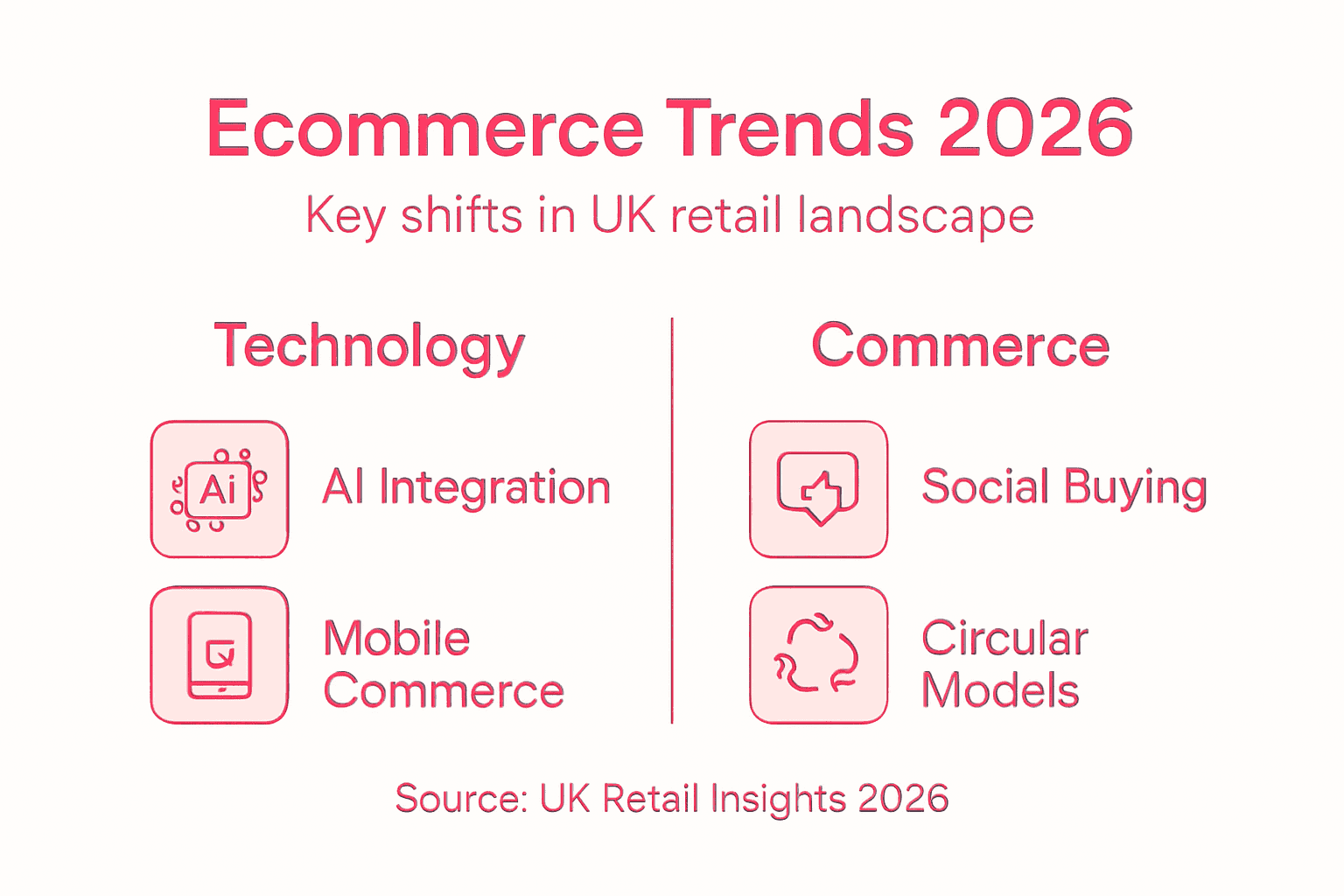
Here’s how key ecommerce trends impact UK retailers in 2026:
| Trend | Main Benefit | Business Impact |
|---|---|---|
| AI Integration | Predicts individual preferences | Drives sales and loyalty |
| Product Transparency | Boosts brand trust | Attracts conscious consumers |
| Social Commerce | Enhances direct engagement | Expands reach and conversion |
| Circular Retail Models | Improves sustainability credentials | Reduces waste, new revenue |
| Intelligent Supply | Optimises logistics and speed | Minimises costs, faster fulfilment |
Pro tip: Invest in technologies that provide deep consumer insights and enable real-time personalisation to stay ahead of emerging ecommerce trends.
AI, Automation, and Hyper-Personalisation
The future of UK ecommerce is intrinsically linked to the transformative power of artificial intelligence, advanced automation, and deeply personalised digital experiences. As technology evolves, brands are moving beyond traditional one-size-fits-all approaches to create dynamic, intelligent shopping environments that anticipate and respond to individual consumer needs.
Agentic AI is revolutionising consumer interactions by introducing autonomous shopping capabilities that fundamentally reimagine product discovery and purchasing processes. This emerging technology goes far beyond simple recommendation engines, offering sophisticated capabilities such as:
- Autonomous Shopping Agents: AI systems that can independently research, compare, and purchase products on behalf of consumers
- Predictive Personalization: Machine learning algorithms that analyse real-time behavioural data to predict and suggest products
- Emotional Intelligence: Advanced systems capable of understanding nuanced consumer preferences and emotional states
- Dynamic Price Optimization: Real-time pricing strategies tailored to individual consumer profiles
- Contextual Marketing: Automated communication strategies that adapt to individual consumer journeys
The integration of artificial intelligence extends across multiple dimensions of the ecommerce ecosystem. Hyper-personalisation strategies are transforming how brands engage with customers, leveraging first-party data to create uniquely tailored experiences that foster deeper emotional connections and sustained loyalty.
Moreover, automation is not just enhancing customer experiences but revolutionising backend operations. Brands are adopting flexible, composable architectures that can instantly adapt to changing market demands, creating more responsive and intelligent digital commerce platforms that can evolve in real-time.
Pro tip: Invest in AI technologies that provide granular consumer insights and enable genuine, emotionally intelligent personalization to differentiate your brand in an increasingly competitive digital marketplace.
The Mainstreaming of Agentic Commerce and Social Buying
The United Kingdom’s digital commerce landscape is experiencing a radical transformation, with social buying and agentic commerce emerging as pivotal mechanisms for consumer engagement and purchasing behaviour. By 2026, these technologies are no longer experimental concepts but fundamental pillars of the retail ecosystem.
Agentic commerce is revolutionising shopping experiences through autonomous AI systems that can independently research, compare, and execute purchases. This emerging paradigm represents a significant shift from traditional consumer decision-making processes, offering sophisticated capabilities such as:
- Autonomous Purchase Decision Making: AI assistants that can evaluate product options based on individual preferences
- Predictive Shopping: Systems that anticipate consumer needs before explicit requests
- Real-time Price and Value Comparison: Instant cross-platform product evaluations
- Personalised Recommendation Engines: Deeply contextual product suggestions
- Seamless Transaction Execution: One-click or voice-activated purchasing
Social commerce has similarly transformed from an experimental channel to a critical retail strategy. Nearly half of consumers now purchase directly through social media platforms, with Instagram, TikTok, and emerging social networks becoming primary shopping destinations. This evolution is driven by several interconnected trends:
- Immersive livestream shopping experiences
- Virtual influencer marketing
- Integrated in-app purchasing mechanisms
- Enhanced product discovery through social content
- Real-time social proof and user-generated content
The convergence of agentic commerce and social buying represents a profound reimagining of retail interactions. Consumers are no longer passive recipients of marketing messages but active participants in a dynamic, intelligent purchasing ecosystem that anticipates and responds to their most nuanced preferences.
Pro tip: Develop a flexible digital commerce strategy that integrates AI-driven personalization with seamless social commerce capabilities to remain competitive in the rapidly evolving UK retail landscape.
Sustainable and Circular Commerce Expectations
The United Kingdom’s retail landscape is experiencing a profound transformation driven by sustainable commerce and circular economy principles. Consumers are no longer passive purchasers but active participants in an environmentally conscious retail ecosystem that prioritises transparency, ethical consumption, and long-term environmental impact.
Sustainability has become a critical consumer expectation, with an overwhelming 67% of UK consumers willing to invest more in products that demonstrate verifiable sustainability credentials. This shift represents a fundamental redesign of purchasing behaviours, characterised by several key developments:
- Transparent Product Sourcing: Complete visibility into supply chain origins
- Lifecycle Tracking: Digital narratives documenting product journeys
- Verified Sustainability Metrics: Quantifiable environmental impact assessments
- Ethical Manufacturing Validation: Comprehensive social responsibility documentation
- Carbon Footprint Reporting: Precise emissions calculations for individual products
Circular commerce is rapidly transitioning from a niche concept to a mainstream retail strategy. Brands are increasingly adopting sustainable business models that prioritise product longevity, refurbishment, and responsible disposal. This evolution is evident in emerging practices such as:
- Trade-in programmes for used electronics
- Manufacturer-supported repair services
- Authenticated secondhand marketplaces
- Modular product design enabling component replacement
- Comprehensive recycling and upcycling initiatives
Technology plays a crucial role in enabling this sustainable transformation. Advanced digital tools now provide consumers with unprecedented insights into product provenance, environmental impact, and potential for circular reuse. By 2026, these technologies will have fundamentally redefined the relationship between consumers, brands, and the products they purchase.
Compare traditional vs. circular commerce strategies:
| Aspect | Traditional Model | Circular Model |
|---|---|---|
| Product Lifespan | Short, single use | Extended, multiple cycles |
| Consumer Role | Passive purchaser | Active participant |
| Environmental Impact | Often higher | Significantly reduced |
| Business Approach | Linear sales, disposal | Repair, resale, recycling |
Pro tip: Develop a comprehensive sustainability strategy that integrates transparent reporting, circular design principles, and verifiable environmental credentials to meet evolving consumer expectations.
Security, Compliance, and Customer Trust in 2026
The digital commerce landscape of 2026 is fundamentally defined by an intricate ecosystem of cybersecurity, data protection, and consumer trust. As technological capabilities expand, so do the complexities surrounding digital interactions, making robust security frameworks no longer optional but essential for sustainable business operations.
Compliance with data protection laws has become a critical priority for UK businesses, with regulatory scrutiny intensifying across multiple dimensions. This emerging landscape demands comprehensive strategies that address multifaceted security challenges:
- Advanced Encryption Technologies: Protecting sensitive transactional data
- Real-time Threat Detection: Proactive cybersecurity monitoring
- Multi-factor Authentication: Enhanced access verification protocols
- Transparent Data Handling: Clear communication of data usage policies
- Regulatory Compliance Frameworks: Adherence to evolving legal standards
Customer trust is now directly correlated with an organisation’s ability to demonstrate rigorous security practices. Modern consumers expect not just protection, but complete transparency about how their personal information is collected, stored, and utilised. This requires businesses to develop sophisticated approaches that go beyond traditional security measures:
- Comprehensive privacy dashboards
- Granular consent management tools
- Regular independent security audits
- Immediate breach notification systems
- Continuous employee cybersecurity training
Moreover, technological infrastructure must evolve to support these trust-building mechanisms. Machine learning algorithms, blockchain technologies, and advanced analytics are becoming instrumental in creating secure, verifiable digital interactions that reassure consumers and regulatory bodies alike.
Pro tip: Implement a holistic security strategy that prioritises transparency, continuous education, and proactive risk management to build lasting customer confidence.
Embrace the Future of Ecommerce with Expert Support from Big Eye Deers
As the article highlights, UK retailers face the challenge of navigating complex trends like AI-driven personalisation, social commerce, and sustainable retail models. Achieving truly intelligent, customer-centric ecommerce platforms that deliver seamless experiences while ensuring security and compliance is critical. Many businesses struggle to integrate innovative technologies such as autonomous shopping agents and circular commerce principles into scalable, high-performance online stores.
Big Eye Deers specialises in crafting tailored Magento and Shopify solutions that empower brands to thrive in this evolving landscape. We combine advanced technical capabilities, including ERP integrations, personalised catalogue management, and robust security with UX-led design to support your growth ambitions. Whether you are looking to harness hyper-personalisation, expand social buying capabilities, or embed sustainability measures, our expertise ensures your ecommerce platform is both future-proof and commercially impactful.
Unlock the full potential of ecommerce trends reshaping UK retail today.

Discover how Big Eye Deers can help transform your online store into an intelligent, secure, and customer-focused powerhouse. Visit our website to start your journey or explore how our Magento and Shopify services align perfectly with the shifts detailed in the article. Take the first step towards a winning ecommerce strategy with Big Eye Deers now.
Frequently Asked Questions
What is the role of AI in ecommerce trends for 2026?
AI plays a crucial role in ecommerce trends for 2026 by enabling hyper-personalisation, predictive shopping, and autonomous purchasing capabilities. This technology allows brands to anticipate consumer preferences, enhance recommendations, and streamline the purchasing process.
How does product transparency impact consumer behaviour in 2026?
Product transparency fosters brand trust among consumers, especially as they seek information about product origins and environmental impact. By providing clear details about sourcing and ethical practices, brands can attract more conscious consumers who prioritise sustainability.
What are circular retail models and why are they important?
Circular retail models focus on sustainability by promoting practices such as resale, refurbishment, and responsible consumption. They are important as they help reduce waste, extend product lifespan, and appeal to consumers who value environmental responsibility.
How will social commerce evolve by 2026?
Social commerce is expected to evolve through immersive livestream shopping experiences, virtual influencers, and integrated purchasing mechanisms within social media platforms. This shift will enhance direct engagement and enable seamless shopping experiences for consumers.
Recommended



Adobe Commerce (Magento)
Formerly known as Magento, Adobe Commerce is built for complex catalogues, integrations, and long term growth. We design and develop stable, scalable stores that support demanding eCommerce requirements, including multi-store setups, complex pricing, and Hyva based performance improvements.

Bespoke Build
We design and build custom eCommerce platforms for businesses with complex workflows, integrations, or non standard requirements. Built from scratch around your business needs using Laravel and modern architectures.

Working with brands across the UK from our offices in Cardiff and Exeter, you deal directly with a senior team of designers and developers specialising in Shopify, Magento, WordPress and bespoke eCommerce platforms.
We focus on commercial outcomes. Better conversion rates, strong SEO foundations and eCommerce platforms that continue to improve long after launch.