Proven strategies to improve online sales for UK retailers
TL;DR:
- UK ecommerce sales are forecast to reach nearly £600 billion, with online retail accounting for over 30%.
- Small, continuous improvements to the user journey and checkout process yield significant conversion gains.
- Building a data-driven, iterative strategy with regular testing outperforms one-off overhauls for sustained growth.
UK retail is at a tipping point. Online retail sales are forecast to approach £600 billion, with ecommerce now accounting for more than 30% of total retail spend. The brands capturing that growth are not necessarily the biggest; they are the most deliberate. If your online sales have plateaued or you are watching competitors gain ground, the gap rarely comes down to one big missed opportunity. It comes down to dozens of smaller ones, stacking up quietly over months. This guide gives you a practical framework to find those gaps, close them, and build sustainable momentum.
Table of Contents
- Analysing your current ecommerce performance
- Optimising the path to purchase: from landing to checkout
- Maximising basket value and repeat purchases
- Future-proofing with data-driven innovation
- Why small continuous wins beat big one-off overhauls
- Expert help to accelerate your ecommerce sales
- Frequently asked questions
Key Takeaways
| Point | Details |
|---|---|
| Benchmark your sales | Compare your key metrics against current UK retail benchmarks for informed goal-setting. |
| Simplify purchase journeys | Prioritise a smooth, fast, and intuitive path from browsing to checkout. |
| Leverage automation | Recover lost sales and increase value with automated cart emails and smart recommendations. |
| Embrace continuous improvement | Regular, small optimisations deliver sustainable sales growth over time. |
| Adopt new technology | Use analytics and AI-driven tools to stay ahead in a dynamic UK ecommerce market. |
Analysing your current ecommerce performance
With a clear picture of the opportunity and its scale, the logical starting point is understanding where your business stands today. Gut instinct is not enough. You need data, and you need the right data.
UK ecommerce accounts for 30.7% of total retail sales, with £599 billion forecast for the near term. That is the market you are competing in. Knowing your share of it, and why it looks the way it does, is non-negotiable. Start with your core KPIs and measure them honestly.
Key KPIs to track and benchmark:
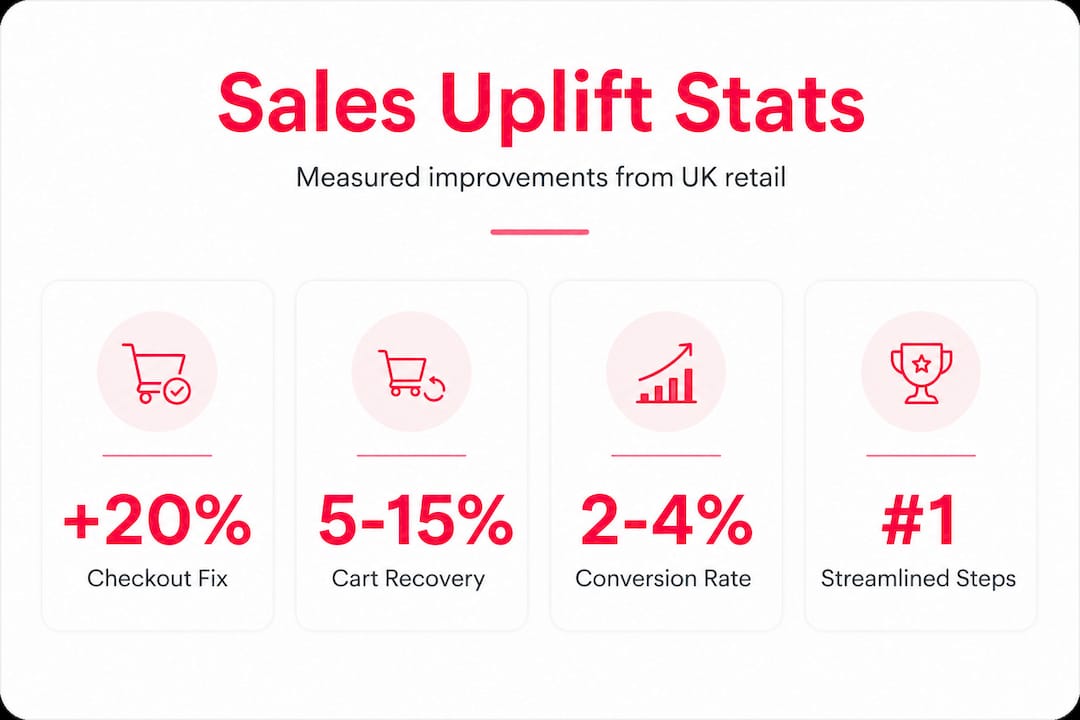
- Conversion rate (CR): The percentage of visitors who complete a purchase. Most UK ecommerce brands sit between 2% and 4%, but this varies significantly by sector.
- Average order value (AOV): What customers spend per transaction. This is a direct lever for revenue growth without acquiring new traffic.
- Cart abandonment rate: Industry averages hover around 70% to 75%. If yours is higher, something in your checkout or product experience is creating friction.
- Repeat purchase rate: A strong indicator of brand loyalty and lifecycle health. For most mid-sized UK retailers, a rate above 25% is a healthy signal.
- Revenue by channel and device: Mobile now drives the majority of ecommerce traffic in the UK. If your mobile conversion rate lags your desktop rate by more than 50%, you have a significant problem.
| KPI | Weak performance | Solid performance | Strong performance |
|---|---|---|---|
| Conversion rate | Below 1.5% | 2% to 3% | Above 3.5% |
| AOV | Below £40 | £40 to £80 | Above £80 |
| Cart abandonment | Above 80% | 65% to 75% | Below 65% |
| Repeat purchase rate | Below 15% | 20% to 30% | Above 35% |
Breaking your sales data down by channel, device, and user journey stage tells you where your funnel is leaking. Analytics platforms like GA4, combined with session recording tools, give you the behavioural layer on top of the numbers. Explore the 2026 UK ecommerce trends to understand how your benchmarks compare to where the market is heading, and factor in your physical retail data too. A well-integrated EPOS system can also surface patterns across both channels that you would otherwise miss entirely.
Pro Tip: Always benchmark against your own sector, not ecommerce as a whole. A fashion retailer and a B2B wholesaler operate in completely different conversion environments.
Optimising the path to purchase: from landing to checkout
After benchmarking performance, the next goal is to fine-tune the sales funnel that moves visitors to paying customers. This is where small improvements have an outsized commercial impact.

Friction in the user journey is the single biggest threat to your conversion rate. The sources of that friction are usually predictable: slow page load times, unclear navigation, a checkout flow that asks too much, or a search function that returns irrelevant results. Each one erodes customer confidence and increases the likelihood of abandonment.
Here is a structured approach to removing that friction:
- Audit your page speed. Core Web Vitals are now a ranking factor and a direct conversion signal. Pages that load in under two seconds consistently outperform slower ones. Start with your product listing pages and checkout, which carry the most commercial weight.
- Simplify your navigation. If a visitor cannot find what they are looking for within two or three clicks, they will leave. Run usability tests, check your internal search queries for failed searches, and flatten your category structure where possible.
- Upgrade your site search. Generic search tools return generic results. AI-powered search and merchandising tools like Klevu use behavioural data to surface the right products at the right moment. The data backs this up: AI-powered search raised conversion rates by 16% and AOV by 22% for Seasalt Cornwall, a result that illustrates just how commercially significant this single change can be.
- Reduce checkout complexity. Every additional field, forced account creation, or unexpected delivery cost at checkout kills conversions. Guest checkout, address autocomplete, and a clear progress indicator all help. For a detailed breakdown of reducing checkout errors in retail environments, the principles translate directly to online.
- Run structured A/B tests. Test one variable at a time: button copy, form layout, trust signals, product image format. Let data decide, not opinion. Our conversion rate optimisation guide walks through the methodology in detail.
“The brands that win on conversion are not the ones with the biggest budgets. They are the ones who treat their checkout as a product in its own right, continuously tested and refined.”
A comparison of common friction points and their fixes:
| Friction point | Impact on conversion | Recommended fix |
|---|---|---|
| Slow load time (above 3s) | High | Image optimisation, CDN, lazy loading |
| Poor site search relevance | Medium to high | AI-powered search (e.g., Klevu) |
| Forced account creation | High | Enable guest checkout |
| Unexpected delivery costs | Very high | Show costs early, offer free threshold |
| Complex navigation | Medium | Simplify menus, add mega nav or facets |
The CRO workflow steps we follow with clients consistently show that checkout improvements deliver the fastest measurable ROI. You can also explore emerging trends to boost your site conversion rate to stay ahead of what your customers are starting to expect.
Pro Tip: If you only do one thing this quarter, streamline your checkout. A single additional form field can reduce completions by as much as 10%. Removing friction at the final step directly protects revenue you have already spent acquiring.
Maximising basket value and repeat purchases
With your site path optimised, focus shifts to lifting average spend and encouraging customers to come back. Acquiring a new customer typically costs five to seven times more than retaining an existing one. Protecting and growing your existing customer base is one of the highest-leverage moves available to any ecommerce manager.
Tactics for increasing AOV:
- Upselling: Present a higher-value version of the product a customer is viewing. Frame it around quality or features, not just price.
- Cross-selling: Recommend complementary products at the product page or cart stage. “Frequently bought together” modules are a simple but effective implementation.
- Bundling: Curated product bundles increase perceived value and make purchasing decisions easier. Seasonal bundles, particularly in gifting periods, consistently outperform individual product promotions.
- Time-limited offers: Urgency is a genuine conversion driver when used honestly. A 24-hour promotional price or a low-stock indicator based on real inventory data encourages action without damaging trust.
Site improvements can boost AOV by over 20%, and that figure compounds when paired with strong lifecycle marketing. Platforms like Klaviyo allow you to build automated email and SMS flows that respond to real customer behaviour. Our guide to increasing average order value covers the tactical detail behind these approaches.
Recovering lost sales through automation:
- Set up a three-part abandoned cart email sequence: send the first within one hour, the second at 24 hours, and the third at 72 hours.
- Add an SMS touchpoint at 24 hours for customers who have opted in. SMS open rates significantly outperform email in most retail categories.
- Include a product image, a clear call to action, and a trust signal (such as a returns guarantee) in every recovery message.
- Test incentive inclusion carefully. A discount in the first email trains customers to abandon intentionally. Reserve incentives for the third message.
Stat to know: Cart recovery emails and SMS campaigns convert between 5% and 15% of abandoned sessions back into completed orders. At scale, that is a material revenue line recovered from traffic you have already paid for.
For repeat purchase behaviour, loyalty programmes are the long game. Points systems, early access rewards, and tiered membership tiers all reduce churn and improve customer lifetime value. The key is making the programme feel genuinely rewarding rather than administratively burdensome. Keep the earning and redemption mechanics simple, communicate clearly, and trigger reminders when points are close to expiry.
Pro Tip: Triggered messages, specifically those sent within one hour of abandonment, consistently yield the highest recovery rates. Speed matters more than the incentive at that first touchpoint.
Future-proofing with data-driven innovation
Maximising today’s sales is vital, but real leaders stay ahead by keeping one eye on tomorrow’s innovations. The UK ecommerce market does not stand still. Online penetration and technology adoption are the primary drivers of year-on-year growth, meaning the brands that embed a culture of experimentation now will be harder to displace later.
Areas driving the next wave of ecommerce growth:
- AI personalisation: Serving different homepage content, search results, and promotional messaging based on individual browsing and purchase history moves conversion rates measurably. This is no longer a capability reserved for enterprise retailers.
- Headless and composable architecture: Decoupling the frontend from the backend (as Hyvä does for Magento) gives development teams the flexibility to iterate on customer-facing features without disrupting core commerce logic.
- Omnichannel integration: Customers increasingly move between physical and digital touchpoints before purchasing. A consistent experience across your website, app, in-store, and social channels builds confidence and reduces drop-off. Modern EPOS technology for retail is increasingly bridging that gap at the operational level.
- Zero-party data strategies: With third-party cookies being phased out, brands that build direct relationships through quizzes, preference centres, and loyalty data capture will have a structural advantage in personalisation.
| Innovation area | Adoption stage (2026) | Impact on sales |
|---|---|---|
| AI site search | Mainstream | High (AOV and CR uplift) |
| Headless frontend | Growing | Medium to high (speed, flexibility) |
| Personalised email flows | Mainstream | High (repeat purchase rate) |
| Zero-party data capture | Early majority | Medium (long-term lifetime value) |
| Social commerce integration | Growing | Medium (new acquisition channel) |
The 2026 web development trends shaping the UK market include composable commerce, performance-first frontend frameworks, and deeper AI integration at the merchandising layer. Building these capabilities incrementally, rather than waiting for the perfect conditions to overhaul everything at once, is where we see the most consistent commercial return. Our advanced store strategies piece explores the operational detail behind embedding these innovations without disrupting existing revenue.
Why small continuous wins beat big one-off overhauls
Here is our honest take, and it may not be what you expect from a digital agency: re-platforming or redesigning your store rarely delivers the sustained ROI that brands hope for. We have seen it repeatedly. A brand invests six months and significant budget into a platform migration or a visual overhaul, goes live, and finds that the conversion needle barely moves. Why? Because the fundamental problems were not architectural. They were behavioural, tactical, and often fixable without touching the codebase.
The most reliable path to improving online sales is a disciplined programme of small, tested changes. Fix the checkout field that causes confusion. Improve the product page copy for your top 20 SKUs. Tune your search results for your most-searched terms. Send the abandoned cart sequence. Each change is modest. But compounded across a quarter, and then a year, they produce the kind of performance improvement that a single overhaul rarely achieves on its own.
This is not an argument against platform investment. If you are on legacy infrastructure that genuinely limits your capabilities, the right Magento or Shopify build absolutely unlocks growth. But even then, the platform is the foundation, not the strategy. The advanced sales strategies that move the needle are the ones applied consistently on top of a stable, well-built platform.
The brands we work with that see the strongest year-on-year growth share one characteristic: they treat their ecommerce store as a product under active development, not a project with a completion date. Monthly testing, quarterly reviews, and annual strategic planning cycles, all running in parallel. That rhythm builds compounding gains that are very difficult for competitors to replicate quickly.
Expert help to accelerate your ecommerce sales
The strategies in this guide work. But applying them consistently, at scale, across a live trading environment requires more than good intentions.

At Big Eye Deers, we work with mid-sized and enterprise UK retail brands to design, build, and continuously improve ecommerce platforms that are built for commercial growth. Whether your store runs on Shopify or requires the complexity of a full Magento web design and build, we bring over 17 years of hands-on experience to every engagement. From Klevu-powered search to Klaviyo lifecycle marketing and Hyvä frontend performance, our approach is practical, evidence-led, and focused entirely on your revenue outcomes. If you want to understand ecommerce best practices in the context of your specific platform and trading model, we are ready to talk through what that looks like for your business.
Frequently asked questions
What is a good online conversion rate for UK retail?
A typical UK ecommerce conversion rate sits between 2% and 4%, though this varies considerably by sector, product category, and traffic source. Fashion and gifting brands tend to sit at the lower end; high-intent categories like consumables often exceed 4%.
How much impact do abandoned cart emails have on sales?
Well-structured abandoned cart email and SMS campaigns recover between 5% and 15% of otherwise lost orders. The first message, sent within one hour of abandonment, consistently drives the highest recovery rate.
Which website improvements have the fastest ROI?
Streamlining your checkout flow and implementing AI-powered site search typically deliver the quickest measurable uplift in both conversion rate and AOV. Both changes reduce friction at the highest-value stages of the purchase journey.
Are EPOS systems relevant for online sales growth?
Yes, particularly for omnichannel retailers. A modern EPOS system improves inventory accuracy, unifies customer data across channels, and enables smarter fulfilment decisions, all of which directly support a better online shopping experience.
How often should I review and update my online sales strategy?
Quarterly reviews are the minimum recommended cadence. They allow you to assess results from recent changes, prioritise the next round of tests, and respond to shifts in customer behaviour or market conditions before they become costly gaps.
Recommended



Adobe Commerce (Magento)
Formerly known as Magento, Adobe Commerce is built for complex catalogues, integrations, and long term growth. We design and develop stable, scalable stores that support demanding eCommerce requirements, including multi-store setups, complex pricing, and Hyva based performance improvements.

Bespoke Build
We design and build custom eCommerce platforms for businesses with complex workflows, integrations, or non standard requirements. Built from scratch around your business needs using Laravel and modern architectures.

Working with brands across the UK from our offices in Cardiff and Exeter, you deal directly with a senior team of designers and developers specialising in Shopify, Magento, WordPress and bespoke eCommerce platforms.
We focus on commercial outcomes. Better conversion rates, strong SEO foundations and eCommerce platforms that continue to improve long after launch.