What is conversion rate optimisation? A guide for e-commerce growth
TL;DR:
- Most UK e-commerce sites focus on traffic but neglect optimizing the customer journey.
- Effective CRO involves understanding user drop-off points and improving usability, trust, and urgency.
- Success requires deep research, a holistic approach, and ongoing testing, not quick fixes or surface redesigns.
Most UK e-commerce businesses are pouring budget into paid traffic, SEO, and social ads, yet quietly haemorrhaging potential revenue on their own websites. The uncomfortable reality is that getting visitors to your store is only half the battle. What happens after they arrive determines whether that spend was worthwhile. Conversion rate optimisation, or CRO, is the discipline that addresses exactly this gap. In this guide, we’ll explain what CRO actually means, how the customer journey shapes your results, which strategies move the needle, and why fixating on conversion rate alone can actually harm your business.
Table of Contents
- Defining conversion rate optimisation and its importance
- The conversion funnel: Understanding your customer’s journey
- Core strategies for effective conversion rate optimisation
- Beyond conversion rate: Other metrics that matter
- Why most e-commerce CRO efforts fail (and what actually works)
- Take your store’s conversions to the next level
- Frequently asked questions
Key Takeaways
| Point | Details |
|---|---|
| CRO boosts sales | Focusing on conversion rate optimisation makes more of your existing traffic turn into customers. |
| Follow the customer journey | Understanding where shoppers drop off is essential to targeting improvements and increasing sales. |
| Metrics beyond conversion | Average order value and profit are just as important as conversion rates for sustainable growth. |
| Research-driven changes win | Strategic testing outperforms random tweaks and helps avoid wasted effort in CRO. |
Defining conversion rate optimisation and its importance
At its core, conversion rate optimisation is the systematic process of increasing the percentage of website visitors who complete a desired action. That action might be making a purchase, signing up for a newsletter, downloading a product guide, or requesting a quote. It is not simply about making your site look nicer. It is about understanding why visitors leave without acting, and then removing those barriers methodically.
Here is the basic formula: divide the number of completed actions by total visitors, then multiply by 100. If 5,000 people visit your store and 100 make a purchase, your conversion rate is 2%. That figure matters enormously because you are paying for every click, whether through Google Ads, social media, or organic search investment. A 1% improvement in conversion rate on a site turning over £500,000 annually can translate directly into tens of thousands of pounds of additional revenue, without spending a single extra penny on traffic.
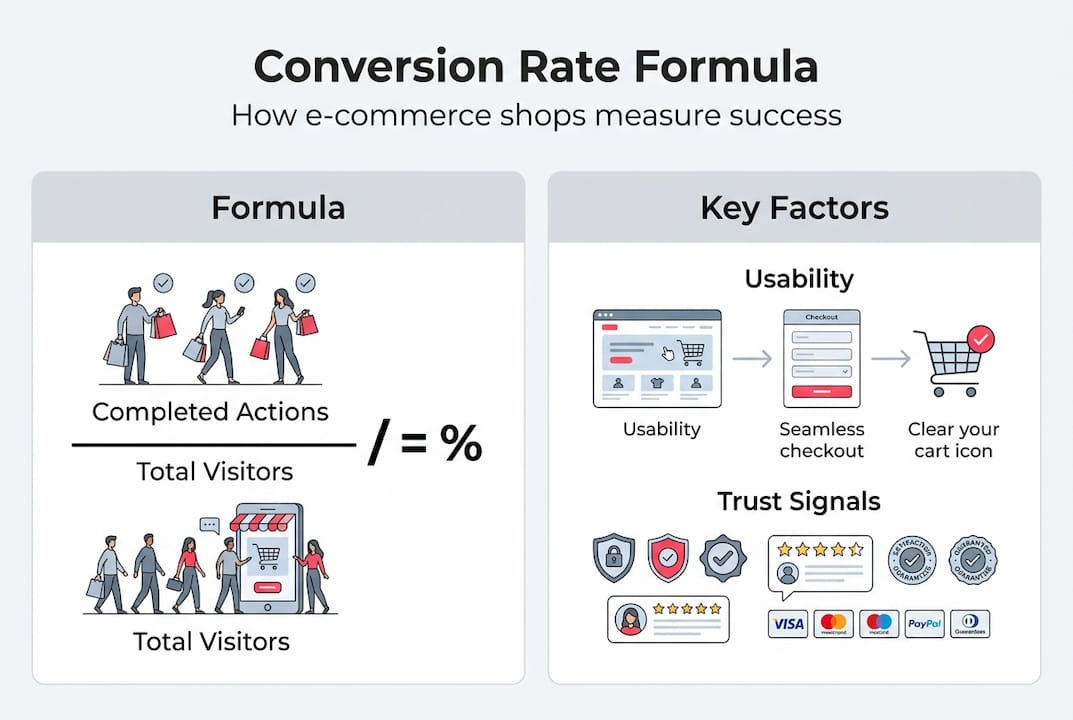
For UK e-commerce businesses, typical conversion rates hover around 2% to 3%, though this varies significantly by sector. Fashion and apparel often sit at the lower end, while niche B2B stores can exceed 5% when their audience intent is high.
Some common misconceptions are worth addressing:
- More traffic always means more sales. Not if your site is leaking visitors at checkout.
- CRO is a one-time project. It is an ongoing process, not a single fix.
- Redesigning the site will solve everything. Design alone rarely moves conversion rates without research behind it.
- Any test result is a win. Testing without a strategic foundation leads to a hamster wheel of marginal, inconclusive results.
“Focusing on volume over value is one of the most common and costly mistakes in e-commerce optimisation. The goal is not more visitors. It is more of the right outcomes.”
The shift from a traffic-first mindset to a value-first one is where real commercial gains begin.
The conversion funnel: Understanding your customer’s journey
Every visitor to your store moves through a sequence of stages before they buy, or before they leave. This sequence is called the conversion funnel, and understanding where people drop out is the foundation of effective CRO.
The four core stages are:
- Awareness — The visitor lands on your site, often via an ad, search result, or social post.
- Interest — They browse product pages or category listings, forming an impression of your brand.
- Consideration — They add items to their basket or begin comparing options.
- Action — They complete the purchase or desired conversion.
Here is a simplified view of how traffic typically behaves across these stages for a UK e-commerce store:
| Funnel stage | Visitors remaining | Common drop-off causes | Improvement opportunities |
|---|---|---|---|
| Landing page | 100% | Slow load, poor first impression | Page speed, clear value proposition |
| Product pages | 55-65% | Weak imagery, missing reviews | Social proof, better product copy |
| Basket | 30-40% | Unexpected costs, distraction | Transparent pricing, fewer distractions |
| Checkout | 15-25% | Complex forms, limited payment options | Guest checkout, multiple payment methods |
| Purchase | 2-4% | Trust issues, final hesitation | Trust badges, clear returns policy |
The numbers above make one thing immediately clear: most of your visitors are leaving before they ever reach checkout. That is not a traffic problem. That is a journey problem.
Pro Tip: Map your funnel using actual analytics data, not assumptions. Tools like Google Analytics 4 can show you exactly where visitors exit. Guessing where the leaks are wastes time and budget.
It is also worth noting that over-reliance on improving only the conversion rate can cause you to overlook metrics like Average Order Value and overall profit. When you optimise store UX with the full funnel in mind, and plan your ecommerce website around real user behaviour, results compound much more effectively.
Core strategies for effective conversion rate optimisation
Knowing where users drop off is only useful if you act on it. Here are the strategies that consistently deliver results for e-commerce stores.
Prioritise usability first. Navigation should be intuitive, your site must load quickly on mobile, and the path to purchase should never require more clicks than necessary. Mobile-first is not a trend. It is a requirement, given that the majority of UK shoppers now browse on their phones.

Build trust with social proof. Ratings, reviews, user-generated photos, and trust badges all reduce the anxiety that stops visitors from buying. A product page with 50 genuine reviews will consistently outperform the same page without them.
Use urgency and scarcity wisely. Low-stock messages, limited-time offers, and countdown timers can nudge hesitant buyers. However, these tactics must be genuine. Fake urgency erodes trust quickly and can damage your brand. Our urgency tactics guide covers this in practical detail.
A/B test one change at a time. Compare two versions of a page element, a headline, a button colour, a product image layout, and measure which performs better with real visitors. Changing multiple elements simultaneously makes it impossible to know what drove the result.
Here is a quick comparison of common CRO tactics:
| Tactic | Benefit | Potential risk |
|---|---|---|
| A/B testing | Data-driven decisions | Requires sufficient traffic |
| Social proof | Builds trust quickly | Negative reviews can backfire |
| Urgency messaging | Increases impulse purchases | Damages trust if artificial |
| Checkout simplification | Reduces abandonment | May remove useful upsell moments |
| Page speed improvements | Improves UX and SEO | Can require technical investment |
Pro Tip: All CRO changes should be driven by real user research, heatmaps, session recordings, and customer surveys, not by copying what competitors are doing. Their audience, traffic mix, and product margins are different from yours.
Testing without research or a strategic foundation is one of the most common mistakes we see. For deeper tactical guidance, explore our advanced store strategies to see how these principles apply at scale.
Beyond conversion rate: Other metrics that matter
Effective CRO is not just about boosting conversion numbers. It is about achieving sustainable business growth, and that requires a broader view.
Average Order Value (AOV) is the average amount a customer spends per transaction. If your conversion rate climbs from 2% to 3% but your AOV drops from £80 to £50 because you introduced heavy discounting to drive purchases, you have not improved your business. You may have made it worse. Our guide on how to increase average order value walks through practical ways to grow this metric alongside conversions.
Other metrics that deserve equal attention include:
- Customer Lifetime Value (CLV): How much a customer spends across their entire relationship with your brand.
- Retention rate: The percentage of customers who return to buy again. Acquiring new customers costs far more than retaining existing ones.
- Profit margin per order: Revenue is vanity, profit is sanity. A high-volume, low-margin strategy can hollow out a business.
- Cart abandonment rate: A direct signal of friction in your checkout process.
“Optimising only for conversion rate can ignore Average Order Value and overall profitability, creating growth that looks good on paper but damages the business underneath.”
The most successful e-commerce brands we work with treat CRO as one lever among many. They use it alongside retention strategies, pricing intelligence, and product development. Understanding the ecommerce success factors that drive long-term growth means resisting the temptation to chase a single metric at the expense of everything else.
A holistic view is not optional. It is the difference between a store that grows and one that spins its wheels.
Why most e-commerce CRO efforts fail (and what actually works)
We have worked on dozens of e-commerce projects over 17 years, and we see the same failure pattern repeatedly. A business reads a list of CRO best practices, runs a few A/B tests on button colours, sees marginal results, and concludes that CRO does not work for them. That is not a CRO problem. That is a strategy problem.
The uncomfortable truth is that elite-scale testing only makes sense for high-traffic sites. If your store receives fewer than 10,000 monthly visitors, you simply do not have enough data to reach statistical significance quickly. Random quick wins have limited ROI at that scale.
What actually works is starting with deep customer research. Talk to your buyers. Review your support tickets. Watch session recordings. Only then should you form a hypothesis and test it. Combine that with conversion-focused UX thinking from the very beginning of any design or build project, and you create conditions where CRO can genuinely compound over time. Generic best practices give you generic results. Research-led strategy gives you an edge.
Take your store’s conversions to the next level
If this guide has made one thing clear, it is that CRO is not a quick fix. It requires the right research, the right tools, and the right expertise to deliver meaningful, lasting results.
At Big Eye Deers, we bring over 17 years of e-commerce experience to exactly this challenge. Whether you are running a Shopify eCommerce store or a complex Magento web design build, we can help you identify where your site is losing conversions and build a plan to fix it. From UX design in Figma to Klaviyo lifecycle marketing and Klevu product discovery, our team covers the full stack. If you want to know more about how we work, meet the Big Eye Deers team and let’s talk about what your store could achieve.
Frequently asked questions
What is a good conversion rate for UK e-commerce sites?
A good e-commerce conversion rate in the UK typically ranges from 2% to 3%, though rates vary by industry, traffic source, and site quality. Niche stores with high-intent audiences can exceed this comfortably.
How can I measure my online store’s conversion rate?
Divide the number of completed desired actions by total site visitors and multiply by 100. Most analytics platforms, including Google Analytics 4, will calculate and track this automatically for you.
Does increasing conversion rate always mean higher profits?
Not always. Focusing only on conversion rate can reduce average order value or profit margin if tactics like heavy discounting are used to drive purchases without considering the broader impact.
What’s the first CRO improvement I should make?
Start by analysing your customer journey using real data to identify the biggest drop-off points, then focus on removing friction and building trust at those specific stages.
Is CRO only for large online shops?
Every store can benefit from CRO thinking, but elite-scale tactics like multivariate testing require substantial traffic volumes to produce statistically reliable results. Smaller stores should focus on research and UX fundamentals first.
Recommended



Adobe Commerce (Magento)
Formerly known as Magento, Adobe Commerce is built for complex catalogues, integrations, and long term growth. We design and develop stable, scalable stores that support demanding eCommerce requirements, including multi-store setups, complex pricing, and Hyva based performance improvements.

Bespoke Build
We design and build custom eCommerce platforms for businesses with complex workflows, integrations, or non standard requirements. Built from scratch around your business needs using Laravel and modern architectures.

Working with brands across the UK from our offices in Cardiff and Exeter, you deal directly with a senior team of designers and developers specialising in Shopify, Magento, WordPress and bespoke eCommerce platforms.
We focus on commercial outcomes. Better conversion rates, strong SEO foundations and eCommerce platforms that continue to improve long after launch.