Ecommerce architecture explained: build smarter online stores
TL;DR:
- Ecommerce architecture is the structural foundation that impacts speed, flexibility, and growth potential.
- Choosing the right architecture depends on business size, growth plans, and integration needs.
- Proper planning of architecture offers competitive advantages through faster scalability and improved user experience.
Many business owners assume launching an online shop means picking a platform, uploading products, and going live. Job done. The reality is quite different. True ecommerce performance, the kind that handles Black Friday traffic spikes, supports complex catalogues, and grows with your business, depends almost entirely on the architecture underneath. Think of it as the foundation of a building. You can dress up the exterior beautifully, but if the structural design is wrong, problems will surface. This guide cuts through the confusion and explains ecommerce architecture in plain terms, using Magento and Shopify as practical reference points throughout.
Table of Contents
- What is ecommerce architecture?
- Core types of ecommerce architecture explained
- How architecture shapes performance, flexibility and growth
- Choosing the right ecommerce architecture for your business
- Why ecommerce architecture is your hidden competitive edge
- Expert ecommerce architecture support for UK stores
- Frequently asked questions
Key Takeaways
| Point | Details |
|---|---|
| Architecture defines success | The right ecommerce architecture makes a store faster, more reliable, and ready for growth. |
| No one-size-fits-all | Different business stages and goals demand different architectural approaches. |
| Plan for the future | Choosing scalable, flexible infrastructure helps avoid costly rebuilds later. |
| Performance is architectural | Customer experience, speed, and integration capabilities all trace back to core architecture choices. |
What is ecommerce architecture?
Ecommerce architecture refers to the design and structure of the systems, platforms, integrations, and data flows that together enable digital selling. It is not just about which platform you choose. It covers how your storefront communicates with your back-end systems, how data moves between tools, and how the entire ecosystem holds together under pressure.
Think of it in four core layers:
- Interface layer: What customers see and interact with. Your product pages, checkout flow, search, and navigation.
- Back-end layer: The server-side logic. This handles orders, pricing rules, inventory, and customer accounts.
- Integration layer: The connections between your store and external tools. ERP systems, warehouse management, payment gateways, and shipping providers all live here.
- Data layer: How information is stored, retrieved, and kept consistent across systems. Poor data architecture causes overselling, pricing errors, and delayed fulfilment.
Architecture matters because it directly shapes retail web design success at every stage. A poorly structured store will struggle to load quickly under high traffic, fail to support new integrations without major rebuilds, and resist any meaningful customisation. Many businesses fall into the trap of choosing an out-of-the-box solution because it is cheap and fast to launch, only to discover the limitations later when growth demands more.
“Good ecommerce architecture is invisible to the customer but felt in every interaction. Speed, reliability, and seamless checkout are not accidents. They are the result of deliberate structural decisions made long before a pixel was designed.”
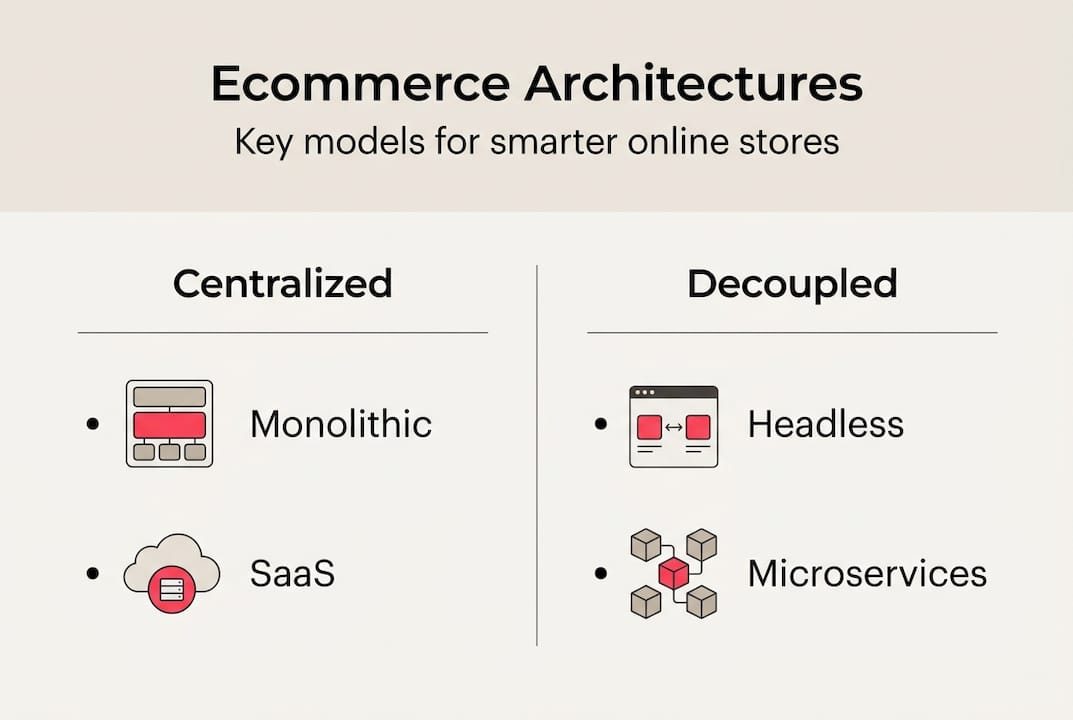
The most common architecture types you will encounter are:
- Monolithic: All components are tightly coupled in a single codebase
- Microservices: Independent services that communicate via APIs
- SaaS (Software as a Service): Hosted, managed platforms like Shopify
- Headless commerce: Decoupled front-end and back-end, connected via API
Each has real trade-offs. As noted in ecommerce architecture research, microservices increase operational complexity around service discovery and data consistency, monoliths limit independent scaling, and SaaS constrains deep custom logic. Understanding those trade-offs is the first step to building well. When we approach Magento web design projects, the architecture conversation always comes before any design work begins, because smart decisions here save significant time and cost downstream.
Clever pricing tactics in ecommerce also depend on a flexible back-end that can handle tiered pricing, promotional rules, and customer group logic without hacking the core system.
Core types of ecommerce architecture explained
Now that we have laid the groundwork, it is time to look at the most common architectural approaches in practical detail.
Monolithic architecture bundles your storefront, back-end logic, database, and integrations into a single, unified codebase. Traditional Magento 1 installations are a classic example. Everything works together tightly, which simplifies early development. The problem appears at scale. When you need to update one component, you must redeploy the entire application. Traffic spikes can bring the whole store down because you cannot scale individual parts independently.
Microservices architecture breaks the store into smaller, independently deployable services. Your checkout, product catalogue, and search might each run as separate services. This enables targeted scaling and faster deployments, but the operational complexity increases significantly, particularly around keeping data consistent across services.
SaaS platforms like Shopify handle infrastructure, security, and updates for you. For many UK SMEs, this is the right starting point. You get reliable hosting, regular updates, and a broad app ecosystem without needing a dedicated DevOps team. The downside is that customisation hits a ceiling. If your business model requires genuinely unique pricing logic, complex B2B account hierarchies, or deep ERP integration, a pure SaaS approach may frustrate you. Learn more about SaaS ecommerce advantages and where its limitations begin.
Headless commerce decouples your front-end presentation layer from the back-end commerce engine, connecting them via APIs. Brands like Adobe Commerce with a Hyvä or React frontend are a good example. This gives front-end teams total creative freedom whilst back-end teams manage data and logic independently. It is powerful but not cheap to build or maintain.
| Architecture | Strengths | Weaknesses | Best for |
|---|---|---|---|
| Monolithic | Simple setup, low initial cost | Hard to scale, rigid to change | Small stores, early stage |
| Microservices | Highly scalable, flexible | Complex ops, high dev cost | Large enterprise |
| SaaS | Fast launch, managed hosting | Limited custom logic | SMEs, DTC brands |
| Headless | Creative freedom, API-first | Expensive, complex builds | High-growth, experience-led brands |
Following ecommerce best practices means matching architecture to your actual growth trajectory, not the one you wish you had.
Pro Tip: Resist the temptation to build a microservices architecture just because it sounds modern. If your team is small and your catalogue is straightforward, a well-configured SaaS or monolithic build will outperform a poorly implemented microservices setup every single time. Fit the architecture to your plans, not your ambitions.
How architecture shapes performance, flexibility and growth
With the main models covered, let us see how these architectural decisions play out in real ecommerce operations, because theory only takes you so far.
Speed is structural. A monolithic store running on shared hosting will buckle under a promotional spike. A well-configured SaaS platform with CDN (Content Delivery Network, a network of servers distributing load geographically) will handle the same spike without breaking a sweat. Meanwhile, a headless build with edge caching can serve pages almost instantly to customers across the UK. The architecture you choose today sets your performance ceiling for years.
Flexibility matters at every stage. When you run a flash sale, you need to update pricing, banners, and promotional rules rapidly. If those systems are tightly coupled in a monolithic build, a change in one area risks breaking another. Architectures that separate concerns, whether through microservices or well-structured SaaS apps, allow your marketing team to move without waiting for developer sign-off on every change.

Integration capacity determines growth. As your store grows, you will need to connect stock management, shipping carriers, accounting software, and CRM platforms. A well-designed scalable ecommerce site anticipates these integrations from day one. Online price factors like supplier costs, competitor pricing, and demand signals all become manageable when your architecture includes clean API connections to pricing and stock tools.
| Scenario | Monolithic | SaaS | Headless/Microservices |
|---|---|---|---|
| Black Friday traffic spike | High risk of downtime | Managed, stable | Scalable with planning |
| Adding new payment provider | Requires dev rebuild | App install, minutes | API connection, modular |
| Seasonal promotion changes | Risky, slow to deploy | Quick via apps | Rapid, independent services |
| ERP integration | Complex, custom code | Limited native support | Clean via REST APIs |
Price transparency in ecommerce is also increasingly expected by customers, and your architecture must support real-time pricing updates across channels without data inconsistency.
Here are practical steps to future-proof your ecommerce store from an architectural perspective:
- Audit your current integration points. Map every tool your store connects to today, and list five you are likely to add in the next two years.
- Assess your peak traffic profile. Understand when and why your traffic spikes, and confirm your architecture can handle three times your current peak load.
- Decouple where it hurts most. Identify the area of your store that causes the most friction when you try to update it, and prioritise architectural separation there first.
- Plan for API-first integrations. Insist on REST API or GraphQL connections for new tools rather than custom database integrations, which are fragile and hard to maintain.
- Review your hosting strategy. Cloud hosting with auto-scaling support is no longer a luxury. It is a baseline expectation for scalable retail architecture in 2026.
As noted in ecommerce architecture analysis, monoliths limit independent scaling, which is a genuine constraint as you pursue enterprise ecommerce growth beyond a certain revenue threshold.
Choosing the right ecommerce architecture for your business
Having understood how architecture shapes outcomes, let us focus on how to make the right choice for your own business, because there is no universally correct answer.
The first thing to assess is your business stage and technical resource. A lean team without in-house developers will struggle to maintain a microservices build. A rapidly growing wholesale business with complex pricing rules and account hierarchies will outgrow a basic SaaS setup within months. Honest self-assessment here saves enormous amounts of time and money.
Before you commit to any platform or architectural approach, work through these questions:
- What is your realistic growth trajectory over the next three years? A store turning over £500k today may look very different at £5m.
- Do you have in-house developers, or will you rely on an agency? This determines how much operational complexity you can absorb.
- What integrations are non-negotiable? ERP, WMS (Warehouse Management System), and PIM (Product Information Management) connections need to be validated against your chosen architecture before you sign anything.
- Do you trade DTC, B2B, or both? B2B ecommerce has specific requirements around multi-store ecommerce strategy, account management, and tiered pricing that not every architecture handles elegantly.
- What is your budget for ongoing development? Headless and microservices builds require continuous investment. SaaS platforms have predictable monthly costs but limit flexibility.
- How important is brand differentiation through the shopping experience? If your UX is a core differentiator, headless gives you the most control.
The biggest pitfalls we see are vendor lock-in and underestimated complexity. E-commerce architecture research confirms that microservices dramatically increase operational overhead, particularly around data consistency. Businesses often choose them for the perceived prestige, then struggle to manage the reality.
Price comparison in ecommerce is now a major customer behaviour, and your architecture needs to support accurate, real-time pricing across channels. If your pricing engine cannot update quickly because of a rigid monolithic structure, you will lose sales to more agile competitors.
Pro Tip: When planning your architecture, always map your integrations first, then choose the platform. Far too many businesses choose a platform based on its feature list and then discover that their essential ERP or stock management system requires expensive custom development to connect properly. Refer to retail web design guidance to understand how design and technical decisions interact from the very start of a project.
Why ecommerce architecture is your hidden competitive edge
Here is an opinion you will not hear everywhere: most ecommerce businesses spend 80% of their time on features and 20% on foundation, but the returns are almost exactly reversed. The stores we have seen achieve the sharpest growth over the last 17 years are not necessarily the ones with the most features. They are the ones built on foundations that allow rapid change.
When your architecture is right, adding a new sales channel takes days, not months. Onboarding a new integration does not require rebuilding your catalogue logic. Your team spends time on growth activities, not firefighting technical debt. Platforms chosen for shiny features often saddle businesses with rigid systems that resist every subsequent improvement.
Real enterprise ecommerce results consistently come from businesses that made brave, considered architectural decisions early. Architecture-first thinking is not pessimistic caution. It is commercial confidence. The biggest winners in ecommerce today build for tomorrow. They accept slightly more upfront complexity in exchange for genuine agility, cost control, and the ability to innovate faster than their competitors. That is the real edge.
Expert ecommerce architecture support for UK stores
If you are serious about building an online store that performs under pressure and scales with your ambitions, the architecture conversation needs to happen before anything else.
At Big Eye Deers, we bring over 17 years of Magento and Shopify expertise to exactly this kind of challenge. Whether you need a bespoke Magento web design services build with ERP integration and tiered pricing, or a beautifully designed Shopify development experts store optimised for conversion, we start every project with architecture. We help UK ecommerce managers and business owners make informed, confident decisions about platform, structure, and integrations before a single line of code is written. Get in touch for a consultation and let us review your current setup.
Frequently asked questions
How do I know if my current ecommerce architecture suits my business?
Assess whether your setup is genuinely scalable and able to handle integrations and traffic growth without regular performance failures or expensive bespoke fixes each time you need a change.
Can I switch my architecture later if my store grows quickly?
Yes, but re-platforming is disruptive and often costly, so it is far better to plan for scalability at the outset rather than attempting a major architectural migration under commercial pressure.
What architecture type is best for small UK online shops?
SaaS platforms are typically ideal for smaller stores because of their simplicity and low operational overhead, though microservices or headless approaches become worth considering as business complexity and revenue increase.
How does architecture affect site speed and customer experience?
A well-designed architecture enables faster page loads, stable performance during high-traffic periods, and smoother checkout flows, all of which directly improve customer experience and conversion rates.
Recommended



Adobe Commerce (Magento)
Formerly known as Magento, Adobe Commerce is built for complex catalogues, integrations, and long term growth. We design and develop stable, scalable stores that support demanding eCommerce requirements, including multi-store setups, complex pricing, and Hyva based performance improvements.

Bespoke Build
We design and build custom eCommerce platforms for businesses with complex workflows, integrations, or non standard requirements. Built from scratch around your business needs using Laravel and modern architectures.

Working with brands across the UK from our offices in Cardiff and Exeter, you deal directly with a senior team of designers and developers specialising in Shopify, Magento, WordPress and bespoke eCommerce platforms.
We focus on commercial outcomes. Better conversion rates, strong SEO foundations and eCommerce platforms that continue to improve long after launch.