Multi-Store Ecommerce: Unlocking Retail Growth

Over 60 percent of british ecommerce managers report that managing product catalogues and customer experiences across multiple storefronts is far more complex than expected. As retail brands in the United Kingdom expand and diversify, the need for streamlined multi-store solutions is growing rapidly. This article explains how adopting a modern multi-store ecommerce model can help UK retailers deliver tailored experiences and efficient product management while supporting business growth in a competitive market.
Table of Contents
- Defining Multi-Store Ecommerce Models
- Magento and Shopify Multi-Store Capabilities
- Core Architecture and Setup Considerations
- Benefits for UK Retailers and Brands
- Operational Costs and Common Pitfalls
Key Takeaways
| Point | Details |
|---|---|
| Multi-Store Ecommerce Strategy | Allows businesses to manage multiple online stores through a single backend, enhancing targeted marketing and operational efficiency. |
| Platform Selection | Choosing between Magento and Shopify should be based on business scalability, technical capabilities, and growth objectives. |
| Operational Planning | Careful planning is required to mitigate risks and control costs associated with multi-store infrastructures. |
| Market Research Importance | Conducting thorough market research ensures each storefront effectively meets the needs of distinct customer segments. |
Defining Multi-Store Ecommerce Models
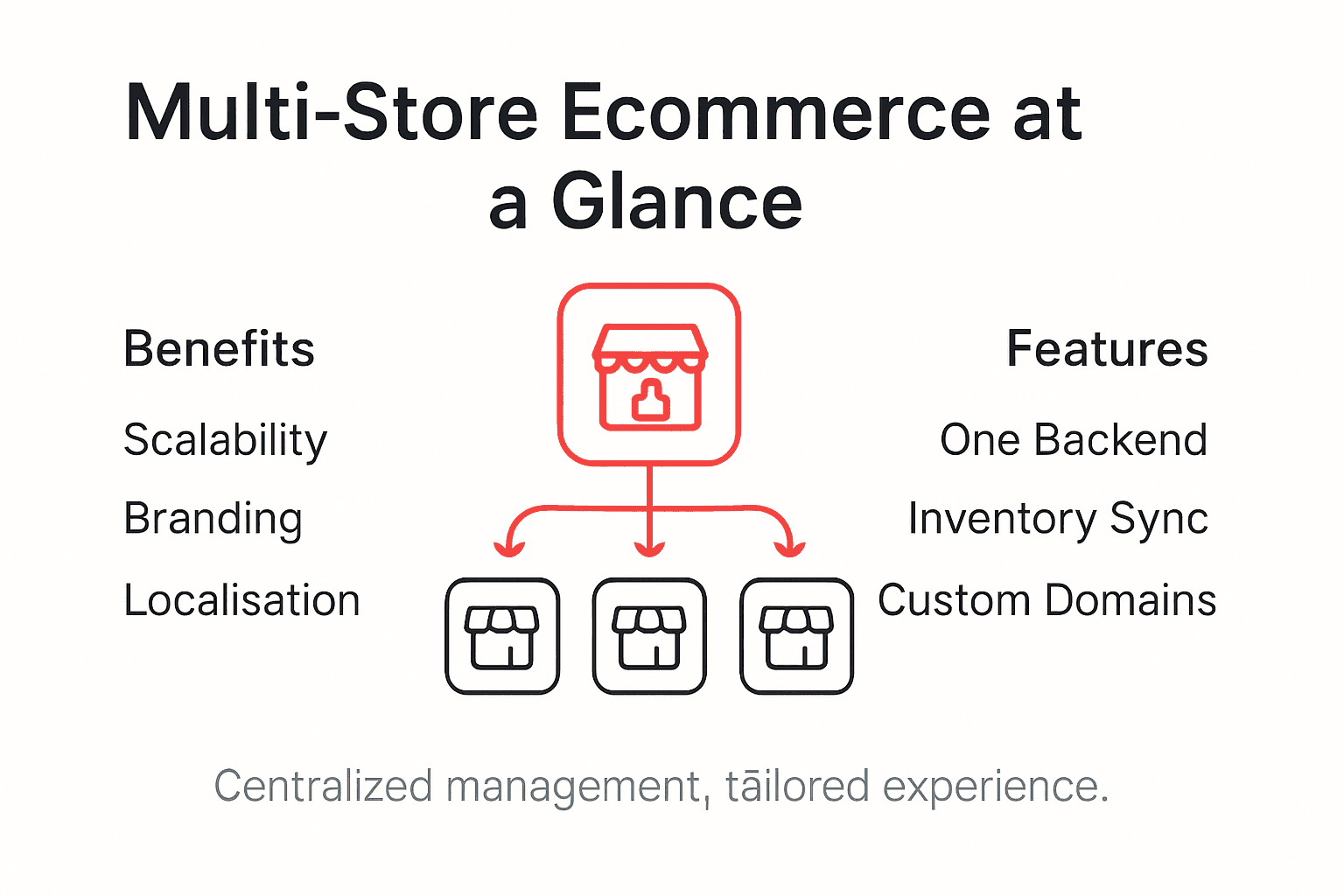
Multi-store ecommerce represents a sophisticated digital retail strategy enabling businesses to operate multiple online storefronts from a single backend platform. This approach allows retailers to target diverse customer segments, manage distinct product catalogues, and customise experiences across different markets or brands. Multi-channel retailing strategies are becoming increasingly critical as businesses seek to integrate online and offline sales channels effectively.
At its core, a multi-store ecommerce model enables organisations to create and manage several unique online stores, each potentially serving different geographical regions, customer demographics, or brand identities. These stores can share core infrastructure like inventory management and payment systems while maintaining distinct visual designs, product ranges, pricing strategies, and localised content. Key capabilities typically include:
- Centralised product and inventory management
- Separate domain names and branding for each store
- Customisable design themes per storefront
- Independent pricing and promotional rules
- Multilingual and multi-currency support
- Distinct customer segmentation and targeting
The strategic implementation of multi-store models allows businesses to expand their digital footprint without developing entirely separate technological ecosystems. This approach is particularly powerful for retailers with multiple brands, international expansion plans, or complex market segmentation requirements. By leveraging a unified backend, companies can reduce technological complexity while maintaining the flexibility to create tailored online shopping experiences.
Pro tip: When planning a multi-store strategy, conduct thorough market research to ensure each storefront addresses a distinct customer need or market segment rather than creating redundant online presences.
Magento and Shopify Multi-Store Capabilities
Multi-store ecommerce platforms like Magento and Shopify offer distinct approaches to managing multiple online storefronts, each with unique strengths tailored to different business requirements. Enterprise-level multi-store capabilities have become increasingly sophisticated, enabling retailers to create complex, interconnected digital retail ecosystems.
Magento, now part of Adobe Commerce, provides an exceptionally robust multi-store architecture that allows businesses to manage multiple websites, stores, and store views from a single administrative panel. This platform excels in offering granular control over product catalogues, pricing strategies, and customer segmentation across different stores. Key Magento multi-store features include:
- Centralised inventory management
- Separate payment and shipping configurations
- Independent website designs and themes
- Multilingual and multi-currency support
- Customisable product catalogues per store
- Advanced reporting across different storefronts
Shopify Plus offers a more streamlined approach, particularly attractive for direct-to-consumer brands seeking efficient multi-store management. While less complex than Magento, Shopify provides intuitive tools for businesses wanting to launch multiple storefronts quickly. Its strengths lie in user-friendly interfaces, rapid deployment, and seamless integrations with marketing and sales tools.
Pro tip: When selecting a multi-store platform, carefully assess your business’s scalability requirements, technical capabilities, and long-term growth strategy to choose the most suitable solution.
The following table compares Magento and Shopify’s multi-store capabilities for helping UK retailers choose the right solution:
| Aspect | Magento (Adobe Commerce) | Shopify Plus |
|---|---|---|
| Architectural control | Highly granular, flexible configuration | Streamlined, less complex |
| Expansion suitability | Best for broad or international growth | Ideal for rapid brand expansion |
| Technical requirement | Advanced expertise needed | Minimal technical skills required |
| Reporting depth | Extensive cross-store analytics | Standard, customisable reports |
| Speed to market | Longer, needs planning | Quick store launch possible |
Core Architecture and Setup Considerations
Multi-store ecommerce architecture represents a sophisticated approach to digital retail management, enabling businesses to create complex, interconnected online ecosystems. Enterprise multi-store configurations provide sophisticated tools for managing diverse digital storefronts while maintaining centralised administrative control and consistent operational standards.
The core architecture of a multi-store setup involves several critical technical and strategic components that determine the platform’s effectiveness. Key architectural considerations include:
- Centralised Management: Single administrative panel controlling multiple websites
- Shared Infrastructure: Common backend systems for inventory, customer data, and reporting
- Granular Permissions: Role-based access controls for different administrative levels
- Scalable Configuration: Flexible framework supporting diverse business models
- Localisation Capabilities: Independent language, currency, and regional settings
Successful multi-store implementations require meticulous planning around technical integration, brand consistency, and operational efficiency. Retailers must carefully map out their digital strategy, considering how different storefronts will interact, share resources, and maintain unique identities while leveraging a unified technological foundation. This approach allows organisations to create tailored experiences across different market segments without duplicating technological infrastructure.

Pro tip: Conduct a comprehensive audit of your existing technological ecosystem and business requirements before implementing a multi-store solution to ensure seamless integration and optimal performance.
Benefits for UK Retailers and Brands
Multi-store ecommerce represents a transformative strategy for UK retailers seeking to expand their digital footprint and adapt to rapidly evolving market dynamics. Strategic digital market expansion enables businesses to leverage online channels more effectively, optimising geographic demand prediction and creating sophisticated retail approaches that complement traditional brick-and-mortar operations.
The UK retail landscape presents unique opportunities for brands implementing multi-store strategies, with key advantages including:
- Enhanced market segmentation capabilities
- Reduced technological infrastructure costs
- Improved regional and international expansion potential
- Tailored customer experience design
- Flexible brand positioning across different markets
- Centralised yet customisable operational management
For UK brands, multi-store platforms offer unprecedented flexibility in managing diverse customer demographics. Retailers can create distinct digital storefronts targeting specific consumer groups, regions, or product lines while maintaining a unified backend system. This approach allows for nuanced marketing strategies, localised pricing models, and targeted customer engagement without requiring separate technological investments for each digital storefront.
Pro tip: Conduct comprehensive market research to identify distinct customer segments before implementing your multi-store strategy, ensuring each digital storefront delivers genuine value to its intended audience.
Operational Costs and Common Pitfalls
Multi-store ecommerce strategies demand careful financial and technological planning to mitigate potential risks and control escalating expenses. Comprehensive operational cost management requires retailers to anticipate and strategically address the complex financial and technological challenges inherent in managing multiple digital storefronts.
Key operational cost considerations for multi-store implementations include:
- Infrastructure Expenses: Hosting, software licensing, and domain management
- Technical Resources: Specialised developer expertise and ongoing maintenance
- Security Investments: Multi-domain SSL certificates and comprehensive cybersecurity measures
- Integration Costs: Connecting disparate systems and synchronising data platforms
- Compliance Expenditures: Managing tax, currency, and regional regulatory requirements
The most significant pitfalls emerge from inadequate architectural planning and governance. Many organisations encounter challenges such as code duplication, fragmented customer data management, and inconsistent merchandising strategies across different storefronts. These issues can rapidly escalate operational complexity and undermine the potential efficiency gains of a multi-store approach. Successful implementations require robust admin tools, standardised workflows, and a strategic approach to platform design that prioritises scalability and operational coherence.
Here’s a summary of major operational cost risks and matching mitigation strategies in multi-store ecommerce:
| Cost Risk | Example Challenge | Mitigation Strategy |
|---|---|---|
| Infrastructure overspend | Paying for unused server resources | Scale cloud infrastructure flexibly |
| Integration complexity | Data mismatches between systems | Use synchronised integration tools |
| Compliance surprises | Hidden tax or regulatory changes | Regular regulatory audits |
| Security vulnerabilities | Multi-domain SSL gaps | Annual cybersecurity reviews |
Pro tip: Conduct a comprehensive cost-benefit analysis and develop a detailed governance framework before launching multiple storefronts to prevent technological redundancy and control long-term operational expenses.
Unlock Seamless Multi-Store Growth with Expert Ecommerce Solutions
Managing multiple online storefronts presents clear challenges such as ensuring brand consistency, integrating complex systems, and controlling operational costs. The article emphasises that effective multi-store ecommerce requires a unified backend, customisable storefronts, and scalable architecture to unlock true retail growth. If you are navigating these complexities in the UK market, it is essential to leverage a specialised partner who understands multi-store setups on platforms like Magento and Shopify.
At Big Eye Deers, we combine over 17 years of experience with deep expertise in Magento Open Source, Adobe Commerce, and Shopify Plus to design, build, and support scalable multi-store ecommerce solutions. Our holistic approach includes:
- Custom catalogue management and tiered pricing to serve diverse customer groups
- ERP integrations that unify inventory and ordering across stores
- Robust security monitoring with Sansec to maintain PCI compliance
- UX-driven design planned with Figma to enhance user journeys and conversion
Want to accelerate your multi-store ecommerce ambitions while avoiding common pitfalls? Explore how our tailored Magento and Shopify expertise can power your expansion with efficiency and confidence. Connect with us today and start unlocking the full potential of your retail brands across multiple markets.
Frequently Asked Questions
What is a multi-store ecommerce model?
A multi-store ecommerce model allows businesses to operate multiple online storefronts from a single backend platform, enabling targeted marketing and custom experiences for different customer segments.
What are the core features of multi-store ecommerce platforms?
Key features include centralised inventory management, separate domain names, customisable designs for each store, multilingual and multi-currency support, and distinct pricing and promotional rules.
How do Magento and Shopify compare in their multi-store capabilities?
Magento offers robust and granular control for complex multi-store setups, while Shopify provides a more streamlined, user-friendly interface suitable for quicker store launches. The choice depends on specific business needs and technical expertise.
What are the potential operational costs associated with a multi-store ecommerce strategy?
Operational costs can include infrastructure expenses, technical resource requirements, security investments, integration costs, and compliance expenditures, all of which need careful planning to avoid overspending.
Recommended


Adobe Commerce (Magento)
Formerly known as Magento, Adobe Commerce is built for complex catalogues, integrations, and long term growth. We design and develop stable, scalable stores that support demanding eCommerce requirements, including multi-store setups, complex pricing, and Hyva based performance improvements.

Bespoke Build
We design and build custom eCommerce platforms for businesses with complex workflows, integrations, or non standard requirements. Built from scratch around your business needs using Laravel and modern architectures.
Working with brands across the UK from our offices in Cardiff and Exeter, you deal directly with a senior team of designers and developers specialising in Shopify, Magento, WordPress and bespoke eCommerce platforms.
We focus on commercial outcomes. Better conversion rates, strong SEO foundations and eCommerce platforms that continue to improve long after launch.