Why Hyvä for Magento boosts your store’s speed and sales
TL;DR:
- Hyvä is a modern Magento 2 frontend solution that offers faster load times, better performance, and improved user experience compared to legacy themes like Luma. It uses lightweight tools such as Alpine.js and Tailwind CSS, enabling easier customization and higher Core Web Vitals scores, which boost search rankings and conversions. Transitioning to Hyvä enhances store agility, supports faster development cycles, and can significantly increase sales through optimized customer journeys and quicker response to market needs.
Your Magento store might be technically capable, but if it’s running on a bloated frontend theme, you’re losing sales every single day. Slow load times, clunky interfaces, and frustrated users are not a Magento problem; they’re a theme problem. Hyvä is a modern frontend solution built specifically for Magento 2 that strips away the unnecessary complexity, delivering stores that load faster, convert better, and are genuinely enjoyable to build and maintain. In this article, we’ll walk you through exactly why Hyvä deserves serious attention from any UK ecommerce manager or store owner who cares about performance and profitability.
Table of Contents
- What makes Hyvä different from other Magento themes
- How Hyvä improves store speed and user experience
- Driving conversion rates and sales with Hyvä
- Is Hyvä right for your Magento business?
- Our take: What most Magento owners miss about Hyvä
- Let us help you transform your Magento store
- Frequently asked questions
Key Takeaways
| Point | Details |
|---|---|
| Hyvä boosts Magento speed | Adopting Hyvä dramatically improves load times and user experience in Magento stores. |
| Higher conversion rates | Hyvä’s streamlined frontend helps drive sales by reducing buyer friction and improving page performance. |
| Easy migration for most stores | Hyvä is compatible with modern Magento setups, making migration straightforward for most UK ecommerce businesses. |
| Expert support available | Specialist agencies provide Hyvä consultation and technical support for seamless integration. |
What makes Hyvä different from other Magento themes
Traditional Magento themes, most notably Luma, were built for compatibility rather than performance. Luma ships with RequireJS, KnockoutJS, and a heavy layer of JavaScript that the browser has to parse, compile, and execute before your customer sees a usable page. That is a lot of work happening before anyone can even click “add to basket.”
Hyvä takes a completely different approach. It replaces that JavaScript-heavy stack with Alpine.js and Tailwind CSS, two modern, lightweight tools that are far easier to work with and far kinder to browser performance. The result is a frontend that loads dramatically faster, is simpler to customise, and produces cleaner, more maintainable code.
Here is a straightforward comparison between the two approaches:
| Feature | Hyvä | Luma |
|---|---|---|
| JavaScript framework | Alpine.js (lightweight) | KnockoutJS + RequireJS (heavy) |
| CSS approach | Tailwind CSS (utility-first) | LESS (bulky, verbose) |
| Page load speed | Significantly faster | Often slow, especially on mobile |
| Developer experience | Modern, enjoyable | Complex, frustrating |
| Customisation flexibility | High, with clean structure | Possible but costly |
| Core Web Vitals performance | Excellent | Typically poor |
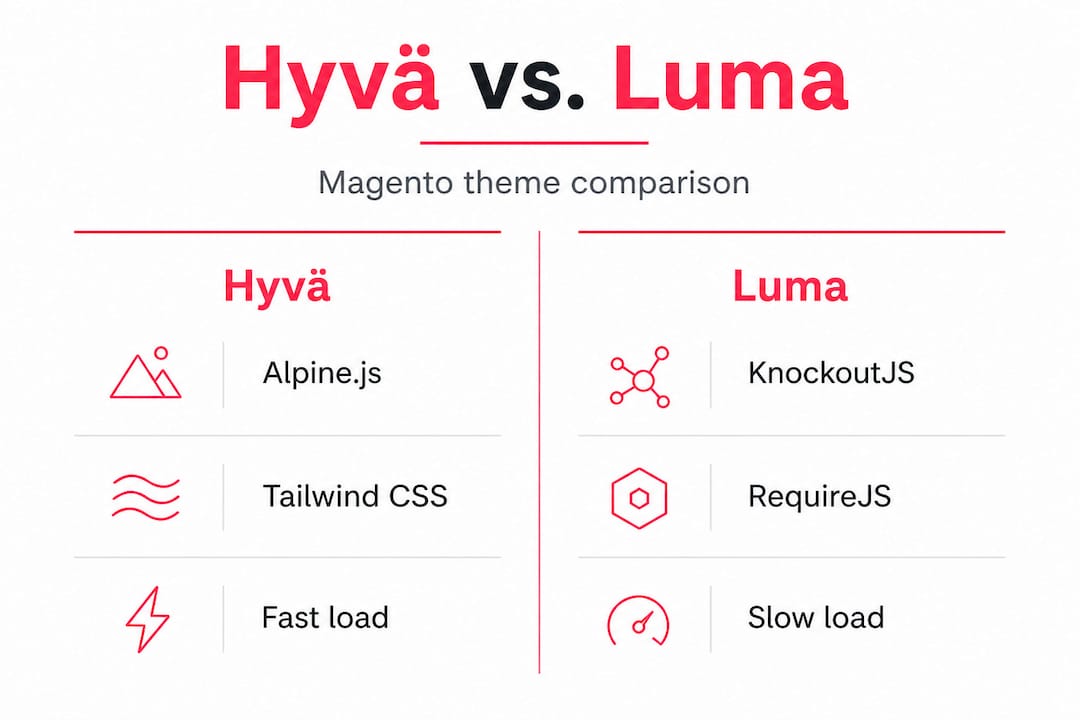
For UK ecommerce businesses reviewing their Magento themes comparison, the contrast is striking. Luma was never designed with today’s performance expectations in mind, and trying to optimise it is a bit like fitting a performance exhaust to a tractor.
What makes Hyvä genuinely exciting is that it was built by the Magento community, for the Magento community. It is not a third-party bolt-on or a quick fix. It is a purposeful architectural decision that aligns with how modern web development works. Developers enjoy building with it, which matters enormously because happier developers produce better code, faster.
Key advantages Hyvä brings to your storefront:
- Minimal JavaScript footprint: Fewer scripts mean faster parse times and less risk of third-party conflicts.
- Tailwind CSS: Utility-first styling keeps your CSS lean and makes design changes predictable and fast.
- No more KnockoutJS: Removing this framework alone can dramatically reduce JavaScript bundle sizes.
- Better mobile performance: Hyvä-built stores consistently score higher on Google’s Core Web Vitals, which now directly influence search rankings.
- Faster developer iteration: Simpler codebase means features and fixes are delivered more quickly, reducing your agency costs over time.
The shift from Luma to Hyvä is not simply a visual refresh. It is a fundamental rethink of how your Magento store is delivered to customers, and the performance data backs this up clearly.
How Hyvä improves store speed and user experience
Understanding why Hyvä is architecturally different is one thing. Seeing what that means in practice is another entirely. The performance gains are not marginal; in many cases they are transformative.
Hyvä’s speed advantages for UK ecommerce platforms are well documented. Stores migrating from Luma to Hyvä commonly report Google Lighthouse scores jumping from the 30 to 50 range up to 90 or above. That is not a small improvement; it is the difference between a site that struggles to compete and one that is genuinely performing in search results and keeping customers engaged.

Here is how key performance metrics typically compare after a Hyvä migration:
| Metric | Luma (typical) | Hyvä (typical) |
|---|---|---|
| Google Lighthouse score (mobile) | 30 to 55 | 85 to 98 |
| Time to First Byte (TTFB) | 800ms to 2s | 200ms to 500ms |
| Largest Contentful Paint (LCP) | 4s to 8s | 1.5s to 2.5s |
| Total Blocking Time (TBT) | 500ms to 2000ms | Under 100ms |
| JavaScript bundle size | 500KB to 1MB+ | Often under 100KB |
These are not abstract numbers. LCP, or Largest Contentful Paint, measures how quickly the main content of your page loads. Google now uses this directly in its ranking algorithm. A poor LCP score means your competitors are outranking you simply because their pages load faster. That is business you are actively losing.
There are several specific reasons why Hyvä achieves these results. Consider the following steps in how a Hyvä store serves a page more efficiently:
- Server renders the HTML: The page structure arrives in the browser immediately, ready for the user to see.
- Tailwind CSS delivers only used styles: Unused CSS is purged at build time, meaning the stylesheet is tiny.
- Alpine.js initialises on interaction: JavaScript only activates when the customer actually needs it, not before.
- No RequireJS module loading: Eliminates the lengthy chain of JavaScript dependencies that Luma requires before the page becomes interactive.
- Fewer HTTP requests: Fewer files to fetch means faster overall load times, especially on slower mobile connections.
The UX benefits go beyond raw speed too. Hyvä-built stores feel more responsive and less cluttered because developers can focus on building the right experience rather than wrestling with legacy framework constraints. Customer journeys feel smoother. Product pages load crisply. The checkout process does not stutter.
For practical Magento speed optimisation, Hyvä provides an excellent foundation, but you can build on it further. Pairing it with solid Magento on-page optimisation practices compounds the gains significantly.
Pro Tip: Enable server-side rendering for your category and product pages wherever possible. This ensures the browser receives meaningful content immediately rather than waiting for client-side JavaScript to populate the page, which is especially valuable for customers on slower mobile connections or in areas with weaker signal.
Driving conversion rates and sales with Hyvä
Performance improvements are commercially meaningless unless they translate into actual revenue. Fortunately, the link between page speed, user experience, and conversion rates is well established and the Magento capabilities that Hyvä unlocks are directly tied to improved sales outcomes.
The core logic is straightforward. Every second of delay in page load time reduces conversions. Remove that friction and more customers complete their purchases. Speed is not just a technical metric; it is a sales lever.
The ecommerce trends data is consistent: faster storefronts convert better. Retailers who migrate to Hyvä commonly report conversion rate uplifts of 20% or more, particularly on mobile where the performance gap between Hyvä and legacy themes is most pronounced.
Here are the specific Hyvä features that directly support higher conversion rates:
- Faster product page load: Customers see product images and details immediately, reducing bounce rates before the page is even fully loaded.
- Streamlined checkout flow: Hyvä supports a clean, fast checkout experience with minimal JavaScript overhead, reducing cart abandonment.
- Responsive design by default: Tailwind CSS makes building genuinely mobile-optimised layouts faster and more consistent.
- Cleaner navigation: Simpler frontend code allows developers to build intuitive, frictionless navigation without performance trade-offs.
- Better Core Web Vitals scores: Improved Google rankings drive more qualified organic traffic, which at the same volume means more sales.
- Reduced Cumulative Layout Shift (CLS): Pages that do not jump around as they load build customer trust and reduce accidental misclicks.
Improving ecommerce UX is not just about aesthetics. It is about removing every possible obstacle between a customer’s intent and their completed purchase. Hyvä makes this far more achievable because developers are not constantly fighting the theme to deliver clean experiences.
There is also a meaningful impact on average order value. When customers trust a site, load quickly through it, and find navigation intuitive, they browse more. They discover more products. They spend more per visit. A sluggish site does the opposite; it creates anxiety and shortens sessions.
Pro Tip: Once your Hyvä store is live, set up A/B tests on your checkout process. Test single-page checkout versus multi-step, different call-to-action button placements, and trust signals such as security badges. Hyvä’s lean codebase makes implementing these tests cleaner and the results more reliable because you are not dealing with frontend instability during the test.
Is Hyvä right for your Magento business?
Hyvä is genuinely excellent, but it is not automatically the right choice for every store in every situation. Making an informed decision requires an honest look at your current setup, your roadmap, and your development resources.
Before committing to a Hyvä migration, work through the following checklist:
- Confirm you are on Magento 2: Hyvä is built exclusively for Magento 2 and will not work on Magento 1.
- Audit your current extensions: Some older or poorly maintained extensions rely on Luma’s frontend components. These will need to be updated, replaced, or have Hyvä-compatible modules sourced.
- Assess your custom theme complexity: Heavily customised Luma themes require more migration effort. Budget accordingly and plan in stages if needed.
- Review your developer resources: Hyvä uses Alpine.js and Tailwind CSS. If your team is familiar with modern frontend development, they will adapt quickly. If not, factor in a learning period or bring in a specialist.
- Evaluate your performance baseline: Run a current Lighthouse audit. If your scores are below 50 on mobile, Hyvä migration is likely to deliver significant, measurable returns.
- Consider your growth plans: If you are planning a replatform, redesign, or major new feature build, combining that with a Hyvä migration is highly efficient from a cost and effort perspective.
Common pitfalls we see with Hyvä migrations include underestimating extension compatibility work, skipping the planning phase in favour of jumping straight into development, and treating the migration as purely a technical exercise rather than an opportunity to improve UX at the same time.
As our team at Big Eye Deers observes regularly when working with UK retailers:
“The stores that get the most from Hyvä are not just those that migrate the frontend, but those that use the migration as an opportunity to rethink their user journeys from the ground up. The speed gains are excellent, but the UX uplift is where the real commercial returns come from.”
If you are unsure whether Hyvä is right for your store, speaking to Hyvä development experts who understand the UK retail landscape will save you time and give you a clearer picture than any checklist alone. We have delivered Hyvä migrations for a range of UK businesses and the pattern is consistent: proper planning produces exceptional results.
Our take: What most Magento owners miss about Hyvä
Here is something we rarely see discussed in the standard Hyvä write-ups, and it matters. Most store owners evaluate Hyvä purely as a speed upgrade. They see the Lighthouse scores, they read the headlines about faster load times, and they frame the decision as a technical one. That framing undersells it significantly.
The real opportunity with Hyvä is that it creates the conditions for better commercial decision-making. When your frontend is lean, predictable, and developer-friendly, you can test ideas faster. You can iterate on UX without six-week backlogs. You can respond to trading data in near-real time rather than waiting for a cumbersome development cycle to catch up.
Conventional wisdom says Hyvä is about performance. We would argue it is about agility. And in a competitive UK ecommerce market, the ability to move quickly and test intelligently is often more valuable than any single metric improvement.
We also see many businesses try to do a Hyvä migration in a single, large push. This tends to create pressure, cost overruns, and compromised outcomes. The smarter approach is to plan in stages: start with your highest-traffic templates, validate the performance and conversion uplift, then roll out progressively. It is more manageable, easier to justify to stakeholders, and produces measurable results at each stage rather than one large bet.
Finally, do not migrate to Hyvä without investing in the UX work alongside it. Getting in-depth Hyvä support that combines performance engineering with structured UX planning is where the real results live. Speed without clear user journeys, logical information architecture, and well-tested checkout flows is a wasted opportunity.
Let us help you transform your Magento store
If what you have read resonates with where your store currently sits, the next step is a straightforward conversation. At Big Eye Deers, we have spent over 17 years building, optimising, and supporting Magento stores for UK retailers, and Hyvä is now central to how we approach frontend performance for our clients.
We combine our Hyvä theme expertise with UX planning in Figma, conversion-focused development, and ongoing performance monitoring to ensure your store does not just launch well, it keeps performing. Whether you are starting from scratch, migrating from Luma, or looking to improve an existing Hyvä implementation, our team in Cardiff and Exeter is ready to help. Explore our Magento web design services or get in touch directly to talk through your specific requirements. We will give you honest, practical advice without the sales patter.
Frequently asked questions
Does Hyvä work with Magento 2 and legacy extensions?
Hyvä is designed for Magento 2, but some older extensions may need updates or customisation to ensure compatibility with its modern frontend architecture.
Can Hyvä really improve site speed for my UK store?
Many UK retailers report significant reductions in load times after migrating to Hyvä, thanks to streamlined code, Alpine.js, and the removal of heavy legacy JavaScript dependencies.
Is Hyvä suitable for stores with heavy customisation?
Hyvä offers great flexibility, but heavily customised Magento stores may require additional developer work, as detailed in our Luma vs Hyvä comparison, to enable full compatibility.
Will changing to Hyvä affect current conversion rates?
Switching to Hyvä can meaningfully boost conversion rates through improved speed and UX, though the extent of conversion improvement depends on careful implementation and ongoing optimisation work.
How much developer expertise is needed for Hyvä migration?
Migrating to Hyvä is straightforward for developers experienced with modern frontend tools, though those new to Alpine.js and Tailwind CSS may face an initial learning curve, making specialist support worthwhile.
Recommended
- Hyvä for Magento: speed, sanity, and smarter storefronts • Bigeyedeers.co.uk
- How Magento can help increase your AOV • Bigeyedeers.co.uk
- Why upgrade Magento? Boost performance and customisation
- Magento2 Onpage optimisation vs. Magento1.x | Big Eye Deers Blog
- How to optimize your online store for multichannel growth – Reddog Consulting Group
- Moxy Web – 8 Benefits of a Modern Online Store for Business Success



Adobe Commerce (Magento)
Formerly known as Magento, Adobe Commerce is built for complex catalogues, integrations, and long term growth. We design and develop stable, scalable stores that support demanding eCommerce requirements, including multi-store setups, complex pricing, and Hyva based performance improvements.

Bespoke Build
We design and build custom eCommerce platforms for businesses with complex workflows, integrations, or non standard requirements. Built from scratch around your business needs using Laravel and modern architectures.

Working with brands across the UK from our offices in Cardiff and Exeter, you deal directly with a senior team of designers and developers specialising in Shopify, Magento, WordPress and bespoke eCommerce platforms.
We focus on commercial outcomes. Better conversion rates, strong SEO foundations and eCommerce platforms that continue to improve long after launch.