PWA eCommerce: boost your store’s performance and UX
TL;DR:
- Most UK online retailers believe native apps are essential for a superior mobile shopping experience, but PWAs offer a more cost-effective, faster, and easily maintainable alternative. PWAs behave like native apps, providing offline access, push notifications, and installability without requiring app store approval, significantly boosting engagement and sales. Successful PWA adoption depends on shifting mindset, prioritizing user experience, brand consistency, staff training, and integrated strategic planning.
Most UK online retailers assume that delivering a truly excellent mobile shopping experience means building a native app. That belief costs money, slows development, and often results in two separate platforms to maintain indefinitely. The reality is that progressive web apps for eCommerce have changed the equation entirely. PWAs sit in a space between web and app, offering the best of both without the overhead of either. This article explains what PWAs actually are, how they compare to what you’re probably running now, and how to make a smart move towards better performance.
Table of Contents
- What is a progressive web app (PWA) in eCommerce?
- How do PWAs compare to traditional websites and native apps?
- Key benefits of PWA eCommerce for UK retailers
- What features should a PWA eCommerce site include?
- How to get started with PWA eCommerce: Steps for UK retailers
- A new era for UK eCommerce: What most guides miss about PWAs
- Bringing PWA eCommerce to your store: Expert help for UK retailers
- Frequently asked questions
Key Takeaways
| Point | Details |
|---|---|
| PWA eCommerce demystified | Progressive web apps combine web and app strengths to deliver superior online shopping experiences. |
| Clear business impact | UK retailers see measurable improvements in speed, conversion, and bounce rates with PWAs. |
| Essential features matter | Key PWA features like offline access, push notifications, and fast checkout drive user engagement and loyalty. |
| Smooth implementation steps | Start with clear business goals, assess your technical setup, pilot critical features, and iterate for best results. |
What is a progressive web app (PWA) in eCommerce?
A progressive web app is a website that behaves like a native mobile app. It loads in a browser but can be installed on a user’s home screen, work offline, send push notifications, and access certain device features. For an eCommerce business, that combination is genuinely transformative.
“PWAs combine the best features of website and mobile app experiences for online shoppers.” — Big Eye Deers
Think of a PWA as a shop that never closes, loads instantly even on a slow 4G connection, and can nudge your customers with personalised offers even when they’re not browsing. That’s a powerful commercial tool.
Here are the core technical traits that define a PWA in an eCommerce context:
- Service worker: A background script that caches pages and assets, enabling offline access and dramatically faster repeat visits. Think of it as a smart local assistant that pre-fetches what your customer is most likely to need.
- Web app manifest: A configuration file that tells a device how to install and display the PWA, including icon, colours, and display mode.
- HTTPS: All PWAs must be served over a secure connection, which is a baseline requirement for any modern eCommerce site regardless.
- Push notifications: The ability to send timely, relevant messages directly to a customer’s device, even when they’re not on your site.
- Installability: Customers can add your store to their home screen without visiting an app store. No download friction, no approval process, no revenue share with Apple or Google.
Major retail brands including Alibaba, Flipkart, and The Washington Post have adopted PWAs and reported significant uplifts in engagement and revenue. For UK retailers competing in an increasingly mobile-first market, this technology is no longer a curiosity — it’s a strategic priority.
How do PWAs compare to traditional websites and native apps?
Now that we’ve defined PWAs, let’s see how they really measure up when compared to traditional platforms. The differences are clearer when you lay them side by side.
| Feature | Mobile website | Native app | PWA |
|---|---|---|---|
| Load speed | Varies | Fast (post-install) | Fast |
| Installable | No | Yes (app store) | Yes (direct) |
| Offline access | No | Yes | Yes |
| Push notifications | No | Yes | Yes |
| Device access | Limited | Full | Partial |
| Maintenance cost | Low | High (dual codebases) | Low |
| App store required | No | Yes | No |
| Discoverability (SEO) | High | Low | High |
The table tells a clear story. Traditional responsive websites score well on SEO but fall short on engagement features like offline access and push notifications. Native apps offer a richer feature set but demand significant ongoing investment — you’re essentially maintaining two separate products when you build for iOS and Android independently.
PWAs thread the needle. They’re discoverable through search engines, require a single codebase to maintain, and deliver an app-quality experience without the friction of an app store download. For many UK retailers, that combination resolves a genuine strategic dilemma.
Some common weaknesses we see in traditional approaches:
- Slow load times on standard mobile web, particularly on product-heavy category pages
- High bounce rates when users are prompted to download an app mid-session
- Lack of re-engagement tools beyond email on standard websites
- Fragmented development teams managing separate iOS, Android, and web projects
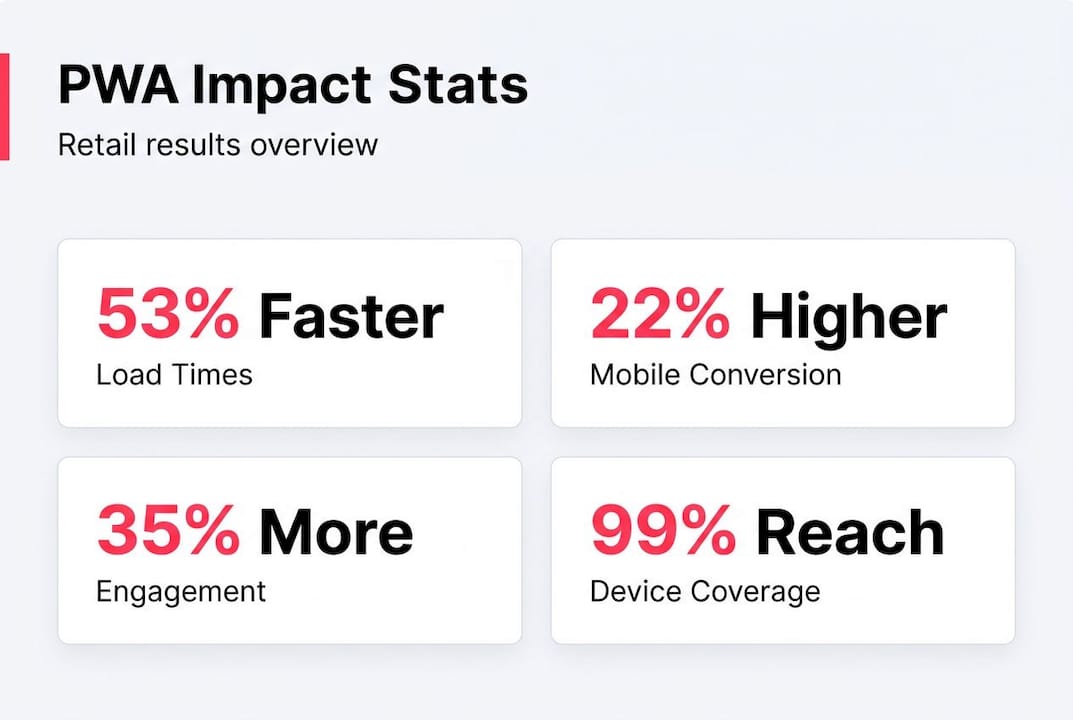
The data backs this up. PWA adoption in retail drives faster load times, improved conversion rates, and stronger mobile engagement across multiple sectors. More specifically, PWAs can reduce bounce rates by up to 42% in eCommerce. That is not a marginal gain. For a site doing meaningful traffic, a 42% reduction in bounces translates directly into revenue.
Pro Tip: You can spot a PWA in the wild by looking for the “Add to home screen” prompt in your browser address bar, or by checking whether the site loads content when you disconnect from the internet. If it does, you’re likely looking at a PWA.
Key benefits of PWA eCommerce for UK retailers
By laying out the differences, we can better appreciate exactly how PWAs create value for retailers. Let’s walk through the five headline benefits in order of commercial impact.
-
Higher conversion rates. Faster load times reduce the chance of a customer abandoning before they’ve even seen your product. Adopting a PWA can lead to notable improvements in conversion, speed, and responsiveness, and that directly affects your bottom line on every traffic campaign you run.
-
Dramatically faster page loads. Service workers cache critical assets so returning visitors experience near-instant page loads. For a mobile shopper on a commute or in a queue, speed is the difference between a completed purchase and a closed tab.
-
Offline and low-connectivity access. In the UK, patchy 4G coverage is still a reality in rural areas and underground transport networks. A PWA serves cached content when the connection drops, keeping the customer engaged and allowing them to complete a purchase once connectivity returns.
-
Lower long-term maintenance overhead. One codebase for web, iOS, and Android is simply more efficient. Your development team spends less time on platform-specific bug fixes and more time improving the shopping experience. This is a meaningful operational saving for any retailer running a lean digital team.
-
Re-engagement through push notifications. Bounce rates on retail sites dropped by over 42% post-PWA adoption in documented cases, and push notifications are a significant driver of that improvement. Abandoned basket reminders, flash sale alerts, and back-in-stock notifications all become possible without requiring an app install.
For UK retailers in particular, the mobile-first argument is compelling. The majority of eCommerce browsing in the UK now happens on smartphones. If your current site is slow, clunky on mobile, or fails to keep customers coming back, you’re leaving money on the table. PWAs directly address all three of those problems.
It’s also worth reassuring you that PWAs integrate well with existing eCommerce platforms. Whether you’re running Magento or Shopify, there are proven technical pathways to layer PWA capabilities onto your existing stack without starting from scratch.

What features should a PWA eCommerce site include?
Understanding the ‘why’ helps, but knowing exactly ‘what’ to include is crucial for successful PWA adoption. Not every PWA feature delivers equal ROI, so it pays to prioritise carefully.
| Feature | User benefit | Business benefit |
|---|---|---|
| Offline mode | Browse and shop without connectivity | Captures low-connectivity customers |
| Push notifications | Timely, relevant alerts | Drives repeat visits and re-engagement |
| Add to home screen | One-tap access to your store | Higher repeat visit rate |
| Seamless checkout | Fast, frictionless purchasing | Reduced basket abandonment |
| Responsive performance | Fast load on any device | Improved conversion and lower bounce |
| Device camera access | Product scanning, AR try-on | Enhanced product interaction |
| Background sync | Orders queue and submit when online | Fewer failed transactions |
Best practice is to prioritise PWA features such as offline functionality, push notifications, and lightning-fast checkout for eCommerce. These three alone account for the majority of measurable commercial uplift in PWA adoption case studies.
It’s also important to think about retail website UX features holistically. A PWA that loads quickly but has a confusing navigation or a broken checkout flow will not convert. The technology enables better UX — it doesn’t replace the design thinking required to achieve it.
Pitfalls to avoid during a PWA rollout:
- Treating it as a purely technical project. PWA success requires UX, design, and development working in alignment from day one.
- Ignoring browser compatibility. While PWA support has improved significantly, some features behave differently across Safari, Chrome, and Firefox. Test thoroughly.
- Overloading push notifications. Customers opt out fast when notifications become spam. Frequency and relevance matter enormously.
- Neglecting performance monitoring post-launch. A PWA that degrades over time as content grows is a missed opportunity. Set up real-user monitoring from the start.
- Skipping the pilot phase. Rolling out to your full customer base before validating with a segment is a high-risk approach.
How to get started with PWA eCommerce: Steps for UK retailers
With features prioritised, it’s time for action. Here’s how to start your PWA journey as a UK retailer.
-
Define your business objectives. What specific problem are you solving? Slow mobile load times, high bounce rates, poor re-engagement, or something else? Clear goals shape every subsequent decision. Successful PWA adoption starts by identifying business objectives and evaluating technical readiness.
-
Audit your current tech stack. Understand whether your eCommerce platform supports PWA features natively or through extensions. Magento and Shopify both have established PWA pathways. Check your hosting environment, HTTPS configuration, and current performance baseline using tools like Google Lighthouse.
-
Engage a specialist development partner. PWA development requires specific expertise across service workers, web app manifests, and platform integration. This is not a project to crowdsource from a general web development team unfamiliar with eCommerce performance requirements.
-
Build a minimum viable PWA. Start with the highest-impact features: offline caching, add-to-home-screen, and fast checkout. A focused MVP is easier to test, faster to launch, and less risky than a full-featured rollout.
-
Pilot with a segment of your customers. Use A/B testing or a phased rollout to compare the PWA experience against your existing site. Measure bounce rate, session duration, conversion rate, and average order value.
-
Gather data and iterate. A PWA is not a one-time project. Use real-user monitoring and customer feedback to identify friction points and improve continuously. Optimise your eCommerce store as an ongoing discipline, not a launch activity.
Pro Tip: One of the most common implementation mistakes we see is launching a PWA without briefing your customer service team. When customers ask why your site now offers a home screen install option, or why it works differently in their browser, your team needs to be ready with clear answers. Internal communications are as important as the technical rollout.
A new era for UK eCommerce: What most guides miss about PWAs
After mapping out your action plan, let’s share a frank perspective on what really determines PWA success in eCommerce. Most articles focus almost entirely on the technical spec — service workers, manifests, Lighthouse scores. Important, yes. But in our experience, that’s rarely what separates a successful PWA rollout from a disappointing one.
The retailers who genuinely benefit from benefits of progressive web apps are the ones who treat PWA adoption as a mindset shift, not a technology upgrade. They ask different questions from the start: How does our brand feel on a small screen? Does the offline experience reflect our standards? Are we using push notifications to add value or just to chase clicks?
Brand consistency is quietly one of the biggest differentiators in PWA UX. When a customer installs your store on their home screen, they’re extending a meaningful degree of trust. The experience they get from that icon needs to feel as polished and intentional as your main website. Corners cut in the PWA layer become visible quickly, and they erode exactly the trust you’ve worked to build.
Then there’s staff education. We’ve seen technically excellent PWA builds underperform because nobody internally understood how to communicate the new experience to customers. When a shopper asks a customer service agent why the site looks different or how to install it, a blank response damages confidence. Training your team to champion the new experience is not optional — it’s part of the rollout.
The broader point is this: PWAs reward retailers who lead rather than follow. The technology is mature enough to deploy with confidence. The question is whether you’re willing to commit to the full picture, not just the code.
Bringing PWA eCommerce to your store: Expert help for UK retailers
You understand the value and practicalities of PWA eCommerce — here’s where to get expert help implementing it.
At Big Eye Deers, we’ve spent over 17 years building high-performing online stores for growing and enterprise UK retailers. We know that moving to a PWA isn’t simply a technical decision — it involves UX, design, platform architecture, and commercial strategy working together from the outset. Our team uses Figma to map user journeys before a single line of code is written, ensuring every PWA feature is grounded in real customer behaviour and business goals.

Whether you’re on Magento or Shopify, we can assess your current platform and build a PWA roadmap that fits your specific situation. Explore our PWA eCommerce solutions for a full overview, or take a closer look at our Shopify PWA development and Magento web design services to see how we approach PWA builds within each platform. We’d be happy to have a frank conversation about what’s realistic for your store, your budget, and your timeline — no sales pressure, just practical advice.
Frequently asked questions
How much does it cost to develop a PWA for an eCommerce store?
Costs vary based on features and integration needs, but initial PWA development is often more affordable than building and maintaining separate native apps for iOS and Android alongside a website.
Can my existing website be upgraded to a PWA?
Most modern eCommerce sites can be progressively enhanced to support PWA features with the right technical approach, as most eCommerce sites are well-suited to PWA adoption.
Will a PWA eCommerce site work on all devices?
Yes, PWAs are compatible with most modern devices and browsers, including desktops and mobiles, though some advanced features vary slightly across Safari and Chrome.
Is a PWA better than a native app for mobile shopping?
For many UK retailers, PWAs provide superior speed and usability compared to native apps, with significantly lower maintenance costs and no app store dependency.
How quickly can I launch a PWA for my store?
Some eCommerce businesses pilot basic PWA features within a few weeks, but realistic timelines depend on your platform, the scope of features required, and integration complexity.
Recommended



Adobe Commerce (Magento)
Formerly known as Magento, Adobe Commerce is built for complex catalogues, integrations, and long term growth. We design and develop stable, scalable stores that support demanding eCommerce requirements, including multi-store setups, complex pricing, and Hyva based performance improvements.

Bespoke Build
We design and build custom eCommerce platforms for businesses with complex workflows, integrations, or non standard requirements. Built from scratch around your business needs using Laravel and modern architectures.

Working with brands across the UK from our offices in Cardiff and Exeter, you deal directly with a senior team of designers and developers specialising in Shopify, Magento, WordPress and bespoke eCommerce platforms.
We focus on commercial outcomes. Better conversion rates, strong SEO foundations and eCommerce platforms that continue to improve long after launch.