Progressive web apps: 42% bounce rate drop for e-commerce
TL;DR:
- PWAs load 2-3 times faster and reduce bounce rates by up to 42 percent.
- They offer offline access, home screen installation, push notifications, and app-like experiences.
- Implementing PWAs requires careful planning, especially for iOS limitations and analytics integration.
PWAs can reduce bounce rates by up to 42% and load two to three times faster than traditional sites. If your online store is haemorrhaging visitors before they reach the checkout, that single statistic should stop you in your tracks. Progressive web apps are no longer a niche technology reserved for Silicon Valley giants. They are a practical, proven upgrade that e-commerce managers across the UK are actively exploring right now. This guide explains what PWAs are, what they genuinely deliver, and what you need to consider before committing to one for your store.
Table of Contents
- What is a progressive web app?
- Faster loading and improved retention
- Enhanced user experience: engaging features in practice
- Limitations and implementation considerations
- Why the next generation of e-commerce is built on PWA principles
- Take your store further with expert PWA support
- Frequently asked questions
Key Takeaways
| Point | Details |
|---|---|
| Supercharged loading speed | PWAs load two to three times faster than typical sites, helping keep shoppers engaged. |
| Bounce rates tumble | Adopting PWAs can reduce bounce rates by up to 42%, maximising your site’s visitor retention. |
| Enhanced engagement | Features like offline access and push notifications make shopping more seamless and repeat visits more likely. |
| Platform considerations | iOS devices have some limitations, so weigh feature needs before rolling out a PWA. |
What is a progressive web app?
A progressive web app is a website that behaves like a native mobile app. It runs in a browser but feels fast, reliable, and immersive in a way that standard mobile-optimised sites rarely achieve. Think of it as the best of both worlds: the reach of the web combined with the experience of an app, without asking your customers to visit an app store.
For e-commerce, this matters enormously. Shoppers are impatient. Any friction in the browsing or checkout journey costs you sales. Progressive Web Apps for eCommerce address that friction at a technical level, and the results are tangible.
Here are the core features that define a PWA:
- Offline access: PWAs use service workers for caching, meaning pages load even on poor connections or offline.
- Fast loading: Cached assets mean repeat visits are near-instant, even on slower networks.
- Push notifications: You can re-engage customers with timely, relevant messages, just like a native app.
- Home screen installation: Users can add your store to their phone’s home screen without an app store download.
- Responsive and secure: PWAs are served over HTTPS and adapt to any screen size.
How does this differ from a standard mobile site? A mobile-optimised website simply resizes your content. A PWA actively caches resources, runs background processes, and delivers a genuinely app-like experience. It also differs from a native app because there is no separate codebase to maintain and no app store approval process to navigate. That simplicity is one of the reasons mobile eCommerce redefined by PWA technology is gaining serious traction with ambitious retailers.
Faster loading and improved retention
Once you understand how PWAs work under the bonnet, the performance numbers start to make sense. Service workers act as a programmable network proxy sitting between your store and the user’s browser. They intercept requests, serve cached content instantly, and only fetch fresh data from the server when necessary.
The result? PWAs load 2-3x faster than traditional websites on repeat visits and can reduce bounce rates by 35 to 42%. That is not a marginal improvement. For a store doing meaningful traffic, shaving seconds off load time can translate directly into revenue.
Speed is not a luxury feature. It is a conversion lever. Every additional second of load time increases the probability your visitor leaves before buying.
The benchmarks for e-commerce PWAs consistently show speed and conversion lifts across different sectors and store sizes. These are not cherry-picked case studies. They reflect what happens when you remove the technical friction between a shopper and a product.
Here is what the retention improvements look like in practice:
- Lower bounce rates: Visitors who land on a fast-loading page are far more likely to explore further.
- Longer sessions: Smooth navigation encourages browsing, which increases basket size.
- Higher return visit rates: The home screen install feature brings customers back without relying on paid channels.
- Improved conversion: Faster Time to Interactive (TTI) means the checkout is usable sooner, reducing drop-off.
Pro Tip: Pair your PWA rollout with solid responsive design in ecommerce practices. Speed gains from a PWA are amplified when your underlying design is already optimised for mobile viewports. Do not treat them as separate workstreams.
The PWA benefits for online stores extend beyond raw speed. Customers who experience a seamless, app-quality journey associate that quality with your brand. That trust is hard to quantify but very real in its commercial impact.

Enhanced user experience: engaging features in practice
Speed is the headline, but the user experience improvements go deeper. PWAs give you a toolkit of engagement features that were previously only available to businesses investing in full native app development.
Here is how a typical PWA checkout journey looks for a customer:
- The customer visits your store on mobile and is prompted to add it to their home screen.
- On their next visit, they tap the icon and the store opens full-screen, with no browser chrome, in under a second.
- They browse the catalogue offline on the train, with previously visited pages loading from cache.
- They receive a push notification about a limited-time offer and return to complete their purchase.
- The checkout loads instantly and the payment flow completes without interruption.
That is a fundamentally better experience than a standard mobile website. And it is one that effective eCommerce web design can deliver without the overhead of a native app.
Here is how the three approaches compare:
| Feature | Mobile website | Native app | PWA |
|---|---|---|---|
| Offline access | No | Yes | Yes |
| Home screen install | No | Yes | Yes |
| Push notifications | No | Yes | Partial (iOS limits) |
| App store required | No | Yes | No |
| Single codebase | Yes | No | Yes |
| Discoverability via search | Yes | No | Yes |
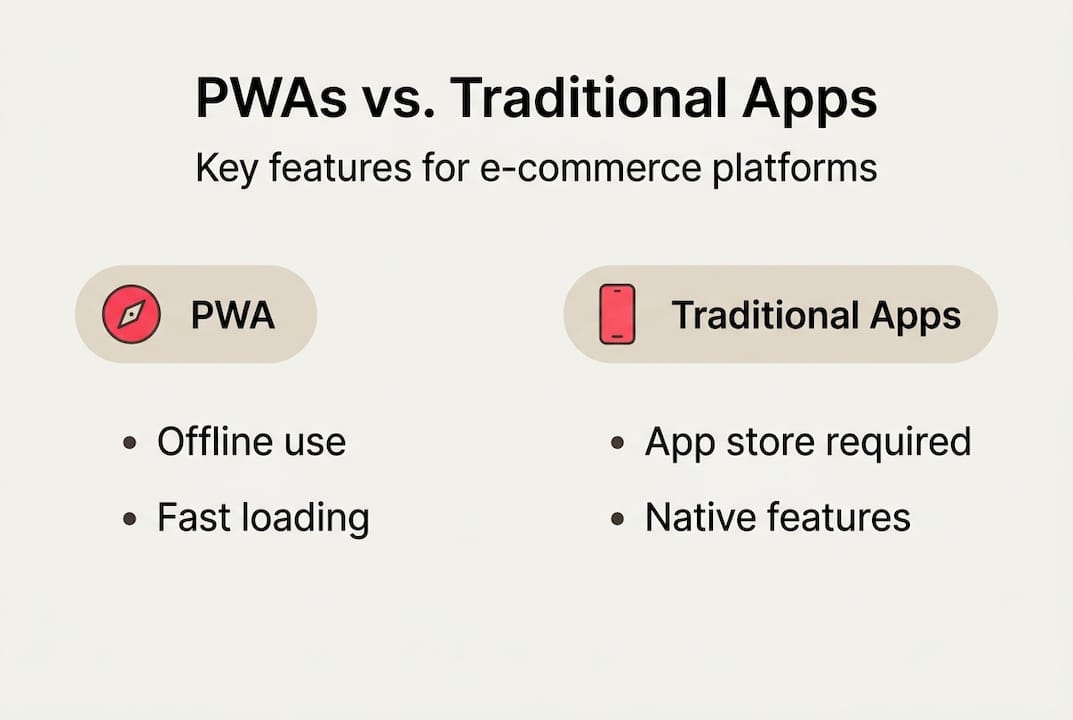
One important nuance: iOS has historically lagged behind Android in PWA support. PWA features are limited on iOS, particularly around background sync and push notifications, which were only introduced for iOS 16.4 and above. If a significant portion of your audience is on older iPhones, this is worth factoring into your expectations. That said, responsive design essentials still apply across all devices, and the core speed and install benefits remain strong even on iOS.
Limitations and implementation considerations
To make an informed decision, you need to look at the full picture. PWAs are a strong upgrade for most stores, but they are not without constraints.
The iOS situation deserves its own breakdown. iOS Safari limitations include a 50MB storage cap, no background sync, manual installation required (no native prompt), and push notifications only available on iOS 16.4 and above. Android, by contrast, supports the full PWA feature set with active install prompts and unrestricted push.
| Feature | Android | iOS |
|---|---|---|
| Install prompt | Automatic | Manual only |
| Push notifications | Full support | iOS 16.4+ only |
| Background sync | Yes | No |
| Storage cap | No fixed cap | 50MB limit |
| Offline caching | Full | Partial |
Beyond device limitations, there are implementation considerations to plan for:
- Analytics integration: Your existing tracking setup needs to account for PWA-specific behaviour, including offline sessions and service worker activity.
- Change management: Your team needs to understand how the PWA behaves differently from the existing site, particularly around caching and content updates.
- Platform compatibility: Not all e-commerce platforms support PWA out of the box. Magento and Shopify both have pathways, but configuration varies.
Pro Tip: Before you launch, benchmark your current TTI (Time to Interactive) and bounce rate. Tracking TTI improvements and bounce reduction is essential when assessing PWA ROI. Without a baseline, you cannot prove the value of the investment.
A PWA is not a silver bullet. It is a meaningful performance upgrade that rewards stores with strong fundamentals. If your underlying architecture is slow or your UX is poor, a PWA layer will not fix those problems on its own.
For Magento stores in particular, optimising store speed through the right frontend architecture is a critical first step before any PWA implementation.
Why the next generation of e-commerce is built on PWA principles
Here is our honest take: the term “progressive web app” may eventually become less fashionable. Technology labels come and go. But the principles underneath it, speed, reliability, offline resilience, and progressive enhancement, are not going anywhere. They reflect something fundamental about how shoppers behave.
We see brands make the mistake of treating PWA as a box to tick. They implement the technical requirements, declare success, and move on. That misses the point entirely. The stores that will win over the next decade are the ones that genuinely obsess over the customer experience at every touchpoint. A PWA done well is an expression of that obsession.
The modern e-commerce platform conversation has shifted. It is no longer enough to have a site that works on mobile. Customers expect instant, frictionless, app-quality experiences as the baseline. PWA principles are how you deliver that without the cost and complexity of native app development. Focus on the customer benefit, not the acronym.
Take your store further with expert PWA support
PWAs can genuinely transform the performance and experience of your online store. But getting the implementation right, from service worker configuration to analytics integration and platform compatibility, takes expertise that goes beyond a standard web build.

At Big Eye Deers, we bring over 17 years of e-commerce experience to every project. Our team specialises in PWA e-commerce expertise alongside full Magento and Shopify builds, so we understand how PWA fits into a broader performance and growth strategy. Whether you need Magento web design support or a complete PWA rollout, we can help you plan and deliver it properly. Talk to the PWA agency experts at Big Eye Deers and find out what a well-executed PWA could do for your store.
Frequently asked questions
Do progressive web apps work on all devices?
PWAs work on most modern browsers, but iOS Safari limitations mean features like background sync and push notifications are restricted or unavailable on older Apple devices. Android offers the most complete PWA experience.
Are PWAs expensive to implement for small shops?
PWA costs are typically lower than native app development because a single codebase serves all platforms. Many e-commerce platforms, including Magento and Shopify, support PWA integrations that can be scoped to suit smaller budgets.
What analytics should I track after going PWA?
Prioritise bounce rate, TTI and bounce reduction, and conversion rate. These three metrics give you the clearest picture of whether your PWA investment is delivering measurable commercial return.
Can my store appear on customer home screens like a mobile app?
Yes. PWAs allow users to install your store directly to their home screen, giving them a full-screen, app-like experience without visiting an app store. On Android, users receive an automatic install prompt.
Recommended
- Progressive Web Apps for eCommerce • Bigeyedeers.co.uk
- BED Blog: How to boost site conversion rate | Bigeyedeers.co.uk
- eCommerce Urgency to Increase Conversions | eCommerce Specialists
- Responsive Design and Ecommerce – Boosting Store Performance
- Playable Ads In Ecommerce – playablemaker.com Playable Ads In Ecommerce



Adobe Commerce (Magento)
Formerly known as Magento, Adobe Commerce is built for complex catalogues, integrations, and long term growth. We design and develop stable, scalable stores that support demanding eCommerce requirements, including multi-store setups, complex pricing, and Hyva based performance improvements.

Bespoke Build
We design and build custom eCommerce platforms for businesses with complex workflows, integrations, or non standard requirements. Built from scratch around your business needs using Laravel and modern architectures.

Working with brands across the UK from our offices in Cardiff and Exeter, you deal directly with a senior team of designers and developers specialising in Shopify, Magento, WordPress and bespoke eCommerce platforms.
We focus on commercial outcomes. Better conversion rates, strong SEO foundations and eCommerce platforms that continue to improve long after launch.