How to Audit Ecommerce Website for Performance and Security

Many Ecommerce managers know the frustration of discovering unnoticed security gaps or sluggish performance just as peak trading hits. For British retail brands using Magento or Shopify, these issues can lead not only to lost revenue but also to regulatory headaches and unhappy customers. A detailed audit that covers everything from third-party integration governance to accessibility and site speed offers a practical route to stronger protection and reliable platform efficiency.
Table of Contents
- Step 1: Assess Platform Setup And Integrations
- Step 2: Evaluate User Experience And Accessibility
- Step 3: Analyse Site Speed And Technical Performance
- Step 4: Review Security And Pci Compliance Measures
- Step 5: Test Conversion And Product Discovery Flows
- Step 6: Verify Audit Outcomes And Plan Improvements
Quick Summary
| Key Point | Explanation |
|---|---|
| 1. Regular Integration Audits are Vital | Conduct quarterly reviews of platform integrations to identify security risks and performance issues early. |
| 2. Accessibility Must be a Priority | Ensure your website meets WCAG standards through thorough testing, focusing on diverse user needs and experiences. |
| 3. Optimise Site Performance Metrics | Monitor key performance indicators regularly to improve user experience and technical efficiency on your website. |
| 4. Ensure Ongoing PCI Compliance | Implement continuous security measures and conduct annual assessments to safeguard customer payment data effectively. |
| 5. Actionable Audit Recommendations | Systematically document audit findings and create a clear action plan with timelines to improve platform performance. |
Step 1: Assess platform setup and integrations
Your e-commerce platform’s performance and security depend heavily on how well its various systems and third-party integrations are configured. This step involves systematically reviewing your current platform architecture to identify potential vulnerabilities, performance bottlenecks, and compliance risks.
Begin by mapping out every external integration connected to your e-commerce platform. This includes payment gateways, analytics tools, customer relationship management (CRM) systems, inventory management platforms, and marketing automation services. We recommend creating a comprehensive spreadsheet that documents:
- Integration name
- Vendor/provider
- Connection method (REST API, webhook, direct plugin)
- Last security audit date
- Current access permissions
- Data exchange frequency
As you conduct this audit, pay special attention to third-party integration governance processes, which are critical for maintaining platform security. Look for potential risks such as overly permissive API access, outdated authentication methods, or integrations with unverified vendors.
Critical insight: Not all integrations are created equal. Each connection represents a potential security gateway into your e-commerce ecosystem.
Evaluate each integration’s performance impact by monitoring response times, resource consumption, and potential latency issues. Some third-party services can significantly slow down your website, negatively affecting user experience and conversion rates.
Another crucial consideration involves understanding how these integrations align with platform accounting standards. Web development cost recognition standards provide guidelines for evaluating the economic contribution of your digital infrastructure.
Top professional recommendation: Always maintain a quarterly review schedule for all platform integrations, checking security certificates, performance metrics, and vendor compliance standards.
Here is a summary of critical integration audit criteria and their business impact:
| Audit Criterion | Description | Business Impact |
|---|---|---|
| Security Certificate Validity | Ensures data transfer is encrypted | Reduces fraud risk |
| Performance Metrics | Monitors resource consumption | Maintains fast user experience |
| Vendor Compliance Standards | Checks adherence to regulations | Prevents legal liabilities |
| Quarterly Review Schedule | Regularly evaluates all integrations | Identifies issues early |
Step 2: Evaluate user experience and accessibility
Evaluating user experience and accessibility is crucial for creating an inclusive, high-performing e-commerce platform that serves all potential customers. This step involves a comprehensive assessment of your website’s usability, design, and functional compatibility across different devices and user capabilities.
Start by conducting systematic accessibility testing which goes beyond automated checks. Your evaluation should include multiple critical dimensions:
- Keyboard navigation functionality
- Screen reader compatibility
- Colour contrast and visual readability
- Form input and error message clarity
- Responsive design across mobile and desktop platforms
- Alternative text for images
Pay particular attention to key interaction points such as product pages, checkout processes, and account management sections. These areas require the most rigorous accessibility review to ensure smooth user journeys for everyone, including users with disabilities.
Critical insight: Accessibility is not a checkbox exercise but a fundamental aspect of inclusive digital design.
Implement comprehensive testing protocols that combine accessibility audit guidance with real-world user testing. This means not just using automated tools but also conducting manual reviews and potentially engaging users with diverse abilities to provide genuine feedback.
Ensure your platform meets Web Content Accessibility Guidelines (WCAG) standards, focusing on perceivability, operability, understandability, and robustness. This holistic approach will help you identify and rectify potential barriers in user experience.
Professional recommendation: Conduct accessibility testing quarterly and maintain a dedicated accessibility review log to track improvements and potential issues continuously.
Compare key accessibility standards vital for inclusive e-commerce success:
| Standard Dimension | What It Ensures | Impact on Users |
|---|---|---|
| Perceivability | Content is recognisable | Supports visually impaired |
| Operability | Navigable interface | Benefits mobility impaired |
| Understandability | Clear, simple instructions | Reduces user confusion |
| Robustness | Compatibility across tools | Enables assistive tech use |
Step 3: Analyse site speed and technical performance
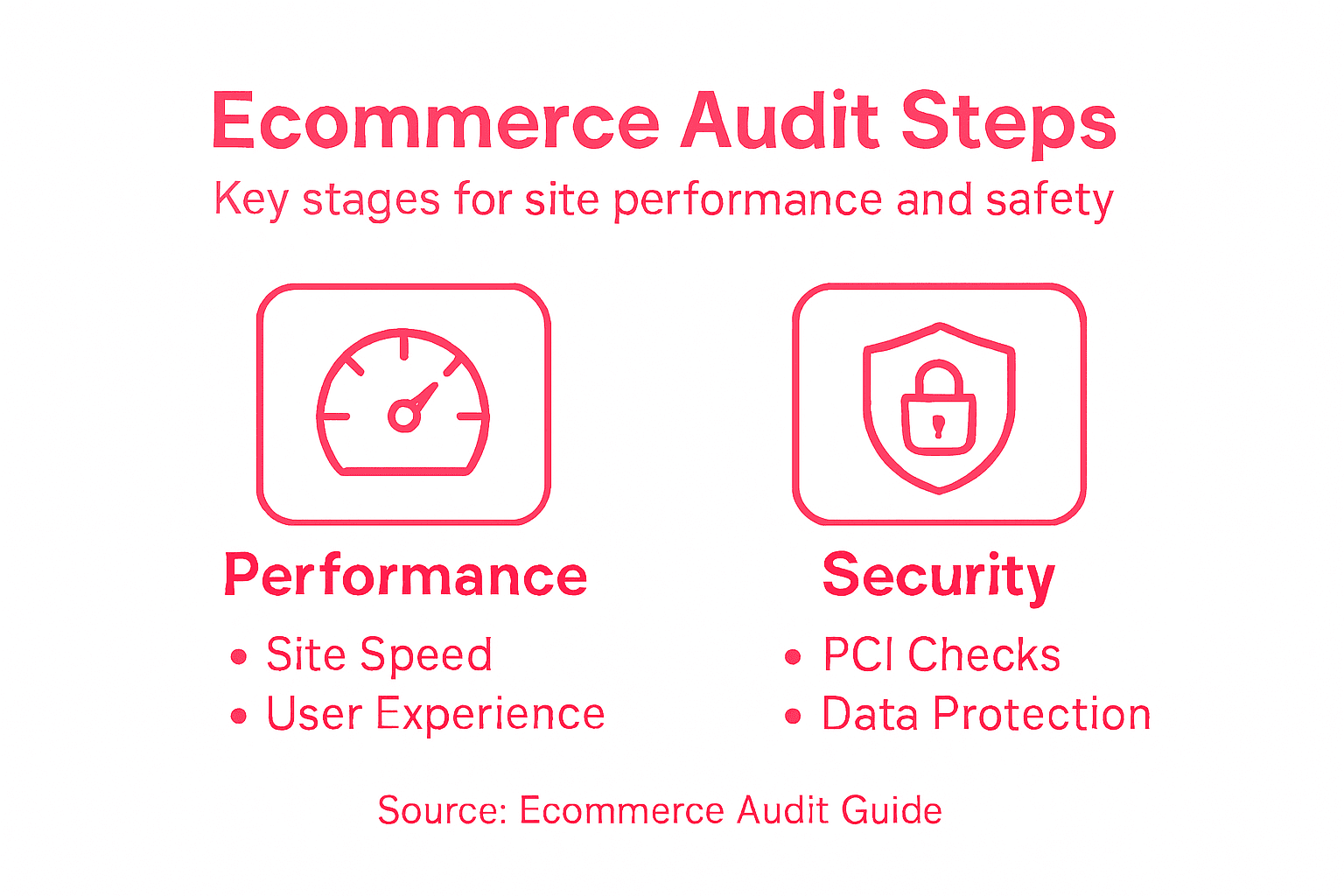
Analysing your e-commerce website’s performance is crucial for maintaining a competitive online presence and ensuring optimal user experience. This comprehensive assessment will help you identify and resolve technical bottlenecks that could be silently undermining your site’s effectiveness.
Begin by leveraging comprehensive web performance metrics that go beyond simple load times. Your technical performance evaluation should encompass multiple critical dimensions:
- Page load speed across different devices
- Server response times
- Resource consumption and efficiency
- Client-side rendering performance
- Network request optimisation
- JavaScript execution times
Utilise professional performance analysis tools to conduct a thorough diagnostic assessment. These tools will help you pinpoint exact areas where your website might be experiencing technical limitations, such as unoptimised images, excessive JavaScript, or inefficient database queries.
Critical insight: Performance is not just about speed – it’s about creating a seamless, responsive user experience.
Implement a systematic website audit approach that examines both objective metrics and perceived performance. This means looking beyond raw numbers and understanding how technical performance translates to real-world user interactions.
Focus on key performance indicators like First Contentful Paint, Time to Interactive, and Total Blocking Time. These metrics provide a holistic view of your website’s technical health and user experience quality.

Professional recommendation: Schedule monthly performance audits and set up continuous monitoring to catch and resolve technical issues before they impact user experience.
Step 4: Review security and PCI compliance measures
Reviewing your e-commerce platform’s security and Payment Card Industry (PCI) compliance is a critical step in protecting your business and customer data. This comprehensive assessment will help you identify potential vulnerabilities and ensure you meet the stringent standards required for handling sensitive payment information.
Begin by understanding comprehensive PCI security guidelines that outline specific requirements for protecting cardholder data. Your compliance review should encompass multiple critical security dimensions:
- Network security configurations
- Encryption protocols for data transmission
- Access control and authentication mechanisms
- Vulnerability scanning and penetration testing
- Secure payment gateway integrations
- Regular security patch management
Conduct a thorough security infrastructure assessment that goes beyond basic compliance checklist. This means critically examining every point of potential data exposure, from server configurations to third-party integrations.
Critical insight: PCI compliance is not a one-time event but an ongoing commitment to data protection.
Evaluate your current setup against the latest PCI compliance standards and expectations, paying special attention to key compliance validation requirements. Ensure you have comprehensive documentation of your security practices, including detailed logs of access, changes, and potential security events.
Implement a robust risk management framework that continuously monitors and adapts to emerging security threats. This proactive approach will help you stay ahead of potential vulnerabilities and maintain the highest standards of data protection.
Professional recommendation: Engage an independent PCI compliance assessor annually and maintain a continuous improvement approach to your security infrastructure.
Step 5: Test conversion and product discovery flows
Testing conversion and product discovery flows is fundamental to understanding and optimising your e-commerce platform’s performance. This critical step involves systematically evaluating how potential customers interact with your website, identifying friction points, and ensuring a seamless path from initial product search to final purchase.
Begin by implementing comprehensive e-commerce website testing methodologies, focusing on multiple key interaction points:
- Search functionality accuracy
- Product filtering and sorting mechanisms
- Category navigation clarity
- Product page information completeness
- Add-to-cart process efficiency
- Checkout flow simplicity
Conduct detailed user journey mapping that tracks every potential customer interaction. This means simulating various user scenarios, from casual browsing to deliberate purchasing, and identifying potential barriers or points of confusion.
Critical insight: Conversion optimisation is about removing obstacles, not adding complexity.
Utilise advanced e-commerce tracking and analytics to gather quantitative data on user behaviour. Pay special attention to key performance indicators such as cart abandonment rates, time spent on product pages, and conversion funnel drop-off points.
Implement both automated testing tools and manual user testing to gain comprehensive insights. This multi-layered approach ensures you capture both technical performance and nuanced user experience elements that might not be immediately apparent.
Professional recommendation: Conduct user testing sessions monthly and maintain a continuous improvement log that tracks specific changes and their impact on conversion rates.
Step 6: Verify audit outcomes and plan improvements
Verifying audit outcomes and strategically planning improvements is the critical final stage of your comprehensive e-commerce website audit. This process transforms your findings into actionable insights that will drive continuous performance and security enhancements.
Begin by systematically assessing audit effectiveness, carefully documenting every identified issue and potential improvement opportunity. Your verification process should encompass multiple strategic dimensions:
- Categorising discovered vulnerabilities
- Prioritising remediation efforts
- Establishing clear improvement metrics
- Determining resource requirements
- Creating realistic implementation timelines
- Assigning accountability for each action item
Conduct a comprehensive impact assessment that evaluates the potential risks and benefits of each proposed improvement. This means critically analysing how recommended changes will affect your platform’s overall performance, security, and user experience.
Critical insight: Effective audits are not about finding fault but creating meaningful, sustainable improvements.
Implement a structured approach to audit recommendation tracking that ensures methodical progress monitoring. Create a detailed action plan that includes specific milestones, responsible team members, and expected completion dates.
Ensure your improvement strategy remains flexible and adaptable. Technology and security landscapes evolve rapidly, so your approach should allow for ongoing refinement and quick responses to emerging challenges.
Professional recommendation: Schedule quarterly review sessions to assess the implementation progress of audit recommendations and adjust your strategy based on real-world performance data.
Elevate Your Ecommerce Website’s Performance and Security with Expert Support
Auditing your ecommerce platform for performance and security uncovers critical vulnerabilities and optimisation opportunities that can make or break your business success. From evaluating third-party integration risks to enhancing user experience accessibility and ensuring PCI compliance, each detailed step requires expert attention and ongoing monitoring to keep your online store fast, secure, and conversion-ready.

Big Eye Deers specialises in designing and building high-performing, secure online stores tailored to your unique needs. With over 17 years of experience working with Magento, Shopify, and bespoke B2B solutions, we provide comprehensive support including proactive security measures, advanced product discovery, and smooth user journeys planned meticulously with Figma. Discover how we can help you implement the essential audit insights featured in this guide by visiting our ecommerce solutions page today. Take control of your site’s future with trusted expertise and continuous innovation.
Frequently Asked Questions
How can I assess my e-commerce platform’s integrations during an audit?
To assess your e-commerce platform’s integrations, map out all external connections, including payment gateways and marketing tools. Create a spreadsheet documenting integration details such as vendor name and access permissions to identify potential vulnerabilities within the next 30 days.
What performance metrics should I monitor while auditing my e-commerce site?
While auditing your e-commerce site, monitor key performance metrics such as page load speed, server response times, and resource consumption. Prioritise these metrics to optimally improve user experience and aim for a site load time of under three seconds.
How can I ensure my e-commerce website meets accessibility standards?
To ensure your e-commerce website meets accessibility standards, conduct systematic testing that includes keyboard navigation and screen reader compatibility. Implement necessary changes based on the insights gathered and schedule quarterly reviews to maintain compliance.
What steps should I take to review my e-commerce site’s security measures?
To review your e-commerce site’s security measures, assess network security configurations and check encryption protocols for data transmission. Conduct a full security infrastructure assessment every six months to identify vulnerabilities and improve data protection.
How often should I test conversion flows on my e-commerce website?
It is essential to test conversion flows on your e-commerce website at least once a month. This ongoing testing helps pinpoint barriers in the customer journey, ensuring a seamless process from product discovery to checkout, which can potentially reduce cart abandonment rates by 15%.
After completing an audit, what should I do with the findings?
After completing an audit, categorise the discovered issues and prioritise improvement actions. Create an action plan with specific milestones and review progress quarterly to effectively implement changes and measure their impact.
Recommended



Adobe Commerce (Magento)
Formerly known as Magento, Adobe Commerce is built for complex catalogues, integrations, and long term growth. We design and develop stable, scalable stores that support demanding eCommerce requirements, including multi-store setups, complex pricing, and Hyva based performance improvements.

Bespoke Build
We design and build custom eCommerce platforms for businesses with complex workflows, integrations, or non standard requirements. Built from scratch around your business needs using Laravel and modern architectures.

Working with brands across the UK from our offices in Cardiff and Exeter, you deal directly with a senior team of designers and developers specialising in Shopify, Magento, WordPress and bespoke eCommerce platforms.
We focus on commercial outcomes. Better conversion rates, strong SEO foundations and eCommerce platforms that continue to improve long after launch.