More than 60 percent of British B2B retailers now consider digital transformation their biggest challenge as they strive to meet rising customer expectations online. For ecommerce managers working with Magento, the path to higher conversion rates demands more than a basic upgrade. Expert consulting tailored for British businesses helps untangle complex catalogues, streamline account management, and create experiences that drive repeat purchasing—giving your platform a strong competitive advantage.
Table of Contents
- Ecommerce Consulting For B2B Retailers UK
- Magento And Shopify: Choosing Your Platform
- Key Strategies To Elevate User Experience
- Consultant Roles And Project Responsibilities
- Risks, Costs And Avoiding Common Pitfalls
Key Takeaways
| Point | Details |
| Ecommerce Consulting Importance | UK B2B retailers need expert consulting to tackle complex digital transformations and optimise platforms like Magento. |
| Platform Selection | Choosing between Magento and Shopify depends on business size, complexity, and growth projections; assess technical needs carefully. |
| User Experience Focus | Effective ecommerce requires data-driven strategies to enhance user experience, personalising interactions and ensuring seamless navigation. |
| Risk Management | Comprehensive risk audits are essential for identifying vulnerabilities in ecommerce operations, focusing on proactive mitigation strategies. |
Ecommerce consulting for B2B retailers UK
B2B retailers across the United Kingdom face increasingly complex digital transformation challenges, particularly when leveraging platforms like Magento for advanced online commerce strategies. The digital landscape demands sophisticated approaches that go beyond traditional selling models. Cranfield School of Management research highlights that successful B2B ecommerce requires understanding evolving customer journeys and implementing strategic digital solutions.
Specifically for UK businesses, ecommerce consulting provides critical support by addressing key challenges such as complex product catalogues, multi-tier pricing structures, and advanced account management requirements. Professional consulting services can help businesses transform their Magento platforms into robust, scalable solutions that meet sophisticated B2B trading needs. This involves comprehensive strategies including custom catalogue development, integration with enterprise resource planning (ERP) systems, and creating seamless user experiences that support both direct-to-consumer and wholesale trading models.
The most effective ecommerce consulting approaches focus on three fundamental pillars: technological infrastructure, user experience design, and strategic digital transformation. By combining deep technical expertise with a nuanced understanding of UK market dynamics, consultants can help businesses optimise their online platforms for maximum performance. Academic research from Strathpryde University underscores the critical importance of website credibility, information quality, and sophisticated online communication tools in building successful B2B digital experiences.
Pro tip: When selecting an ecommerce consultant, prioritise experts with demonstrable experience in Magento platforms and a proven track record of supporting UK B2B retailers through complex digital transformations.
Magento and Shopify: Choosing your platform
Selecting the right ecommerce platform is a critical decision for UK businesses, with Magento and Shopify emerging as two prominent contenders in the digital marketplace. Comprehensive platform comparisons by Forbes Advisor reveal nuanced differences that can significantly impact a retailer’s online strategy, highlighting the importance of understanding each platform’s unique strengths and limitations.
Magento, now known as Adobe Commerce, offers robust customisation capabilities ideal for complex B2B and enterprise-level operations. Its open-source architecture provides unprecedented flexibility for businesses with sophisticated digital requirements. In contrast, Shopify presents a more streamlined, user-friendly approach that excels in rapid deployment and intuitive design. Detailed platform analysis from Hostinger suggests that smaller UK retailers might find Shopify’s straightforward setup more appealing, while larger organisations with intricate product catalogues and custom integration needs will likely gravitate towards Magento’s comprehensive ecosystem.
The decision between Magento and Shopify ultimately hinges on several critical factors: technical complexity, scalability, budget constraints, and specific business model requirements. Magento’s strength lies in its extensive customisation options, supporting complex pricing structures, multiple storefronts, and advanced inventory management. Shopify, meanwhile, offers superior ease of use and rapid market entry, with a robust app ecosystem that can quickly extend platform functionality. UK businesses must carefully assess their current operational needs and future growth projections to make an informed platform selection.
Pro tip: Conduct a comprehensive audit of your business’s technical requirements, projected growth, and budget before committing to either Magento or Shopify, considering not just current needs but potential future scalability.
Here’s a concise comparison of key strengths for Magento and Shopify in the UK B2B context:
| Platform Characteristic | Magento (Adobe Commerce) | Shopify |
| Customisation Capacity | Extensive, highly flexible | Limited, app-based |
| Scalability | Suits large, complex catalogues | Best for smaller retailers |
| Deployment Time | Longer, requires more setup | Quick and straightforward |
| Integration Options | Deep ERP and custom solutions | Wide app marketplace support |
| Total Cost of Ownership | Higher, bespoke development | Lower, predictable fees |
| UK Market Suitability | Enterprise & complex B2B | Fast-growing small businesses |
Key strategies to elevate user experience
Enhancing user experience in ecommerce requires a sophisticated, data-driven approach that goes beyond traditional website design. Innovative strategies from AI research reveal that successful digital platforms must unify customer data, personalise interactions, and leverage predictive analytics to create truly compelling online experiences.

The core of exceptional user experience lies in understanding and anticipating customer needs through intelligent design and technological integration. This involves creating intuitive navigation systems, optimising site performance, and developing personalised customer journeys that adapt to individual user behaviours. UK-specific ecommerce optimisation research highlights the critical importance of mobile responsiveness, streamlined checkout processes, and rapid page loading speeds as fundamental elements of a superior digital shopping environment.
Practical implementation of user experience strategies demands a multi-dimensional approach. Key focus areas include developing adaptive design frameworks, implementing intelligent search and recommendation systems, and creating seamless cross-device experiences. Businesses must invest in advanced analytics tools that provide deep insights into user interactions, enabling continuous refinement of digital touchpoints. This requires a holistic view of customer engagement, integrating technical performance metrics with nuanced understanding of user preferences and behavioural patterns.
Pro tip: Conduct regular user experience audits using both quantitative analytics and qualitative user feedback to identify and address potential friction points in your digital customer journey.
Consultant roles and project responsibilities
Ecommerce consultants play a pivotal role in transforming digital business strategies, bridging the complex intersection between technology, marketing, and strategic planning. Comprehensive job role analysis reveals that these professionals are responsible for far more than simple technical implementation, encompassing strategic advisory, performance optimization, and cross-functional collaboration.
The core responsibilities of an ecommerce consultant span multiple critical domains. This includes platform selection and integration, particularly for complex systems like Magento, developing comprehensive digital strategies, and conducting in-depth performance analyses. Detailed UK-based research on ecommerce specialist roles underscores the importance of managing online sales operations, executing strategic initiatives, and continuously optimising product listings and user experiences through data-driven insights.
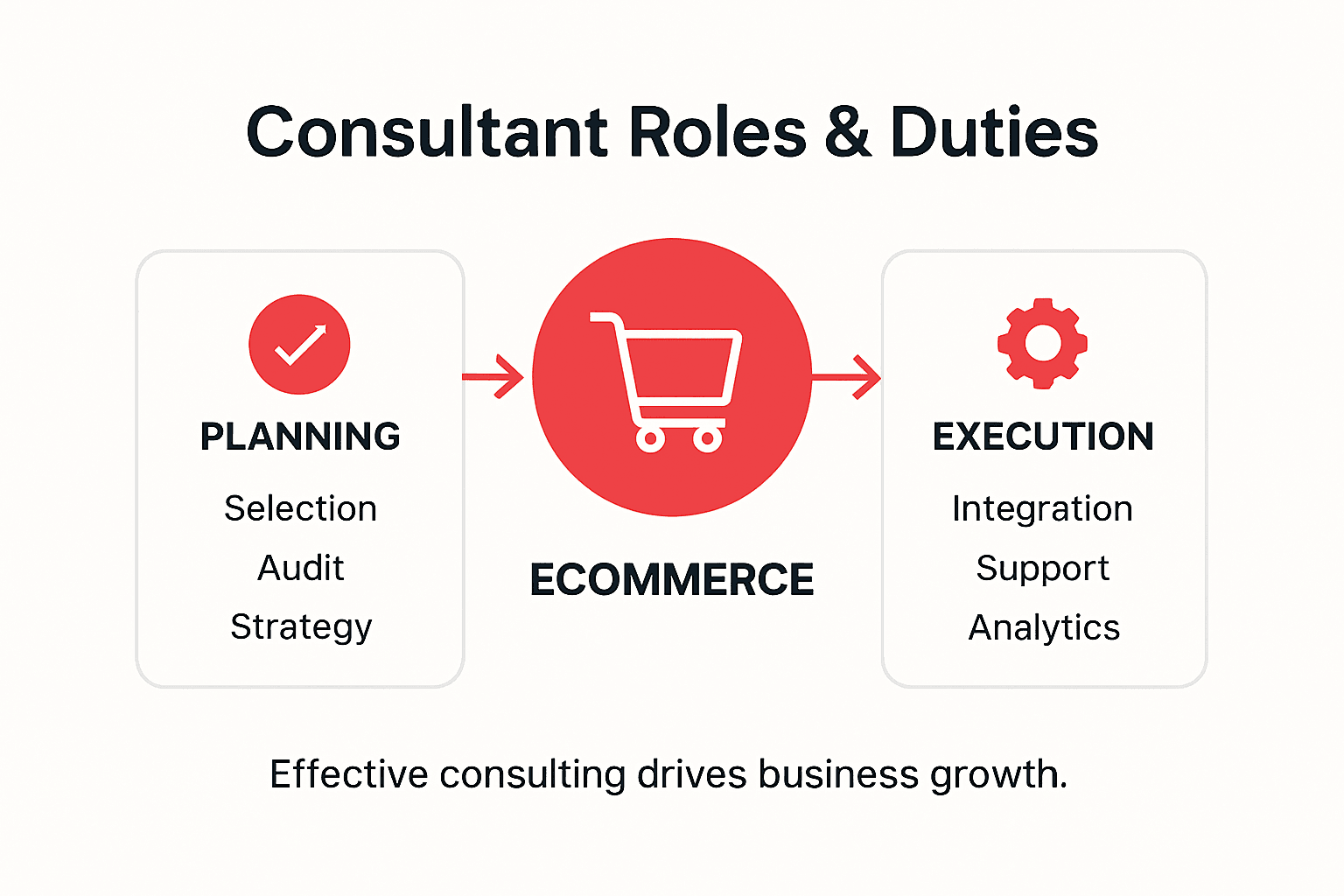
Successful ecommerce consultancy demands a multifaceted skill set that combines technical expertise, strategic thinking, and deep understanding of digital commerce dynamics. Key project responsibilities include conducting thorough platform audits, developing customised digital transformation roadmaps, implementing advanced analytics frameworks, and providing ongoing strategic guidance. Consultants must navigate complex technological ecosystems, working closely with marketing, technical, and leadership teams to align digital capabilities with overarching business objectives and drive sustainable growth.
Pro tip: Maintain a comprehensive portfolio of technical certifications and continuously update your knowledge of emerging ecommerce technologies to remain competitive in this rapidly evolving consulting landscape.
Risks, costs and avoiding common pitfalls
Ecommerce platforms inherently involve complex risk landscapes that demand strategic management and proactive mitigation strategies. Comprehensive academic research on ecommerce risks reveals multiple risk categories that UK businesses must carefully navigate, including environmental uncertainties, operational challenges, perceived customer risks, and intricate reverse logistics complications.
Financial risks represent a critical dimension of ecommerce strategy, with potential detriments extending beyond immediate monetary impacts. OECD analysis of consumer financial risks highlights pervasive challenges such as hidden transaction costs, contractual ambiguities, and product non-conformity that can significantly erode customer trust and organisational reputation. These risks manifest through multiple channels: unexpected shipping charges, unclear return policies, inconsistent product descriptions, and potential data security vulnerabilities.
Effective risk management requires a holistic approach integrating technological safeguards, transparent communication, and robust operational protocols. Successful strategies involve implementing comprehensive security frameworks, maintaining transparent pricing structures, developing clear customer communication channels, and establishing rigorous quality control mechanisms. Businesses must invest in advanced technological solutions that provide real-time risk monitoring, predictive analytics, and adaptive security protocols to mitigate potential threats before they materialise.
For reference, here is a summary of common ecommerce risks faced by UK B2B retailers and typical mitigation strategies:
| Risk Category | Example Challenge | Mitigation Strategy |
| Financial | Hidden transaction costs | Transparent pricing, robust invoicing |
| Operational | Complex returns & logistics | Automated returns and tracking systems |
| Customer Trust | Data security vulnerabilities | Advanced encryption & compliance audits |
| Reputational | Product non-conformity | Rigorous quality checks & detailed listings |
Pro tip: Conduct regular, comprehensive risk audits that systematically evaluate technological, financial, and operational vulnerabilities, ensuring proactive mitigation rather than reactive problem-solving.
Unlock Your Magento Potential with Expert ecommerce Consulting
The journey to mastering Magento for B2B ecommerce in the United Kingdom often presents challenges like complex product catalogues, tiered pricing, and ERP integration. These pain points can slow your digital transformation and hinder business growth. At Big Eye Deers, we understand that delivering a seamless user experience and a scalable platform requires more than technical know-how — it demands strategic insight tailored to UK market dynamics.
With over 17 years of proven expertise, we specialise in transforming Magento platforms to excel at customised catalogues, account hierarchies, multi-store setups and robust B2B ecommerce solutions. By combining thoughtful UX design with performance optimisation and ongoing security monitoring, we help businesses achieve platforms that are not only powerful but built to grow. Discover how our Magento and Shopify solutions can overcome your biggest ecommerce challenges.
Ready to elevate your B2B digital experience and secure long-term success with Magento?

Partner with Big Eye Deers today. Explore how we can craft a tailored ecommerce strategy that drives conversions and supports your unique business model. Visit Big Eye Deers and start transforming your online store now.
Frequently Asked Questions
What are the key benefits of ecommerce consulting for B2B retailers?
Ecommerce consulting helps B2B retailers by providing expertise in digital transformation, optimising their Magento platforms, and addressing challenges such as complex product catalogues and multi-tier pricing structures.
How can I enhance user experience on my Magento site?
Enhancing user experience involves creating intuitive navigation, optimising site performance, and personalising customer journeys. Regular user experience audits and feedback can also help identify areas for improvement.
What factors should I consider when choosing between Magento and Shopify?
Key factors include technical complexity, scalability, budget, and specific business model requirements. Magento offers extensive customisation for larger operations, while Shopify provides a user-friendly experience for smaller businesses.
What common risks do ecommerce platforms face and how can they be mitigated?
Common risks include hidden transaction costs, operational challenges like logistics, and data security vulnerabilities. Mitigation strategies involve transparent pricing, automated returns, and implementing robust security measures.