Cloud Hosting for Ecommerce: Enhanced Security and Growth

Managing a growing B2B retail brand in the United Kingdom often means juggling unpredictable traffic surges and high customer expectations. When your Magento or Shopify store needs to scale rapidly without downtime, traditional physical servers can hold you back. Adopting a subscription-based service that provides networked storage space and computer resources ensures your team accesses data, applications, and store functionality securely from anywhere, while specialists handle security and maintenance behind the scenes. Discover how tailored cloud hosting keeps your online operations agile and robust, ready for every trading challenge.
Table of Contents
- Cloud Hosting For Ecommerce Explained
- Types Of Cloud Hosting For Online Stores
- How Cloud Hosting Supports Scalability And Security
- UK Legal Requirements And Compliance For Cloud Hosting
- Risks, Costs And Common Mistakes To Avoid
- Comparing Cloud Hosting With Traditional Alternatives
Key Takeaways
| Point | Details |
|---|---|
| Flexibility and Scalability | Cloud hosting allows businesses to adjust resources based on actual demand, avoiding costs associated with over-provisioning or under-resourcing during peak times. |
| Enhanced Security | With enterprise-grade security measures and compliance certifications, cloud hosting ensures the protection of sensitive data, which is vital for ecommerce operations. |
| Operational Efficiency | Cloud providers manage infrastructure maintenance and updates, enabling businesses to focus on scaling sales and optimising customer experience rather than handling technical issues. |
| Legal Compliance | Understanding UK regulations like GDPR and PCI DSS is essential when selecting a cloud provider to ensure data protection and compliance responsibilities are met effectively. |
Cloud hosting for ecommerce explained
Cloud hosting is fundamentally different from the physical servers you might imagine sitting in a basement somewhere. Instead of purchasing and maintaining dedicated hardware, you rent computing resources on a pay-as-you-go basis. A subscription-based service that provides networked storage space and computer resources is accessible from anywhere via the Internet, meaning your online store isn’t confined to one physical location. Your data, applications, and store functionality live in data centres managed by specialists who handle security, backups, and infrastructure maintenance. For growing B2B retail brands, this shift transforms how you manage your operations, especially when you’re scaling from handling hundreds of orders to thousands each month.
The real power of cloud hosting lies in its flexibility and scalability. Instead of committing to a fixed amount of server capacity upfront—and then either running out of space during peak trading periods or paying for unused resources during quiet months—cloud hosting lets you scale resources up or down based on your actual demand. Think of Black Friday or Cyber Monday. Your store suddenly experiences a 300% traffic spike. With traditional hosting, this might crash your site. With cloud hosting, your infrastructure automatically adjusts to handle the surge. Cloud computing is defined as a model that enables on-demand network access to computing resources such as networks, servers, storage, and applications. You only pay for what you use, which reduces capital expenditures significantly. For B2B retailers running complex Magento builds with custom catalogues, tiered pricing, and ERP integrations, this operational flexibility is crucial. You’re not locked into paying for peak capacity year-round; instead, your costs align with your actual usage patterns.
Beyond cost efficiency, cloud hosting fundamentally changes your approach to security and reliability. Your ecommerce platform benefits from enterprise-grade infrastructure, redundancy across multiple data centres, and automatic disaster recovery—capabilities that would be prohibitively expensive to build yourself. Cloud providers maintain compliance certifications and security protocols that protect customer payment data and personal information, which is absolutely non-negotiable for UK ecommerce operations. When you’re handling customer data and processing transactions, security isn’t optional. Cloud hosting also simplifies ongoing updates and maintenance. Rather than your team managing server patches and system upgrades, your hosting provider handles these automatically. This is where the distinction between DIY infrastructure and managed solutions becomes critical for growing brands. When you’re focused on converting customers and managing inventory, you shouldn’t be distracted by server maintenance. The cloud approach lets your in-house team concentrate on what matters: growing sales, optimising user experience, and managing your product catalogue, whilst your hosting provider handles the technical backbone.
For retailers running Shopify or Magento platforms specifically, cloud hosting is already embedded in your architecture. Shopify is cloud-native by design. Magento, meanwhile, runs on your chosen hosting infrastructure—and here’s where your decision matters. You can host Magento on traditional servers, but cloud hosting provides the scaling capability and security depth that mature ecommerce operations require. When you’re managing multiple store locations, wholesale and DTC channels, or complex product hierarchies, you need infrastructure that scales with your complexity. A growing UK B2B retailer managing tiered customer accounts, custom pricing rules, and integrated ERP systems will find cloud hosting removes the infrastructure bottleneck. Your platform performance, security posture, and operational costs all improve simultaneously—which rarely happens in business. Understanding your hosting architecture, whether you’re using Shopify’s managed cloud or hosting Magento yourself on cloud infrastructure, directly impacts your ability to implement the security and performance standards your customers expect.
Pro tip: Request detailed specifications from your hosting provider about data centre locations, backup frequency, and disaster recovery procedures before committing—especially if you’re handling international B2B transactions and need compliance across multiple regions.
Types of cloud hosting for online stores
Cloud hosting isn’t one-size-fits-all. Your choice of hosting model depends on how much control you want, your budget constraints, your security requirements, and your growth trajectory. The structure breaks down into two key dimensions: deployment models (how your infrastructure is managed) and service models (what level of control you maintain over the technology stack). Understanding these options is crucial before you commit to a hosting solution, especially when you’re running a complex ecommerce operation handling customer data and processing payments daily.
Let’s start with deployment models. Public cloud is the most common and cost-effective option. Your online store shares infrastructure with other businesses on the hosting provider’s servers. This shared approach keeps costs low because the provider spreads infrastructure expenses across many customers. For growing UK retail brands just launching their first Shopify store or testing a new product line, public cloud works well. You get automatic scaling, minimal management overhead, and predictable monthly costs. However, you share physical resources, which means your neighbours’ traffic spikes theoretically affect your performance (though modern providers isolate workloads effectively). Private cloud gives you dedicated infrastructure exclusively for your business. This costs significantly more but provides enhanced security, complete control over your environment, and guaranteed resource allocation. For B2B retailers handling sensitive wholesale pricing data, customer account hierarchies, and confidential ERP integrations, private cloud often makes sense. You’re not competing with other tenants for resources, and you can implement strict security protocols tailored to your specific needs. Finally, hybrid cloud blends both approaches. You might run sensitive operations on private infrastructure whilst using public cloud for scalable, variable workloads. This flexibility appeals to mature retailers managing multiple store locations and channels simultaneously.
Within each deployment model, you choose your service level. Infrastructure as a Service (IaaS) gives you the most control but the most responsibility. You essentially rent virtual servers, storage, and networking from your provider, then build your environment on top. Magento installations typically run on IaaS because they require flexibility to customise your stack. You manage the operating system, patches, software installation, and security—which demands technical expertise. Platform as a Service (PaaS) abstracts away infrastructure management. You focus on your application code whilst the provider handles servers, databases, security patches, and scaling. This reduces operational burden significantly. Some managed Magento hosting solutions use PaaS principles. Software as a Service (SaaS) is the most hands-off approach. Shopify exemplifies SaaS—you access a fully managed ecommerce platform without managing any infrastructure. You log in, configure your store, and Shopify handles everything else: security, updates, scaling, backups. The trade-off is less customisation flexibility, though modern SaaS platforms are surprisingly customisable through APIs and apps.
Here’s the practical reality for your situation. If you’re running Shopify, you’re already using public cloud SaaS—Shopify manages everything. If you’re running Magento on managed hosting, you’re likely using public cloud PaaS or IaaS with a provider handling some responsibilities. If you’re processing massive B2B volumes with complex integrations and need compliance across multiple regions, you might consider private cloud IaaS where you control everything. The key question isn’t which is “best”—it’s which matches your operational maturity, technical capabilities, and growth stage. A startup needs simplicity and low upfront costs. An enterprise needs control and customisation. Most growing retailers benefit from hybrid approaches, using SaaS for standard functionality whilst leveraging IaaS for custom integrations.
Here is a concise comparison of cloud hosting deployment and service models for ecommerce:
| Model Type | Example Scenario | Control Level | Primary Benefit |
|---|---|---|---|
| Public Cloud (SaaS) | Shopify store launch | Minimal control | Rapid start, low cost |
| Private Cloud (IaaS) | Large B2B retailer, complex data | Maximum control | Custom security, data isolation |
| Hybrid Cloud (PaaS) | Multi-channel retailer | Balanced control | Scalability plus security |
Pro tip: Document your actual traffic patterns, data sensitivity levels, and customisation requirements before evaluating hosting options—this clarity prevents choosing a model that doesn’t match your real needs and avoids costly migrations later.
How cloud hosting supports scalability and security
Scalability and security often feel like opposing forces in ecommerce. Push hard on one and the other suffers. Cloud hosting breaks this pattern. Modern cloud infrastructure enables you to scale your operations dramatically whilst simultaneously strengthening your security posture. This dual capability is what separates cloud hosting from traditional on-premise solutions and why it’s become essential for growing B2B retailers managing complex operations across multiple channels.

Let’s start with scalability. Your ecommerce store experiences unpredictable traffic patterns. A successful marketing campaign drives 500% more traffic than usual. A product goes viral on social media. Black Friday arrives. Traditional hosting forces you to provision infrastructure for peak demand, which means you pay for massive capacity most of the year when it sits idle. Cloud hosting flips this model entirely. Resource pooling and elasticity allow your infrastructure to expand and contract based on real demand. When traffic spikes, additional computing resources automatically provision within minutes. When traffic drops, those resources release and you stop paying for them. You’re not buying a server; you’re buying capacity on-demand. For a growing B2B retailer managing tiered pricing, wholesale orders, and complex product catalogues, this flexibility means your infrastructure costs track your actual business growth rather than your peak theoretical demand. You might scale from handling 1,000 daily transactions to 50,000 daily transactions during peak season without infrastructure becoming a constraint. The platform simply accommodates the load automatically.
Security, meanwhile, receives a comprehensive overhaul in cloud environments. Cloud hosting providers invest heavily in security infrastructure that individual businesses cannot replicate cost-effectively. Multi-layered defences including identity and access management, encryption, and continuous monitoring protect your data and services. Your cloud provider maintains dedicated security teams, implements compliance certifications, and conducts regular vulnerability assessments. For UK ecommerce operations, this means compliance with Payment Card Industry Data Security Standard (PCI DSS) requirements, General Data Protection Regulation (GDPR), and other regulatory standards. Rather than your small team managing these complex requirements alone, you inherit the provider’s expertise and infrastructure. Encryption protects data both in transit (when customers send payment information) and at rest (when data sits in storage). Identity and access management controls precisely who accesses what data and when. Continuous monitoring detects suspicious activity in real-time, triggering automatic responses to threats. This layered approach is more robust than what most individual retailers could build independently. When your cloud provider detects a threat pattern affecting thousands of customers across all their platforms, they issue updates protecting everyone simultaneously. You benefit from collective threat intelligence you wouldn’t have alone.
The magic happens when scalability and security work together. Your platform can handle massive traffic spikes without degrading security. In fact, cloud infrastructure often improves under load because additional resources include additional security monitoring. If a malicious actor attempts to overwhelm your site with traffic (a distributed denial-of-service attack), cloud hosting automatically scales defensive resources to absorb the attack. Traditional hosting simply crashes. Cloud hosting customers running Magento with custom integrations, wholesale account management, and sensitive pricing data can rest knowing that their infrastructure automatically scales to handle growth whilst maintaining strict security controls over that sensitive information. Compliance with regulatory standards and robust network security measures protect you as your business evolves. You’re not choosing between growth and safety; you’re getting both simultaneously.
Pro tip: When evaluating cloud hosting providers, specifically request their security certifications (ISO 27001, SOC 2), their disaster recovery procedures, and their incident response timelines rather than just asking about uptime percentages.
UK legal requirements and compliance for cloud hosting
Running an ecommerce business in the United Kingdom means operating within a specific legal framework that directly impacts your cloud hosting choices. This isn’t bureaucratic overhead to ignore; it’s foundational to protecting your customers, your business, and your ability to trade legally. UK law doesn’t just suggest compliance—it mandates it. From data protection regulations to payment processing standards, your cloud hosting provider must meet strict requirements, and you’re responsible for ensuring they do. Understanding these legal obligations before selecting a hosting provider prevents costly migrations, regulatory penalties, and reputational damage down the line.
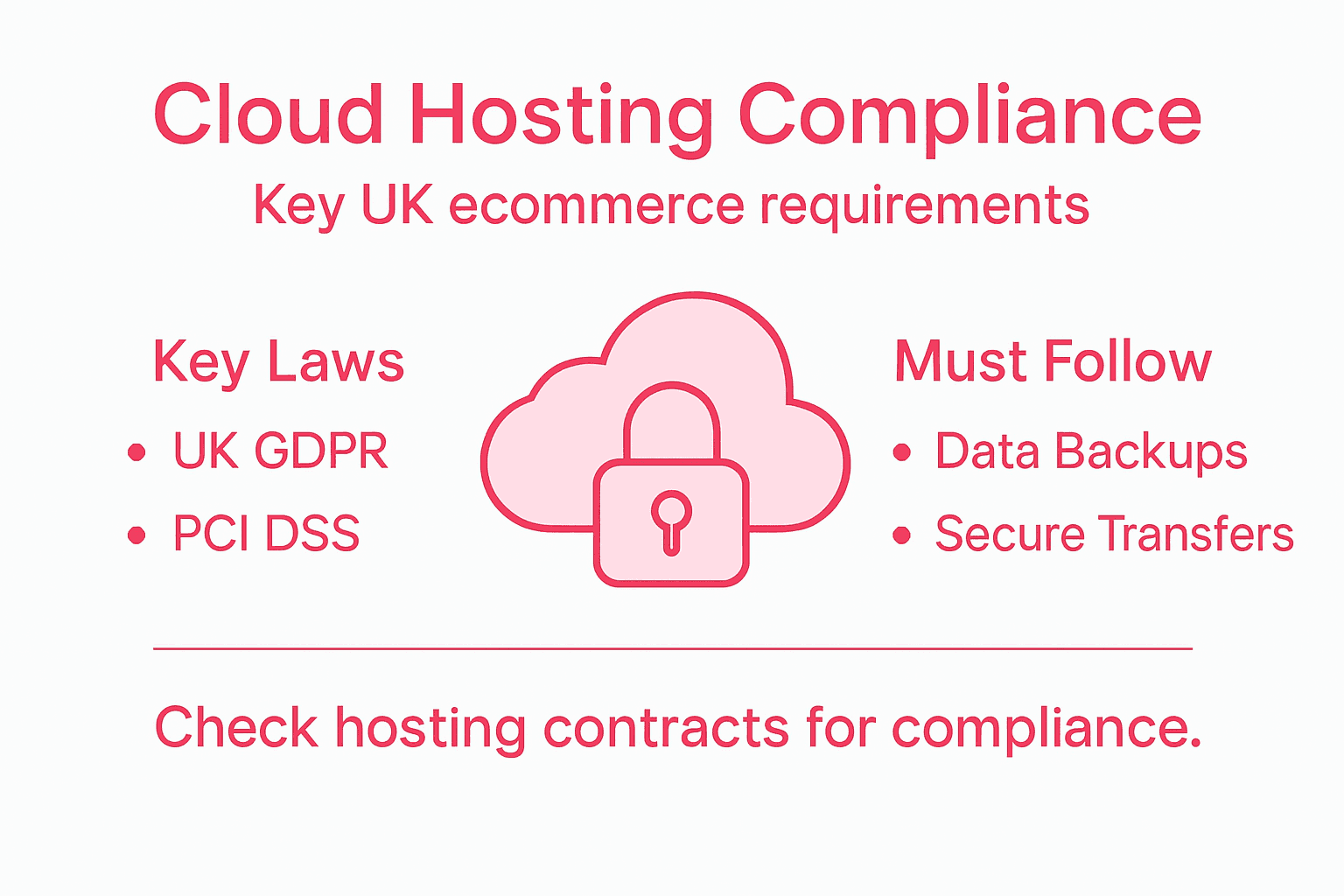
The largest regulatory burden falls under the UK General Data Protection Regulation (UK GDPR) and the Data Protection Act 2018. These laws govern how you collect, store, process, and transfer customer data. When you host your ecommerce store in the cloud, you’re not outsourcing your legal responsibility. You remain the “data controller”—the entity answerable for protecting customer information. Your cloud hosting provider becomes a “data processor” handling data on your behalf. This relationship must be documented in a Data Processing Agreement (DPA) that specifies exactly what data the provider processes, how they process it, where they store it, and how they protect it. Without a proper DPA in place, you’re operating outside the law. Additionally, UK GDPR compliance extends to security obligations, data breach notification, and customer rights that affect every layer of your hosting infrastructure. Your provider must implement technical and organisational measures to prevent unauthorised access, data loss, or corruption. They must notify you of security breaches within specific timeframes so you can notify affected customers. They cannot transfer customer data outside the United Kingdom and European Economic Area without explicit legal mechanisms (Standard Contractual Clauses). For B2B retailers handling wholesale customer data, pricing agreements, and account information, this becomes particularly complex because you’re processing both consumer data and business partner information under slightly different rules.
Beyond GDPR, you must satisfy Payment Card Industry Data Security Standard (PCI DSS) requirements if you process, store, or transmit payment card information. The PCI Council, an industry body representing major card schemes, mandates that payment data receives specific security treatment. If you’re collecting credit card details directly (rather than using a payment gateway like Stripe or PayPal that assumes PCI responsibility), your hosting provider must support PCI DSS Level compliance appropriate to your transaction volume. This includes network segmentation, encryption, regular security assessments, and documented incident response procedures. Most modern ecommerce platforms offload payment processing to specialised providers, which simplifies your PCI obligations considerably, but your hosting infrastructure still needs to support their security requirements. Service level agreements and contractual obligations must clearly address data security, liability limits, subcontracting arrangements, and termination procedures to ensure you maintain legal protection. Your contract should specify exactly what happens to your data if the provider goes out of business, experiences a security breach, or terminates service. Does the provider delete your data immediately? Do they provide a reasonable transition period? Who’s liable if customer data is compromised due to their negligence?
Here’s what often gets overlooked. Your cloud hosting contract’s terms and conditions aren’t just commercial negotiation points—they carry legal weight. If your contract doesn’t address data location, many providers retain the right to migrate your data globally, potentially violating UK GDPR. If liability clauses cap the provider’s responsibility at your monthly subscription fee, that’s worthless protection for a data breach affecting thousands of customers. If the contract permits unlimited subcontracting, you can’t audit who actually handles your data. You need a contract that explicitly commits to UK data residency (or at minimum, European Economic Area residency), defines the security standards they’ll maintain, specifies your audit rights, and establishes reasonable liability limits for security failures. For growing retailers handling sensitive wholesale pricing data and customer account hierarchies, you should insist on contracts that recognise your data controller status and commit to specific technical controls. This isn’t paranoia; it’s legal due diligence that regulators expect you to demonstrate.
Pro tip: Before signing any cloud hosting agreement, have your legal team review the Data Processing Agreement and service level agreement specifically, focusing on data location commitments, security standards, breach notification procedures, and liability clauses rather than just pricing and uptime guarantees.
Risks, costs and common mistakes to avoid
Cloud hosting isn’t a set-and-forget solution. Selecting a cloud provider and deploying your ecommerce platform is just the beginning. What happens next determines whether you experience the benefits of cloud hosting or stumble into expensive pitfalls that drain your budget and compromise your security. Growing B2B retailers often discover these problems the hard way, discovering costly mistakes only after they’ve committed to a provider or after a security incident forces their hand. Understanding the common risks and mistakes beforehand lets you build proper safeguards from day one, protecting both your finances and your customers.
Start with vendor lock-in, perhaps the most underestimated risk in cloud hosting. When you commit to a specific provider and build your infrastructure around their proprietary services, switching becomes technically complex and financially painful. You’ve customised your Magento build to integrate deeply with your provider’s database services, backup systems, and security tools. Moving to a different provider means rewriting integrations, reconfiguring your entire environment, and potentially rebuilding your data architecture. What seemed like a minor convenience at setup time becomes a major liability if your provider increases prices dramatically, changes their service terms unfavourably, or experiences widespread security incidents. You’re stuck. The financial cost of migration often exceeds the cost difference between providers for several years, leaving you trapped. To mitigate this, design your infrastructure with portability in mind from the start. Use standard technologies and APIs rather than provider-specific proprietary solutions. Document your entire configuration so migration isn’t starting from scratch. Negotiate contract terms that provide reasonable notice before major price increases.
Cost management represents another critical vulnerability. Cloud pricing seems transparent initially, but unexpected expenses accumulate rapidly if you’re not monitoring carefully. Data transfer costs, storage overages, increased computing resources during peak periods, backup retention, and security services all add up. A retailer might budget £500 monthly for hosting, then face £2,000 bills during their first peak season because they didn’t anticipate the cost of scaling resources. Worse, many providers structure pricing to encourage overprovisioning. It’s easier to provision excess capacity than to implement proper autoscaling policies, so retailers end up paying for resources they rarely use. Additionally, vendor lock-in, data sovereignty challenges, and security vulnerabilities from misconfiguration create financial risks that extend beyond monthly fees. Prevent cost surprises by implementing detailed cost monitoring from day one. Set budget alerts at 75% of your expected monthly spend. Review your cloud bills weekly, not monthly, so you catch anomalies early. Implement proper autoscaling policies that add resources only when needed, not by default. Request detailed cost breakdowns from your provider so you understand what’s driving expenses.
The security and operational mistakes often prove most damaging. Data breaches frequently result from misconfiguration, inadequate staff training, and insufficient risk assessments in cloud environments. A retailer enables public access to their cloud storage bucket by accident and leaves it exposed for months. Database credentials get hardcoded into application files and committed to version control, exposing them to anyone with repository access. Staff receive no training on handling customer data, so they email sensitive information using personal accounts. Security groups are configured too permissively, allowing unnecessary network access. These aren’t sophisticated attacks; they’re preventable mistakes. Proper access controls, regular security audits, and comprehensive staff awareness programmes eliminate most of these vulnerabilities. Your team needs documented procedures for handling data, clear policies on password management, and regular training on security best practices. Security isn’t a one-time setup; it’s ongoing. Schedule regular audits of your cloud configuration (quarterly minimum), reviewing access permissions, data exposure settings, and network segmentation. Document everything. When something goes wrong, you need audit trails showing who accessed what and when.
Don’t underestimate the importance of proper due diligence before selecting a provider. Ask detailed questions about their security certifications, incident response procedures, data residency commitments, and audit access. Request references from existing customers running similar operations. Review their security incident history and how they’ve responded. Poor provider selection creates problems you’re stuck with for years. Similarly, neglect proper data governance. You need a clear inventory of what data you’re storing where, who accesses it, how long you keep it, and what security controls protect it. Without this clarity, you can’t verify compliance, identify security gaps, or respond effectively to breaches.
Below is a summary of key cost, risk, and operational factors to monitor with cloud hosting:
| Factor | Potential Issue | Mitigation Step |
|---|---|---|
| Vendor Lock-In | Expensive migration, technical debt | Favour open standards, document setup |
| Unexpected Costs | Surges during peak periods | Set budget alerts, review usage weekly |
| Security Oversights | Data breaches via misconfiguration | Regular audits, enforce access controls |
Pro tip: Before signing any cloud hosting contract, run a test migration and cost simulation for your actual data volumes and traffic patterns rather than relying on provider estimates, and establish monthly cost monitoring alongside monthly security audits from your first day on the platform.
Comparing cloud hosting with traditional alternatives
If you’re evaluating whether cloud hosting makes sense for your ecommerce operation, you’re likely comparing it against traditional alternatives. Understanding the practical differences isn’t academic exercise. The choice directly impacts your capital expenditure, operational costs, technical complexity, and your ability to scale as your business grows. For B2B retailers managing complex Magento builds or Shopify stores with growing transaction volumes, this decision shapes your infrastructure strategy for years. Let’s examine what you’re actually choosing between.
Traditional hosting typically means leasing dedicated or shared physical servers from a hosting provider, or running servers on your own premises. You commit to a specific amount of server capacity upfront, often signing annual contracts with fixed costs. The provider (or you, if self-hosted) maintains the physical hardware, applies security patches, manages backups, and handles infrastructure updates. You pay whether you use the full capacity or not. Capital expenditure is significant upfront. You’re purchasing equipment that depreciates, managing physical infrastructure, and carrying inventory risk if your needs change. Scaling requires purchasing additional hardware, which takes weeks to procure and configure. Scaling down is essentially impossible without financial loss. You have complete control over your infrastructure, which appeals to some organisations, but that control comes with responsibility. Your team manages security, patches, monitoring, and disaster recovery. If something breaks at 3am on a Sunday, your team fixes it. Traditional hosting works well if your traffic is predictable, your technical team is substantial, and you value complete control. For many growing retailers, these conditions don’t apply.
Cloud hosting inverts nearly everything. You pay for resources on-demand without long-term commitments. Your costs scale with your actual usage rather than theoretical peak capacity. Infrastructure scaling happens automatically in minutes, not weeks. You don’t purchase or maintain physical hardware. Instead, you rent access to resources managed by cloud providers who specialise in infrastructure operation. Scaling down happens automatically too. You stop paying for resources you’re not using. Cloud hosting has increasingly replaced traditional hosting by offering on-demand resource scalability, reduced capital expenditure, and faster deployment times. Your provider manages security patches, backups, hardware maintenance, and infrastructure monitoring. You focus on your application and business. The trade-off is that you have less granular control over the underlying infrastructure, and you’re dependent on your provider’s reliability and pricing decisions. For most growing ecommerce retailers, this trade-off favours cloud hosting decisively.
Let’s look at specific scenarios. If you’re a brand-new UK retailer launching your first ecommerce store on Shopify, cloud hosting is your only option. Shopify runs entirely in the cloud. You don’t choose between cloud and traditional because Shopify is already cloud-native. The question becomes which cloud platform (Shopify’s infrastructure, which is fine for most retailers). If you’re running Magento and experiencing unpredictable traffic growth, cloud hosting lets you scale infrastructure as demand increases without purchasing new servers or renegotiating hosting agreements. During your first Black Friday, traffic might increase 600%. Cloud hosting absorbs this automatically. Traditional hosting would crash or require emergency infrastructure purchases you didn’t budget for. If you’re managing a B2B store with complex integrations, wholesale accounts, and seasonal demand variation, cloud hosting’s flexibility is invaluable. If you’re managing multiple store locations or multiple brands, cloud hosting’s ability to provision separate environments quickly reduces deployment complexity significantly. The operational burden of traditional hosting escalates dramatically. Conversely, if you have a small, stable store with highly predictable traffic that doesn’t grow, and you have substantial in-house technical expertise, traditional hosting might reduce costs slightly. This scenario is increasingly rare.
From a financial perspective, the comparison matters. Traditional hosting requires capital expenditure upfront. You’re purchasing equipment with multi-year depreciation cycles. Cloud hosting converts this to operational expense spread across months. For growing retailers, operational expense flexibility is valuable because it lets you scale costs as revenue grows rather than committing capital upfront. However, cloud hosting’s long-term costs can exceed traditional hosting if you’re not disciplined about resource management. An inefficiently configured cloud environment paying for unnecessary resources might cost more than a properly sized traditional server. The key difference is flexibility. Cloud hosting lets you adjust costs monthly as your needs change. Traditional hosting locks you in for annual commitments. Cloud solutions enable remote management, flexible scaling, and reduced operational overheads by outsourcing updates, security, and backups to service providers. This operational reduction is substantial for retailers without dedicated infrastructure teams.
Here’s the honest assessment. For modern ecommerce retailers, cloud hosting is usually the better choice. You get flexibility, scalability, reduced operational burden, and predictable costs. You avoid capital expenditure and the technical complexity of infrastructure management. Shopify already operates in the cloud. Modern Magento hosting typically uses cloud infrastructure. The question isn’t really whether to use cloud; it’s which cloud provider and which service model suits your specific needs. Traditional hosting remains relevant for organisations with highly specialised requirements, on-premise compliance mandates, or existing infrastructure investments they’re leveraging. For growing UK B2B retailers, cloud hosting removes infrastructure as a constraint on your growth, letting you focus on what matters: building better stores, converting more customers, and managing your product portfolio.
Pro tip: If you’re evaluating a move from traditional to cloud hosting, calculate your true total cost of ownership for traditional hosting including labour costs, hardware maintenance, security staffing, and downtime expenses rather than just monthly fees, then compare honestly against cloud pricing.
Unlock Scalable and Secure Ecommerce Solutions with Big Eye Deers
Scaling your ecommerce business while maintaining ironclad security is not just a goal but a necessity for growing UK retailers. The challenges of managing complex Magento builds, ensuring PCI compliance, and meeting UK GDPR requirements demand a partner who understands both the technical and legal landscape intimately. With cloud hosting transforming how stores manage traffic surges and protect sensitive customer data, you need expert guidance to avoid costly vendor lock-in, unexpected expenses and security oversights.

Trust Big Eye Deers, a UK ecommerce agency with over 17 years of experience specialising in Magento and Shopify platforms. Our tailored solutions incorporate advanced B2B ecommerce features like tiered pricing, account hierarchies and ERP integrations designed to scale seamlessly on cloud infrastructure. We prioritise performance, security and compliance through proactive monitoring and Sansec protection to keep your store PCI compliant and malware-free. Ready to secure your online store’s future while accelerating growth? Start the conversation today by visiting Big Eye Deers and discover how our Magento expertise and shopify solutions can transform your ecommerce operation.
Frequently Asked Questions
What is cloud hosting for ecommerce?
Cloud hosting for ecommerce is a subscription-based service that provides scalable and flexible computing resources over the Internet. Instead of maintaining physical servers, businesses can rent storage and processing power, allowing for easy scaling as demand fluctuates.
How does cloud hosting enhance security for ecommerce businesses?
Cloud hosting enhances security through enterprise-grade infrastructure, redundancy, and compliance with regulations like GDPR. Cloud providers implement robust security measures such as encryption, identity and access management, and continuous monitoring to protect customer data and transactions.
What are the different types of cloud hosting models available for ecommerce?
There are three main types of cloud hosting models: public cloud, private cloud, and hybrid cloud. Public cloud is cost-effective and shares resources among multiple users, while private cloud provides dedicated resources for a single business. Hybrid cloud combines aspects of both, offering flexibility in resource management and security.
How does cloud hosting support scalability for ecommerce operations?
Cloud hosting supports scalability by allowing businesses to automatically adjust their computing resources based on real-time traffic demands. This means during peak times, additional resources can be provisioned instantly, ensuring optimal performance without the need for extensive hardware investments.
Recommended
- Web Development Consulting: Catalysing Ecommerce Growth • Bigeyedeers.co.uk
- Shopify Plus for Retail Brands: Unlocking Scalable Ecommerce • Bigeyedeers.co.uk
- Ecommerce Website Launch Checklist for Secure UK Stores • Bigeyedeers.co.uk
- Enterprise Ecommerce: Empowering Scalable Online Growth
- Bedeutung von Mode-E-Commerce – Chancen und Risiken – LM Fashion Online Store



Adobe Commerce (Magento)
Formerly known as Magento, Adobe Commerce is built for complex catalogues, integrations, and long term growth. We design and develop stable, scalable stores that support demanding eCommerce requirements, including multi-store setups, complex pricing, and Hyva based performance improvements.

Bespoke Build
We design and build custom eCommerce platforms for businesses with complex workflows, integrations, or non standard requirements. Built from scratch around your business needs using Laravel and modern architectures.
Working with brands across the UK from our offices in Cardiff and Exeter, you deal directly with a senior team of designers and developers specialising in Shopify, Magento, WordPress and bespoke eCommerce platforms.
We focus on commercial outcomes. Better conversion rates, strong SEO foundations and eCommerce platforms that continue to improve long after launch.