Role of Content in Ecommerce – Driving Retail Growth

Choosing the right content approach can shape whether your Magento or Shopify store thrives or blends into the background. For UK retail brands, content means much more than eye-catching product copy. E-commerce platforms increasingly blend both seller-created and buyer-created content, transforming shoppers from passive readers into active contributors. Understanding this shift helps you build a store that not only attracts attention but also turns visitors into dedicated repeat customers.
Table of Contents
- Defining Content In Ecommerce Contexts
- Types Of Ecommerce Content And Their Impact
- Content’s Influence On Customer Journeys
- SEO, Conversion, And Retention Strategies
- Common Mistakes And Optimisation Pitfalls
Key Takeaways
| Point | Details |
|---|---|
| Understanding Content | Content in ecommerce encompasses all digital information that connects businesses with customers and facilitates transactions. |
| Types of Content | Distinguish between seller-created content, which builds credibility and educates, and buyer-created content, which enhances authenticity and influences purchasing decisions. |
| Content Strategy’s Importance | A comprehensive content strategy is foundational for driving discovery, building trust, and improving customer retention on platforms like Magento and Shopify. |
| SEO and Conversion | Integrating SEO strategies with effective content ensures organic traffic, optimises conversion rates, and enhances customer retention, leading to sustained growth. |
Defining content in ecommerce contexts
Content in ecommerce isn’t just product descriptions and marketing copy. It’s the entire digital ecosystem that connects your business with customers and enables transactions to happen smoothly.
E-commerce involves electronic trading that goes beyond exchanging goods. It encompasses the information systems and digital infrastructures supporting those exchanges. Content, therefore, includes every piece of digital information that facilitates market access, transaction processing, and customer interaction.
Two core types of content exist in your store
Your ecommerce platform hosts two distinct content categories:
- Seller-created content: Product pages, descriptions, guides, blog posts, videos, and brand messaging you produce to inform and persuade
- Buyer-created content: Customer reviews, ratings, Q&A responses, user-generated photos, and testimonials that build trust and community
This distinction matters because modern e-commerce platforms now blend both types, shifting customers from passive information receivers to active contributors. Your shoppers aren’t just consuming content anymore; they’re creating it.
Here is a comparison of seller-created and buyer-created content roles in ecommerce:
| Aspect | Seller-Created Content | Buyer-Created Content |
|---|---|---|
| Ownership | Controlled by retailer | Provided by customers |
| Influence on trust | Builds credibility via expertise | Enhances authenticity and loyalty |
| Impact on conversion | Optimises user journey and clarity | Drives decisions with social proof |
| Typical formats | Product pages, guides, blogs | Reviews, ratings, photos, Q&A |
Why this definition matters for your store
Understanding content broadly changes how you approach your Magento or Shopify platform. It’s not just about writing better product copy. It’s about building systems where content—across all forms—drives discovery, builds confidence, and keeps customers returning.
When you recognise the comprehensive role content plays in ecommerce stores, you start thinking about:
- Product information architecture and how customers find what they need
- Review systems and how social proof influences purchasing decisions
- Content performance metrics and which pieces actually drive conversion
- Integration between your content management and inventory systems
Content in ecommerce contexts is everything that helps customers make informed decisions and complete transactions successfully.
For mid-sized UK retail brands, this means content isn’t an afterthought tacked onto product listings. It’s foundational infrastructure. It’s what separates a basic online store from one that converts visitors into loyal customers.
Pro tip: Audit your current content across both seller and buyer categories to identify gaps. Check which product pages lack depth, which categories have minimal reviews, and where customer questions go unanswered. This inventory reveals where content investment will have the biggest impact on conversions.
Types of ecommerce content and their impact
Not all content works the same way in your store. Different types serve different purposes and influence your customers at different stages of their journey. Understanding these distinctions helps you allocate resources where they’ll have the most impact on conversions.
Seller-created content: Your store’s voice
This is the content you control entirely. It includes product descriptions, category pages, guides, blog posts, images, and videos. This content educates customers, showcases your brand personality, and helps search engines understand what you sell.
Seller-created content drives:
- Product discoverability through search engines and internal site search
- Clear value propositions that explain why customers should buy from you
- Brand trust through consistent messaging and professional presentation
- Conversion optimisation by removing friction from the purchase process
Seller-created content such as product descriptions and promotional materials forms the foundation of your ecommerce strategy. On Magento and Shopify platforms, this content lives in your product database, metadata fields, and content management systems.

Buyer-created content: Your customers’ voice
Reviews, ratings, Q&A responses, and user-generated photos come from your actual customers. This content is powerful because it comes from people with no financial interest in your brand. It’s authentic social proof.
Buyer-created content influences:
- Purchase confidence and willingness to complete transactions
- Product-level conversion rates—products with reviews convert higher than those without
- Customer questions answered before they contact support
- Repeat purchases through community and belonging
User-generated content significantly enhances trust and purchase intentions, making it one of the most valuable content types for retail growth. A single negative review on a product can substantially reduce conversions, but systems for encouraging and managing reviews amplify this positive effect.
How content types work together
The most effective approach blends both. Your product description explains the features. Customer reviews show real-world results. Your guide answers common questions. Customer photos show the product in use.
When you integrate content strategically across product information and social proof, customer engagement and conversion rates improve noticeably. European retailers using integrated content strategies report stronger performance than those treating content types in isolation.
Different content types influence customers at different trust levels—seller content educates, buyer content convinces.
For mid-sized UK brands using Magento or Shopify, this means building systems that encourage and showcase both types. Your platform should make it easy for customers to leave reviews, upload photos, and answer questions. Your product pages should feature this content prominently alongside your descriptions.
Pro tip: Prioritise reviews and ratings first—these drive the fastest conversion improvements. Implement review requests via email after purchase, make review submission simple, and feature your highest-rated products prominently on category pages. Then layer in user-generated photos and Q&A content to deepen trust further.
Content’s influence on customer journeys
Content isn’t static. It moves with your customers through every stage of their purchasing process, from the moment they discover your brand through to their third repeat purchase. Strategic content placement at each stage dramatically improves conversion rates and customer lifetime value.
The prepurchase stage: Discovery and awareness
When customers first encounter your brand, they’re searching for solutions. Content here builds awareness and establishes your credibility. Product descriptions, comparison guides, blog posts, and category pages all serve this stage.
Content at this stage accomplishes:
- Organic search visibility through keyword-optimised guides and articles
- Problem identification—customers learn your product solves their specific need
- Brand credibility through expertise demonstrated in educational content
- Initial trust signals through professional copywriting and product imagery
Without strong prepurchase content, you’re invisible to customers still researching options. Search engines won’t rank you, and customers will visit competitors instead.
The purchase stage: Decision and conversion
User-generated content plays a pivotal role throughout customer journey stages, particularly during the purchase decision. Reviews, ratings, and customer testimonials reduce purchase anxiety by providing real-world validation.
Content at this stage removes friction:
- Customer reviews answer questions about real-world performance
- Product specifications and comparison tables clarify differences
- Trust signals like security badges and guarantees reduce hesitation
- Clear pricing and shipping information prevent last-minute abandonment
The difference between a customer who reads three reviews before purchasing and one who sees none can be 20-30% in conversion rates. This is where buyer-created content becomes your most powerful sales tool.
The postpurchase stage: Retention and advocacy
Content doesn’t end at checkout. Confirmation emails, shipping updates, care guides, and loyalty content keep customers engaged after purchase. This stage builds repeat purchase behaviour and turns customers into advocates.
E-commerce content affects customer journeys by shaping perceptions, trust, and personalisation. Personalised content based on purchase history, follow-up guides addressing common questions, and invitations to share their experience all strengthen customer relationships.
Content guides customers smoothly from discovery through purchase to retention—each stage requires different content types and formats.
For Magento and Shopify stores, this means thinking beyond product pages. It means lifecycle email sequences with guides relevant to what customers bought, post-purchase follow-up content addressing setup or usage, and strategic invitations to leave reviews once customers have experienced your product.
Pro tip: Map your content to each journey stage in a spreadsheet: list the URLs, content types, and which stage they serve. You’ll quickly spot gaps—perhaps your prepurchase content is strong but postpurchase engagement is weak. Prioritise filling the biggest gaps first for fastest conversion improvements.
This summary table outlines where content impacts each ecommerce journey stage:
| Customer Stage | Key Content Focus | Outcome for Retailer |
|---|---|---|
| Prepurchase | Educational/SEO content | Increased visibility and discovery |
| Purchase | Social proof, clear policies | Higher conversion, reduced friction |
| Postpurchase | Loyalty and support material | Better retention, repeat purchases |
SEO, conversion, and retention strategies
Content drives growth through three interconnected strategies: attracting visitors through SEO, converting them into customers, and retaining them for repeat purchases. These three pillars work together—weak performance in any one undermines the others.
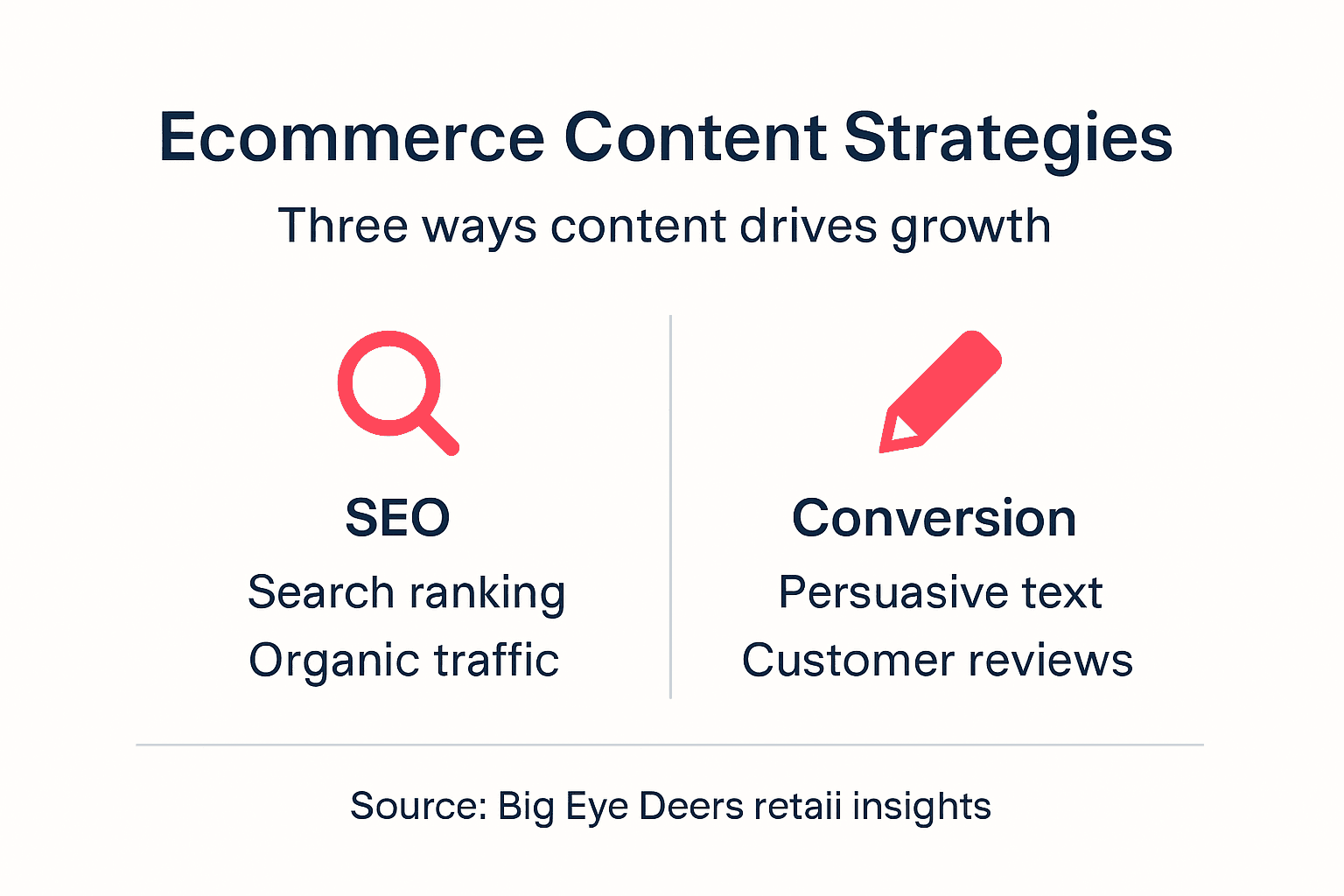
SEO: Getting discovered through content
SEO content attracts organic traffic without paid advertising. Product guides, category descriptions, blog posts, and comparison articles all serve SEO purposes when optimised for the keywords your customers are searching for.
SEO content delivers:
- Organic traffic that costs nothing per click, reducing customer acquisition costs
- Long-term visibility—a well-optimised article drives traffic for months or years
- Authority signals that build trust with search engines and customers
- Competitive advantage over retailers ignoring organic search
UK ecommerce leaders consistently emphasise SEO as a key strategy to drive organic traffic and sustainable growth. For Magento and Shopify stores, this means integrating keyword research into your content planning, optimising product page titles and descriptions, and publishing regular blog content addressing customer questions.
Conversion: Content that persuades
Getting traffic means nothing if visitors leave without purchasing. Conversion-focused content removes objections and builds confidence. Product descriptions addressing specific customer concerns, trust badges, clear pricing information, and customer testimonials all contribute to conversion optimisation.
Conversion-driving content accomplishes:
- Reduced bounce rates through clear value propositions
- Increased average order value through product recommendations and upsell content
- Lower cart abandonment through transparent policies and shipping information
- Improved customer confidence through social proof and guarantees
Retention strategies including personalised marketing drive sustainable retail growth by improving customer experiences. Focus on conversion optimisation through better content before scaling paid advertising.
Retention: Content that keeps customers returning
Once customers purchase, strategic content keeps them engaged and buying again. Post-purchase guides, loyalty programme communications, personalised product recommendations, and email sequences nurture repeat purchases.
Customer retention is enhanced through an integrated approach combining churn prediction and personalised recommendations, which foster loyalty and improve overall customer lifetime value. Machine learning-powered recommendation engines can analyse purchase history and suggest products customers actually want.
Content excellence across discovery, conversion, and retention creates a compounding effect—each pillar strengthens the others.
For mid-sized UK retail brands, this means content strategy isn’t a single initiative. It’s an interconnected system where SEO content feeds traffic into conversion-optimised product pages, which then lead into retention sequences that bring customers back.
Pro tip: Audit your content performance across all three pillars using analytics. Which keywords drive traffic but have low conversion? Fix those product pages. Which customer segments abandon after first purchase? Create retention content specifically addressing their concerns. Prioritise the biggest gaps for fastest revenue growth.
Common mistakes and optimisation pitfalls
Content strategy fails when retailers make the same preventable errors. Understanding these pitfalls helps you avoid costly mistakes and accelerate growth. Most mistakes fall into predictable categories—poor planning, technical oversights, and underestimating effort.
Underestimating SEO investment and timeline
Many retailers treat SEO as a quick fix rather than foundational infrastructure. They expect results in weeks when SEO typically requires months to show meaningful returns. Common e-commerce pitfalls include misunderstanding SEO investment needs and neglecting foundational SEO in website design, resulting in businesses abandoning strategies before they mature.
This mindset causes:
- Inconsistent content publishing that fails to build momentum
- Underfunded content initiatives that don’t reach critical mass
- Premature strategy abandonment before ROI materialises
- Lost competitive advantage to retailers committing long-term
SEO ROI takes time because search engines need time to crawl, index, and rank your content. For mid-sized retailers, this typically means 3-6 months of consistent effort before meaningful traffic improvements appear.
Neglecting keyword research and content quality
Without proper keyword research, you’re creating content nobody searches for. Poor-quality product descriptions and duplicate content across categories confuse search engines and waste your time. Typical SEO mistakes include overlooking keyword research and using thin or duplicate product content, which directly damage search visibility and conversion rates.
These errors manifest as:
- Low organic traffic despite significant content investment
- Poor product page rankings for keywords customers actually search
- High bounce rates from searchers finding irrelevant content
- Wasted budget on content that doesn’t drive conversions
Technical SEO and user experience oversights
Technical SEO aspects like site speed and mobile responsiveness are just as critical as content quality. Slow-loading product pages frustrate customers, increase bounce rates, and signal poor quality to search engines. Mobile responsiveness matters increasingly as more customers shop from phones.
Common technical mistakes include:
- Unoptimised images that slow page load times
- Missing meta descriptions that reduce click-through rates from search results
- Poor mobile layouts that frustrate mobile shoppers
- Broken internal links that waste crawl budget
Avoid these three pitfalls—underestimating timelines, skipping keyword research, and ignoring technical SEO—and you’re already ahead of most competitors.
For Shopify and Magento stores, technical SEO should be part of your platform setup, not an afterthought. Addressing web design mistakes early prevents costly fixes later, protecting your investment and performance.
Pro tip: Before publishing any content, audit it against three criteria: Does it target a keyword with actual search volume? Does it answer customer questions comprehensively? Will it load fast on mobile devices? Content failing any of these checks wastes effort—improve it or skip publication.
Unlock The Full Potential Of Your Ecommerce Content
The article highlights how essential it is for mid-sized UK retail brands to treat all ecommerce content—seller-created and buyer-created—as foundational infrastructure rather than mere afterthoughts. Without clear product information architecture, optimised review systems, and strategic content performance analysis, ecommerce stores struggle to maximise visibility, build trust, and convert visitors. At Big Eye Deers, we understand these challenges intimately. Our expertise across Magento and Shopify platforms means we can help you develop seamless content ecosystems that drive discovery, enhance social proof, and fuel long-term retail growth.

Take control of your ecommerce content strategy today with Big Eye Deers. Benefit from our proven solutions including custom catalogue builds, powerful onsite search with Klevu, and lifecycle marketing with Klaviyo that boost both conversion and retention. We combine UX design, technical SEO, and secure platform support to ensure your store not only attracts visitors but turns them into loyal customers. Start your journey to a higher-performing online store now by visiting our website and discover how we can help you build a content-driven ecommerce platform that truly delivers.
Frequently Asked Questions
What types of content are essential for driving growth in ecommerce?
Seller-created content, which includes product descriptions, blog posts, and guides, along with buyer-created content like customer reviews and photos, are both essential for enhancing visibility, building trust, and increasing conversions in ecommerce.
How does buyer-created content influence customer purchasing decisions?
Buyer-created content such as reviews and ratings enhances authenticity, builds trust, and provides social proof, which significantly influences customers’ confidence and willingness to complete transactions.
What role does SEO play in ecommerce content strategy?
SEO helps in attracting organic traffic by optimising content like product guides and blog posts for relevant keywords, ultimately leading to increased visibility and lower customer acquisition costs.
Why is it important to integrate both seller-created and buyer-created content?
Integrating both types of content creates a more comprehensive customer experience, where seller content educates and informs, while buyer content enhances credibility and supports trust, leading to improved engagement and conversion rates.
Recommended



Adobe Commerce (Magento)
Formerly known as Magento, Adobe Commerce is built for complex catalogues, integrations, and long term growth. We design and develop stable, scalable stores that support demanding eCommerce requirements, including multi-store setups, complex pricing, and Hyva based performance improvements.

Bespoke Build
We design and build custom eCommerce platforms for businesses with complex workflows, integrations, or non standard requirements. Built from scratch around your business needs using Laravel and modern architectures.
Working with brands across the UK from our offices in Cardiff and Exeter, you deal directly with a senior team of designers and developers specialising in Shopify, Magento, WordPress and bespoke eCommerce platforms.
We focus on commercial outcomes. Better conversion rates, strong SEO foundations and eCommerce platforms that continue to improve long after launch.